
On this page
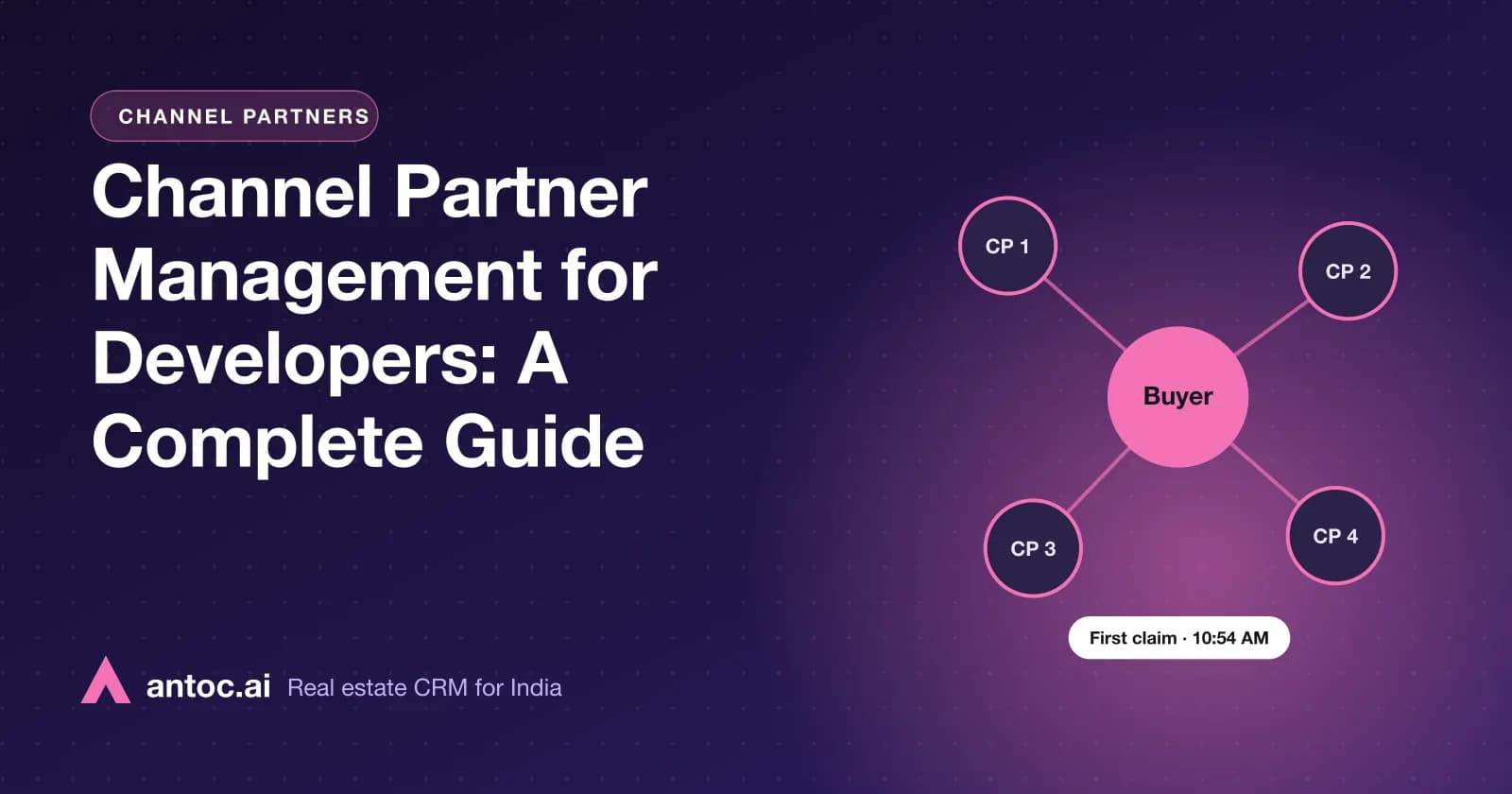
Channel partner management in real estate is how a developer onboards brokers, registers their buyers with a date and time stamp, fixes who owns each lead and for how long, tags site visits and pays brokerage on schedule. When all of this sits on one record per buyer, ownership disputes drop and good CPs keep bringing you walk-ins.
This guide is for developers' sales heads, CP managers and promoters who sell through outside brokers. Channel partners will also find it useful as a picture of what a fair, transparent process should look like.
Channel partner management means onboarding brokers properly, registering their buyers with a timestamp, fixing ownership for a set window, tagging visits and paying brokerage on time. Put all of it on one CRM lead so disputes are settled by records, not arguments.
- Register every CP buyer with date, time and project before the site visit.
- Publish one written ownership window and apply it to every CP equally.
- Tag each site visit and booking to the registering CP on the lead.
- Track brokerage from booking to payout so CPs are paid on time.
What channel partner management covers
Most developers think of CP management as "the WhatsApp group where brokers send names". That group is where the trouble starts. A real CP process has seven parts, and each one needs a record someone can check later.
| Stage | What happens | Record to keep | Owner |
|---|---|---|---|
| Onboarding | CP signs up for the project | PAN, GST (if any), RERA agent number, bank details, signed brokerage terms | CP manager |
| Lead registration | CP shares a buyer before the visit | Buyer name, mobile, project, CP name, date and time | CP desk |
| Validity window | Ownership locked for an agreed period | Registration date, expiry date, extension reason | CP manager |
| Site visit tagging | Visit linked to the registering CP | Visit date, who attended, outcome | Site sales team |
| Booking | Unit booked against the lead | Unit number, agreement value, CP tagged | Closing manager |
| Payout | Brokerage calculated and paid | Payout %, milestone reached, invoice, deductions, paid date | Accounts |
| Reporting | CP-wise performance | Registrations, visits, bookings, payout status | Sales head |
If any one of these records lives only in someone's phone, you will eventually have a dispute you cannot settle.
How to set up a channel partner process
1. Onboard every CP with the same pack
Create one onboarding pack per project: project brief, price sheet, approved brochure, RERA registration number, brokerage terms and the ownership policy. Send the same pack to everyone.
Collect the CP's details before accepting their first buyer. That includes their RERA agent registration where applicable. Rules differ by state, so check your state RERA portal (MahaRERA, GujRERA, UP RERA and so on) for current requirements.
2. Register leads with a timestamp before the visit
The registration is the heart of the system. A CP sends the buyer's name, mobile number and the project. Your desk enters it, and the record gets a date and time that nobody can edit later.
Do not accept registrations after the buyer has already walked in. If a CP calls from the parking lot, the registration time is still after the visit. Your policy should say so plainly.
3. Set an ownership and validity window
Decide how long a registration protects the CP. Pick a window, for example 30, 60 or 90 days, and write it into the CP agreement. A visit within the window usually extends it; no visit means the lead opens up again.
4. Tag every site visit to the lead
When the buyer arrives, the site team searches the mobile number first. If a valid registration exists, the visit is tagged to that CP. If not, it is a direct walk-in. Our site visit management guide covers the visit-day process in detail.
Want to see this on your own leads? Book a free Antoc demo.
5. Track brokerage from booking to payout
A booking is not the end for the CP; it is the start of their payout. Record the agreement value, the brokerage percentage, the milestones that trigger payment and the current status: not due, due, on hold (with reason), or paid.
6. Review CP-wise reports every week
Look at registrations, visits and bookings per CP. Spot partners who register hundreds of numbers but never bring visits, and partners who quietly bring your best buyers.
Writing a lead ownership policy CPs will accept
CPs do not mind strict rules. They mind rules that change depending on who complains loudest. Put these in writing and share them at onboarding:
- First valid registration wins. The earliest timestamped registration for a mobile number owns the buyer for that project.
- Developer database comes first. If the buyer already enquired directly (Meta ad, portal, website) before the CP registered, the lead belongs to the developer. Show the CP the original enquiry date if asked.
- The window is fixed. Registration is valid for the agreed number of days. A completed site visit extends it by an agreed period.
- Registration is per project. A buyer registered for Tower A of one project is not automatically registered for your other project.
- Visit must be tagged on the day. If the CP's name is not tagged at the visit, the CP has a fixed number of days to raise it, with proof of registration.
- Disputes go to one person. Name the CP manager who decides, and how quickly they will respond.
- No side deals. Discounts promised by a CP that are not on the approved price sheet are not honoured.
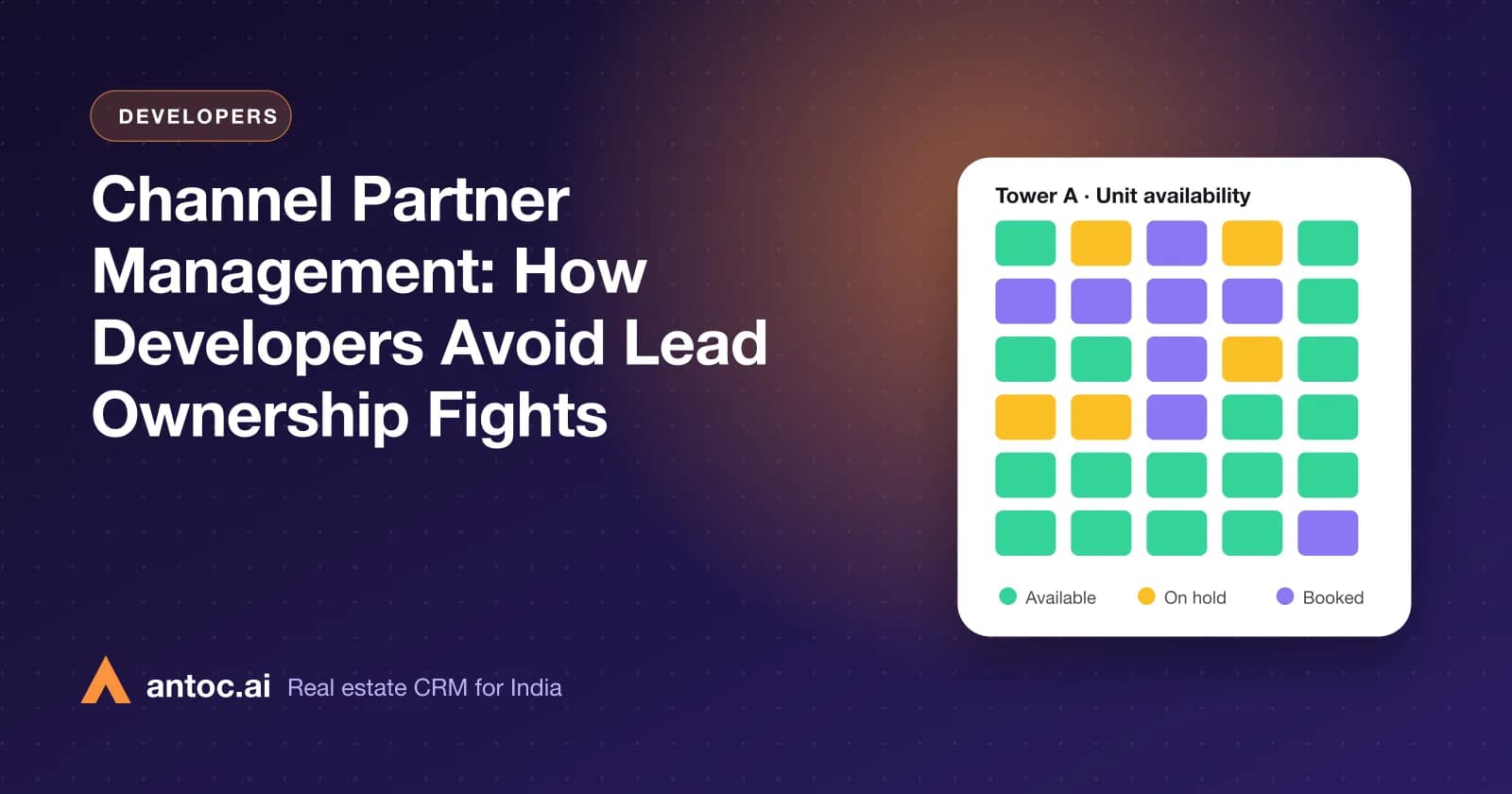
For a story of how these rules play out on a real sales floor, read how developers avoid lead ownership fights.
Worked example: brokerage on a ₹1.2 crore flat in Pune
Illustrative example. The percentages and milestones below are made up to show the maths; use the terms in your own CP agreement.
A developer in Pune signs a CP agreement with these terms:
- Brokerage: 2% of agreement value, excluding taxes and other charges.
- Payout: 50% when the agreement for sale is registered, 50% when the buyer has paid 20% of the agreement value.
A CP registers a buyer on 3 March. The buyer visits on 10 March and books a 3 BHK with an agreement value of ₹1,20,00,000.
| Item | Calculation | Amount |
|---|---|---|
| Total brokerage | 2% × ₹1,20,00,000 | ₹2,40,000 |
| Tranche 1 (agreement registered) | 50% × ₹2,40,000 | ₹1,20,000 |
| Tranche 2 (20% collected = ₹24,00,000) | 50% × ₹2,40,000 | ₹1,20,000 |
Now say the agreement is registered in April but the buyer's home loan disbursement is delayed. Tranche 1 is due; tranche 2 is on hold until collections cross ₹24 lakh.
If this sits in a spreadsheet, the CP calls your accounts team every week. If the lead shows "Tranche 1 paid, Tranche 2 waiting for 20% collection, currently at ₹16 lakh", the CP can see exactly where things stand.
TDS, GST on brokerage invoices and other deductions depend on the CP's status. This is not tax advice; confirm the treatment with your CA.
Which CP reports a developer should review
You do not need twenty reports. These five answer most questions a sales head or promoter will ask:
| Report | What it tells you | Review |
|---|---|---|
| Registrations by CP | Who is actively sourcing | Weekly |
| Registration-to-visit by CP | Who registers real buyers vs random numbers | Weekly |
| Visit-to-booking by CP | Who brings buyers who match the project | Monthly |
| Expiring registrations | Which leads lose protection soon | Weekly |
| Payout status | Brokerage due, on hold and paid | Fortnightly |
Use simple formulas. Registration-to-visit = visits ÷ registrations. Visit-to-booking = bookings ÷ visits. Compare CPs with each other on your own project rather than chasing an outside "benchmark".
A CP with a low registration-to-visit ratio is not always a bad partner. They may be registering their whole contact list to block others. Your validity window and "visit extends registration" rule handle this without a fight.
Handling a launch weekend with many CPs
Launch weekends test every rule above. Fifty CPs may send buyers on the same Saturday, and the site office has one desk.
Set up a registration cut-off, for example the evening before, so the desk is not typing names while buyers wait. Keep one person at the entry whose only job is the mobile number check and visit tagging.
At the end of each day, share a simple list with each CP: buyers registered, buyers visited, buyers tagged. Errors caught on Saturday night are easy to fix. Errors found after a booking turn into disputes.
Common mistakes
- Accepting registrations on a WhatsApp group only. Messages get deleted, edited or lost in the scroll. Enter every registration into one system with a time stamp.
- Changing the validity window mid-launch. Even if the new rule is better, CPs registered under the old one will feel cheated. Apply changes to new registrations only.
- Not checking the developer's own database first. A buyer who came from your Meta ad last week should not become a CP booking because a broker registered them yesterday.
- Letting the site team skip the mobile number search. One rushed Saturday visit without a check is how two CPs end up claiming the same buyer.
- Paying brokerage from memory. Without milestone tracking, some CPs get paid early and others wait months, and both groups talk to each other.
- Treating all CPs the same in reports. Volume of registrations is not performance. Look at visits and bookings per CP.
- No single dispute owner. If the sales head, the CP manager and the promoter all decide disputes, every decision will be challenged.
Where a CRM fits
You can run a small CP programme on a well-kept spreadsheet. Once you have several projects, dozens of active CPs and a launch weekend with hundreds of visits, a spreadsheet cannot lock records or alert anyone.
A developer CRM should keep the CP, the buyer, the visit, the unit and the payment plan on one lead. Antoc's Developer plan includes channel partner management alongside building inventory and unit-wise availability, and source details stay on the lead from first registration to booking. You can see how it fits the wider developer workflow on our CRM for developers page.
If your bigger worry is the period before booking — CP registrations, inventory holds, WhatsApp follow-ups and reminders — look at Antoc's pre-sale workflow for builders. For the full set of developer tools, from inventory to post-sale collections, start with Antoc for real estate developers.
Whatever tool you use, the rule is the same: if it is not on the lead with a timestamp, it did not happen. CPs who trust your records will send you their best buyers first.
Read next

Frequently asked questions
What is channel partner management in real estate?
It is the process a developer uses to work with outside brokers: onboarding them, accepting buyer registrations with a timestamp, deciding lead ownership, tagging site visits, calculating brokerage and paying it. Most developers run it on a CRM so every buyer, visit and booking is linked to the CP who sourced it.
How long should a channel partner's lead registration stay valid?
There is no single legal number. Many developers pick a fixed window, for example 30, 60 or 90 days, and extend it only if the buyer visits within that time. What matters most is that the window is written in the CP agreement, shown on every registration and applied the same way to all partners.
Who owns the lead if two channel partners register the same buyer?
The usual rule is that the earliest valid registration wins, provided the buyer was not already in the developer's own database and the visit happens within the validity window. The CRM timestamp settles it. Write this rule into the CP agreement before launch so nobody argues it after a booking.
Do channel partners need RERA registration?
Under the RERA Act, real estate agents who facilitate sales in registered projects generally need to register with the state RERA authority. Ask every CP for their agent registration number during onboarding. Rules and formats vary by state, so check your state RERA website such as MahaRERA, GujRERA or UP RERA.
When should a developer pay channel partner brokerage?
Payout milestones are set in your CP agreement. A common structure links payment to the registered agreement for sale and a minimum collection from the buyer. Whatever you choose, track each booking's payout status in the CRM so the CP can see what is due, what is on hold and why.
Can a CRM stop channel partner disputes completely?
A CRM cannot replace a clear policy, but it removes most of the guesswork. When the registration time, project, visit date and booking all sit on one lead, the CP manager can show the record instead of relying on memory or WhatsApp screenshots. That is what ends most disputes quickly.
Bring one real lead source. We'll show you the floor.
Book a free demo and bring one source — Meta, 99acres or a CP WhatsApp group. We'll set it up on a lead in front of you.
We build Antoc for Indian brokers and developers, from Pasadi Technologies Pvt Ltd in Ahmedabad. These articles come from patterns we see on real sales floors.