On this page
Site visit management in real estate is the process of booking, confirming, conducting and logging every buyer visit to a project, with one owner and one recorded outcome per visit. For builders, it is where marketing spend turns into bookings or quietly gets wasted, so it needs a fixed process, reminders and a few simple KPIs.
This guide is for developers, sales heads and closing managers who run weekend site visits across one or more projects, often with walk-ins, direct leads and channel partner (CP) buyers arriving on the same day.
Site visit management is the process from booking a visit to logging its outcome. Builders who confirm visits, remind buyers, tag CP visits and track show-up and visit-to-booking rates waste fewer weekends.
- Treat every site visit as a booked slot with an owner and a logged outcome.
- Confirm the day before and remind on the morning of the visit.
- Register CP buyers before the visit to avoid ownership disputes later.
- Track show-up rate and visit-to-booking rate using your own CRM data.
Why site visits need a process, not just a register
Most builder sites still run on a paper register at the gate and a WhatsApp group where pre-sales announces "2 visits at 11". It works until Saturday gets busy.
Then the problems show up. Two closing managers wait for the same family. A CP turns up with a buyer your pre-sales team called last week. A visit happens, but nobody writes down what the buyer thought, so the follow-up call on Tuesday starts from zero.
A visit costs real money. The buyer saw an ad, a portal listing or a CP pitch, someone called them, and someone gave up a Saturday slot. When the visit is not tracked, you cannot tell which of those efforts paid off.
The site visit process: booking to logged outcome
Here is a process that works for a single tower or a multi-project developer. Adjust the timings to your team.
1. Book the visit as a slot
Pre-sales books a date, time, project and number of attendees on the lead record. Assign who will meet the buyer, so the closing manager knows before the buyer arrives.
2. Send the confirmation immediately
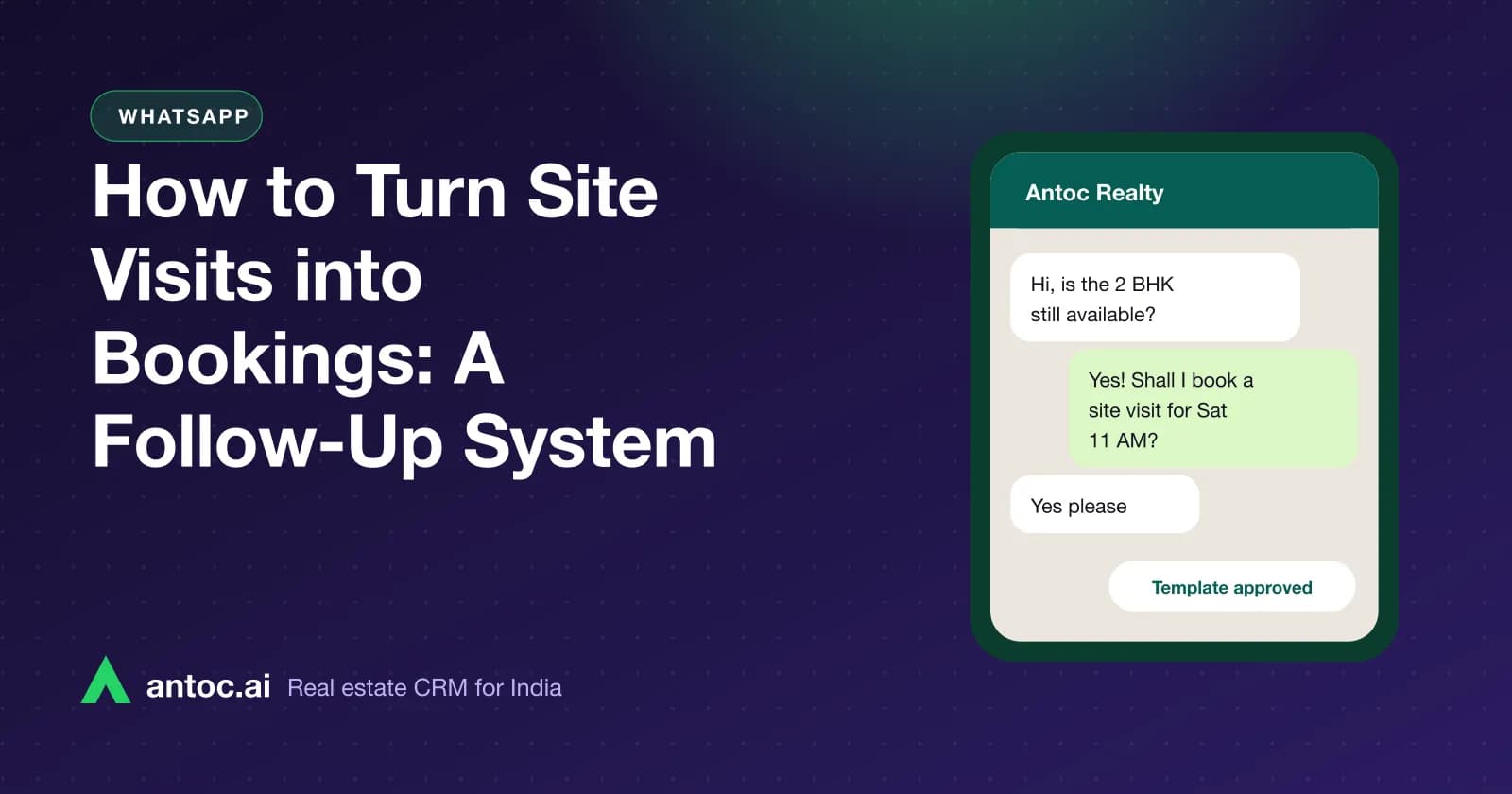
A WhatsApp confirmation goes out with the date, time, project name, location link and the closing manager's name. A visit that exists only in a phone call is easy to forget.
3. Confirm the evening before
A short call or WhatsApp the evening before asks, "Are we still on for 11 tomorrow?" This is your chance to reschedule instead of waiting at the site.
4. Remind on the morning of the visit
Send the location link again, parking details and the meeting person's number. Buyers often search for the project on maps and land at the wrong gate.
5. Mark the visit done at the site
When the buyer arrives, mark the visit as done on the lead, not just in the gate register. This is the single data point most teams lose.
6. Run the visit with context
The closing manager opens the lead before walking out to greet the buyer: source, budget, configuration, questions asked so far. "You were looking at a 3 BHK on a higher floor, right?" builds trust in the first minute.
7. Log the outcome within an hour
Use fixed outcome codes rather than free text, so you can report on them later.
8. Set the next step before the buyer leaves
A second visit with family, a price discussion, a loan meeting or a token date. Put it in the CRM with a reminder, not in someone's memory.
Want to see this on your own leads? Book a free Antoc demo.
Outcome codes to use after every visit
Free-text notes like "good client, will call" are impossible to report on. A short, fixed list makes Monday reviews faster.
| Outcome code | Meaning | Next step to schedule |
|---|---|---|
| Hot | Ready to discuss price or token | Price meeting within 48 hours |
| Revisit with family | Decision-maker not present | Family visit date |
| Needs loan clarity | Interested, unsure of eligibility | Loan desk call |
| Unit mismatch | Liked project, not the units shown | Share alternate units |
| Price objection | Above budget or comparing | Payment plan discussion |
| Not interested | Clear no, with reason | Close with lost reason |
| No show | Did not arrive | Reschedule within 24 hours |
Confirmation and morning reminders
Reminders do two jobs. They help the buyer remember, and they tell your team early when a buyer is wavering. A buyer who does not reply to the evening confirmation is a signal to call, not to wait at the site.
Set reminders for your own team too. The closing manager should get a reminder before each visit, and pre-sales should get an alert when a visit is overdue for an outcome.
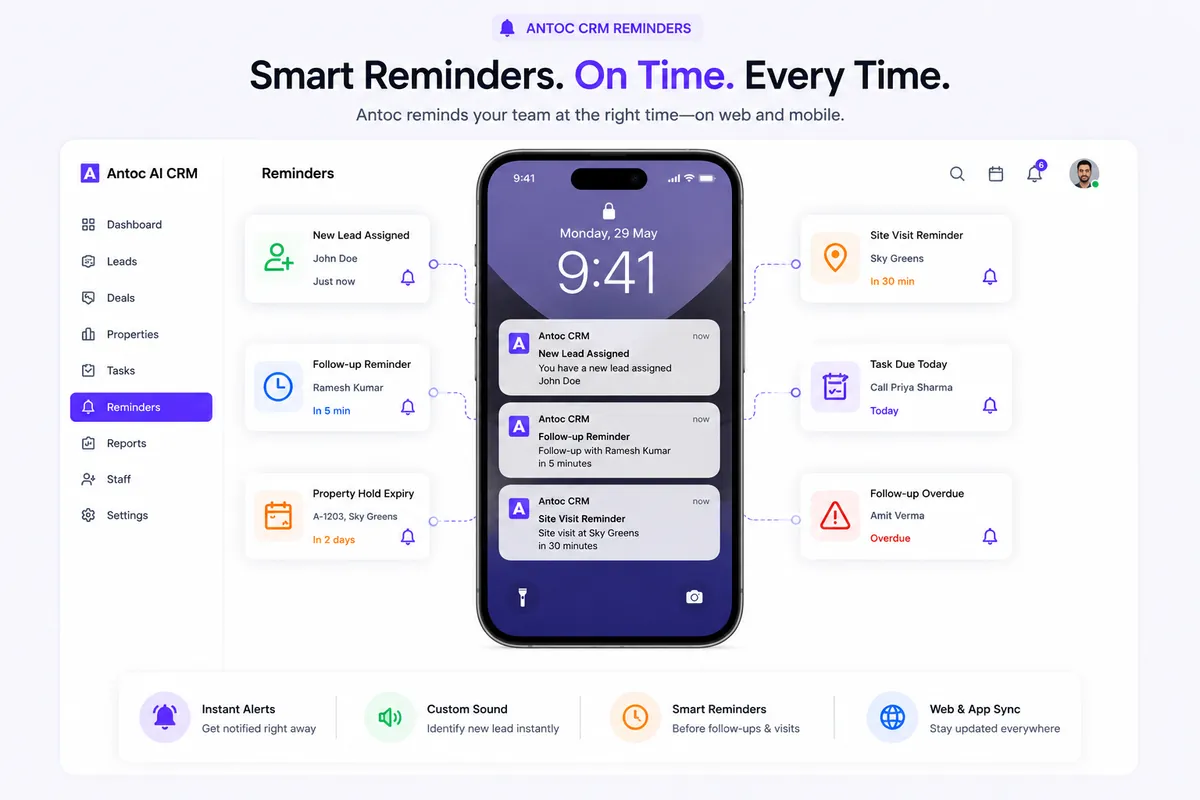
In Antoc, reminders for new lead assignment, follow-ups, site visits and closed deals work on web and mobile, with custom sounds, so a busy closing manager does not miss them on the site floor.
Handling CP-sourced site visits
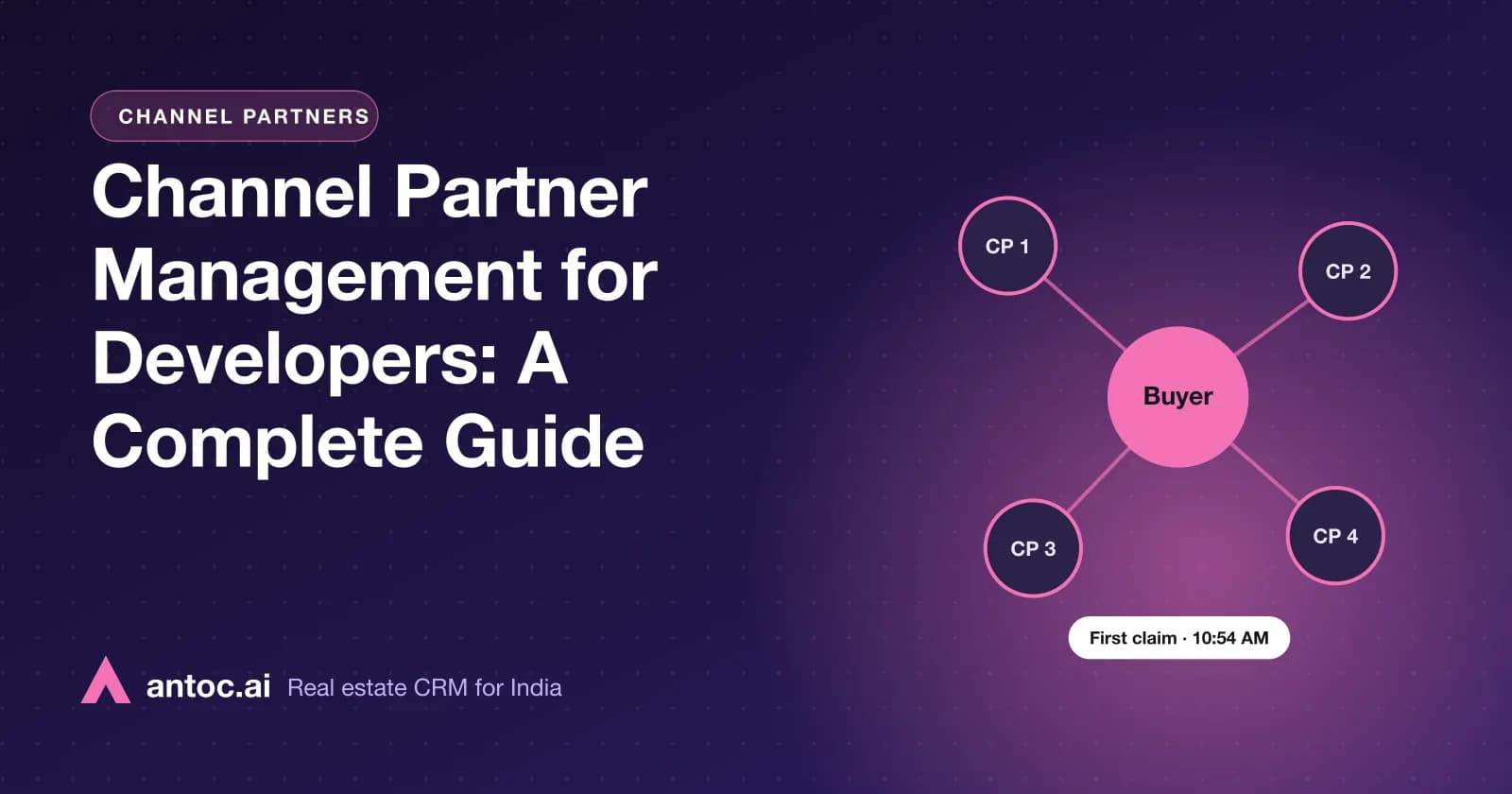
Channel partner visits need one extra rule: registration before the visit. If a CP walks in with a buyer who is not registered, you have no record of who brought them.
A simple CP visit flow:
- The CP registers the buyer's name and phone in the CRM or with your CP desk before the visit.
- The system records the registration time and checks if the buyer already exists as a lead.
- The visit is booked and tagged to that CP.
- On the day, the visit is marked done with the CP tagged.
- If the buyer books within your agreed validity window, the booking is credited to that CP.
Write the validity window and tie-break rules into your CP agreement, and apply them the same way every time. For the full setup, including onboarding and payouts, read our channel partner management guide for developers.
Site visit KPIs and how to calculate them
These are formulas, not benchmarks. Your numbers depend on project, price band, location and construction stage, so compare yourself against your own last quarter.
| KPI | Formula | What it tells you | Review |
|---|---|---|---|
| Visits booked | Count of visits scheduled in the period | Pre-sales output | Daily |
| Visits done | Count of visits marked done in the period | Real footfall | Daily |
| Show-up rate | Visits done ÷ visits scheduled for that period × 100 | Quality of confirmation and reminders | Weekly |
| Visit-to-booking rate | Bookings ÷ visits done × 100 | Closing strength and product fit | Weekly |
| Revisit rate | Leads with 2+ visits ÷ leads with 1+ visit × 100 | How often buyers come back with family | Monthly |
| Outcome logging rate | Visits with outcome logged within 24 hours ÷ visits done × 100 | Data discipline | Weekly |
| Cost per site visit | Marketing spend ÷ visits done | Efficiency of each source | Monthly |
| CP share of visits | CP-tagged visits ÷ visits done × 100 | Dependence on channel partners | Monthly |
Split every KPI by source, project and closing manager. A healthy overall number can hide one source that never shows up and one manager who never closes.
Illustrative example: one month at a Pune project
This is an illustrative example with made-up numbers to show the maths, not a benchmark.
A developer spends ₹6,00,000 in a month on Meta ads and portals for a mid-segment project in Pune. Pre-sales schedules 160 visits for that month. 104 actually happen, and 8 buyers book.
- Show-up rate = 104 ÷ 160 × 100 = 65%
- Visit-to-booking rate = 8 ÷ 104 × 100 ≈ 7.7%
- Cost per site visit = ₹6,00,000 ÷ 104 ≈ ₹5,769
- Cost per booking = ₹6,00,000 ÷ 8 = ₹75,000
Now suppose better confirmations lift visits done to 120 with the same spend. Cost per visit drops to ₹5,000. If the visit-to-booking rate holds, that is roughly one more booking from the same budget. Better reminders are far cheaper than more ads.
Walk-ins without a booking
Not every buyer books. Some see the hoarding from the road and drive in on a Sunday. These visits are easy to lose because nobody in pre-sales owns them.
Create the lead at the site before the visit starts, with source "walk-in" and the closing manager as owner. Ask how they heard about the project, because "saw it on a portal last week" means the lead may already exist. Search by phone number first, so you do not create a duplicate or upset a CP who registered them.
Then treat the walk-in exactly like a booked visit: outcome code, next step and reminder.
Planning for busy weekends
Saturdays and Sundays carry most visits for many projects. A little planning prevents the chaos.
- Cap slots per closing manager so nobody has three families at 11 am.
- Roster a floater who handles walk-ins and CP buyers without bookings.
- Check site readiness on Friday: sample flat clean, lights working, brochures stocked, parking marked.
- Keep price sheets current so every closing manager quotes the same numbers.
- Hold a 15-minute huddle at opening to go through the day's visits and any hot buyers.
How a CRM ties site visits together
A developer CRM should hold the full chain on each lead: source, pre-sales calls, visit booked, reminders sent, visit done, outcome, next step and booking. Then the KPI table above is a report, not a weekend spreadsheet.
Antoc's pre-sale module brings together buildings and inventory, CP management, WhatsApp and reminders, so a visit can be booked, confirmed and tagged without switching tools.
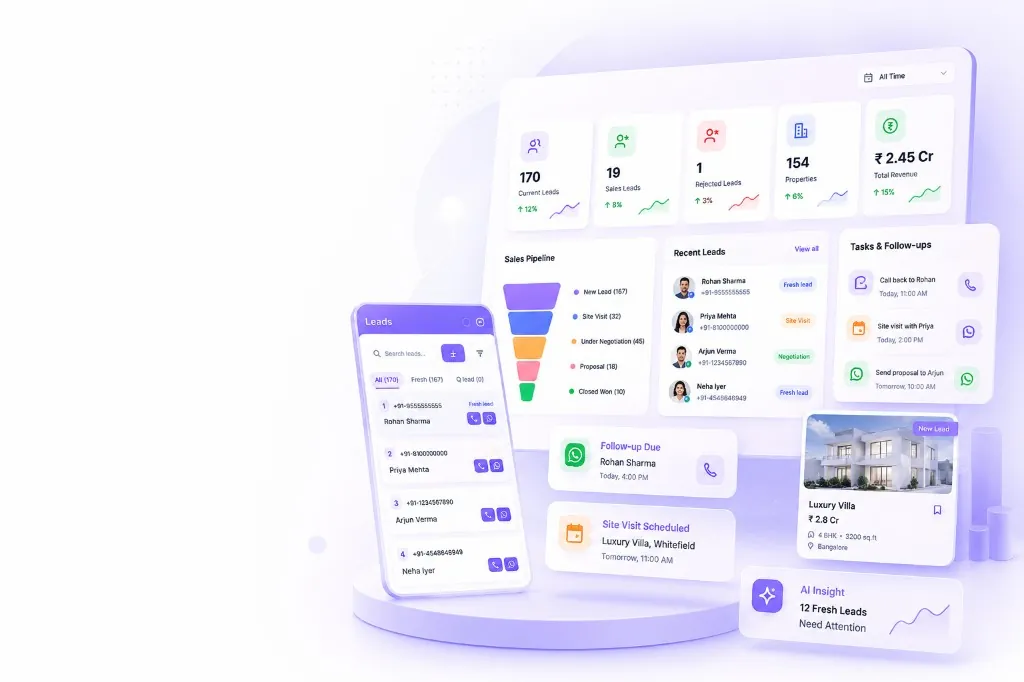
For a wider view of how builders run pre-sale and post-sale on one system, see our CRM for real estate developers page.
Common mistakes
- Booking visits on a call without sending a written confirmation.
- Skipping the evening-before check, then discovering no-shows at the site.
- Recording visits only in the gate register, never on the lead.
- Writing free-text notes instead of fixed outcome codes.
- Letting CP buyers in without prior registration, then arguing over brokerage.
- Measuring visits booked but not visits done, which flatters pre-sales.
- Letting the buyer leave without a dated next step.
Read next
Frequently asked questions
What is site visit management in real estate?
It is the process a builder or broker uses to book, confirm, conduct and follow up on property site visits. It covers who the buyer is, which project and slot, who meets them, whether they showed up, what happened during the visit and the next step. A CRM keeps all of this on the lead record.
How do you calculate site visit show-up rate?
Show-up rate is visits done divided by visits scheduled for the same period, multiplied by 100. Count only visits whose date fell inside the period, not visits booked during it. If 50 visits were scheduled for last week and 34 happened, the show-up rate is 68%. Track it by source and by agent.
What is a good visit-to-booking ratio?
There is no single right number, because it depends on project, price point, location and stage of construction. Instead of chasing a benchmark, measure your own ratio for three months, split it by source and closing manager, and work on the weakest segment. Improvement against your own baseline is the useful measure.
How should channel partner site visits be tracked?
The CP should register the buyer before the visit, with a timestamp, and the visit should be tagged to that CP when it happens. Agree on the validity window in your CP terms. When the buyer later books, the CRM record shows who registered them first, which avoids disputes over brokerage.
When should a site visit reminder be sent?
Send a confirmation immediately after booking, a check the evening before, and a reminder on the morning of the visit with the location link and the name of the person meeting them. WhatsApp works well for all three, and a short call the evening before adds a personal touch for high-value buyers.
What should be logged after a site visit?
Log the outcome within an hour: who attended, units shown, buyer reaction, budget confirmed or changed, objections raised and the agreed next step with a date. Use fixed outcome codes such as hot, needs revisit, family visit pending or not interested, so the team can report on them later.
Bring one real lead source. We'll show you the floor.
Book a free demo and bring one source — Meta, 99acres or a CP WhatsApp group. We'll set it up on a lead in front of you.
We build Antoc for Indian brokers and developers, from Pasadi Technologies Pvt Ltd in Ahmedabad. These articles come from patterns we see on real sales floors.