On this page
AI lead scoring in real estate ranks each property enquiry by how likely it is to become a site visit and booking, using signals such as budget fit, timeline, response behaviour, source and visit intent. Most Indian teams should start with a simple rule-based points table in their CRM, then add AI once outcome data is clean.
This guide is for sales heads and agency owners whose agents have more leads than they can call properly, and who want a fair, explainable way to decide who gets attention first.
AI lead scoring ranks property enquiries by how likely they are to visit and book, using signals such as budget fit, response behaviour, source and visit intent. Most teams should start with a simple points table in their CRM before trying model-based scoring.
- Lead scoring decides who gets called first, not who gets ignored.
- Budget fit, timeline, response and visit intent are the strongest signals.
- Start with a rule-based points table; move to models only with clean data.
- Review scores against actual visits and bookings every month.
What lead scoring actually does
On a busy day, an agent may have 40 or 50 open leads. They cannot give each one a 10-minute conversation before lunch. Without a system, they call whoever is at the top of the list, or whoever sounded nice last time.
Lead scoring replaces that habit with a ranking. A high score means "call now and push for a visit". A low score means "keep in a slower follow-up rhythm". It does not mean "delete".
The scoring itself is simple maths. The hard parts are choosing the right signals, capturing them consistently, and checking every month whether high scores really book more often.
The signals that matter in Indian real estate
Every project is different, but these signals come up again and again on Indian sales floors. The last column matters most: a signal you cannot capture reliably is useless for scoring.
| Signal | Example | Why it matters | How to capture it |
|---|---|---|---|
| Budget fit | Buyer budget ₹80–90 lakh, inventory from ₹82 lakh | No fit, no deal, however keen the buyer | Form question or first-call field |
| Configuration fit | Wants 3 BHK, you have 3 BHK available | Wrong configuration needs a different project | Form question, pipeline note |
| Location fit | Works in Hinjewadi, project in Baner | Commute decides many family purchases | First-call question |
| Buying timeline | "Within 3 months" vs "just exploring" | Near-term buyers move to visits faster | Form question or call |
| Response behaviour | Picked up first call, replied on WhatsApp | Engagement predicts visits better than interest claimed on a form | Call logs and WhatsApp timeline |
| Visit intent | Asked for location pin or a Sunday slot | The clearest buying signal before a visit | WhatsApp chat or call note |
| Lead source | Project-name search, referral, portal, Meta ad | Sources differ in intent; judge them on bookings | Source and campaign on the lead |
| Funding readiness | Home loan in process or own funds ready | Affects how fast a booking can close | Qualification question |
| Repeat enquiry | Enquired again on another portal | Shows active searching, not casual browsing | Duplicate check on phone number |
| Negative signals | Wrong number, broker posing as buyer, rental intent | Saves agent time | Lost reason or disqualification tag |
Rule-based vs model-based scoring
There are two broad ways to turn signals into a score. Most teams should start with rules.
| Factor | Rule-based points | Model-based (AI) scoring |
|---|---|---|
| How it works | You assign points to each signal | A model learns weights from past leads and outcomes |
| Data needed | Very little; works from day one | Months of consistent leads, stages and outcomes |
| Transparency | Agents can see exactly why a lead scored high | Harder to explain individual scores |
| Maintenance | Review points monthly | Retrain and monitor regularly |
| Risk | Your assumptions may be wrong | Learns old biases; breaks when sources or projects change |
| Best for | Teams of 3 to 30 agents, new projects | High lead volume with clean historical data |
The honest view: a well-kept points table with fast follow-up beats a clever model fed by messy data. If agents do not update stages and lost reasons, no model can learn anything useful.
Want to see this on your own leads? Book a free Antoc demo.
How to start: a simple points table
You can run this process inside any CRM that tracks lead stages and follow-ups. Keep the first version small.
- List your last 3 months of bookings. For each, note budget fit, timeline, source, first-call outcome and whether the buyer asked for a visit early.
- Do the same for 30 to 50 leads that were lost. Look at what was different.
- Pick 5 or 6 signals that clearly separated bookings from lost leads.
- Assign points using the table below as a starting point.
- Set three bands: hot, warm and cold, with a follow-up rhythm for each.
- Capture the signals on every new lead within the first call or WhatsApp exchange.
- Review monthly. Compare bookings by band. If warm leads book as often as hot ones, your points are wrong.
A starter points table (adjust to your project):
- Budget matches available inventory: +25
- Timeline within 3 months: +20
- Connected on the first call: +10
- Replied on WhatsApp within a day: +10
- Asked for location or a visit slot: +25
- Repeat enquiry from another source: +10
- Budget well below cheapest unit: −30
- Wrong number or broker posing as buyer: disqualify
Bands: 60 and above is hot, 30 to 59 is warm, below 30 is cold.
What to ask on the first call
Scoring only works if the same questions are asked on every lead. Give agents a short opener and make the answers mandatory before the lead moves past "contacted":
- "Are you looking for 2 BHK or 3 BHK, and roughly what budget are you comfortable with?"
- "Is this for your own use or investment?"
- "When are you hoping to finalise: within three months, this year, or still exploring?"
- "Which area do you work in, or which area are you comparing with?"
- "Would Saturday or Sunday suit you better for a site visit?"
The last question doubles as a visit-intent signal. A buyer who picks a slot is telling you far more than any form field. A buyer who says "send details first" is not cold, but belongs in warm until they engage with what you send.
Record answers in the same place every time. Free-text notes like "budget ok, maybe later" cannot be scored; a budget range and a timeline option can.
Turning bands into action
- Hot: call again today, offer two visit slots, send location and brochure on WhatsApp.
- Warm: follow up every 2 to 3 days, share relevant options and price updates.
- Cold: keep in a weekly or fortnightly nurture rhythm; rescore if they reply.
In Antoc, teams usually run this through lead status, pipeline stages and follow-up reminders, setting tighter reminders for hot leads so they never sit overnight.
Illustrative example in ₹: three leads for one project
This is an illustrative example, not a benchmark. A Pune developer has 3 BHK flats in Baner starting at ₹82 lakh. Three leads arrive on the same morning.
- Lead A: budget ₹80–90 lakh, wants to move within 3 months, picked up the first call, asked for a Saturday visit. Score: 25 + 20 + 10 + 25 = 80 (hot).
- Lead B: budget ₹85 lakh, timeline 6 to 12 months, did not pick up but replied on WhatsApp. Score: 25 + 10 = 35 (warm).
- Lead C: budget ₹50 lakh, timeline unclear, picked up the call. Score: −30 + 10 = −20 (cold), but worth suggesting a smaller project if you have one.
The agent calls A first and books the visit. B gets a brochure and a follow-up in two days. C gets a polite alternative.
Now the time maths. If an agent has 45 open leads and spends an average of 8 minutes on each meaningful contact, that is 360 minutes, or 6 hours, before admin. Scoring tells them which 15 deserve that time before noon.
Where AI fits today
You do not need a black-box model to use AI in scoring. Three practical places already help Indian teams.
AI calling for qualification
An AI calling system can ring new leads quickly, ask budget, configuration, location and timeline questions, and sync answers to the CRM. Those answers are exactly the signals your points table needs. Antoc's AI calling qualifies leads and syncs outcomes to the CRM, so agents start with qualified information rather than a bare phone number.
AI assistants for spotting patterns
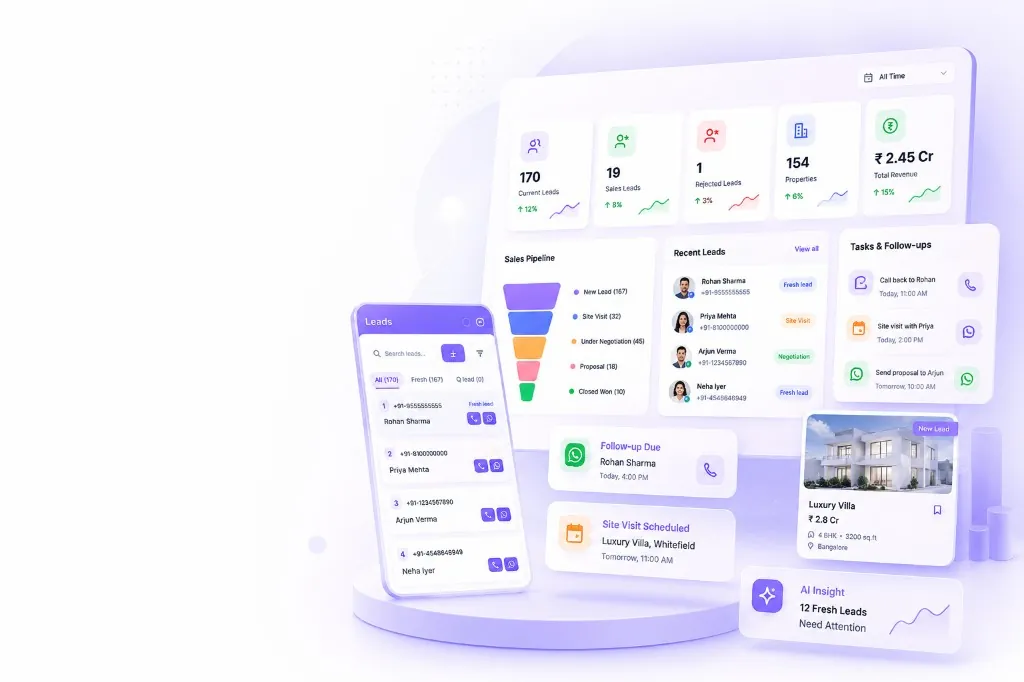
The Antoc AI Assistant, included in the Prime and Developer plans, sits alongside your dashboard. You can also connect Antoc to ChatGPT or Claude and ask in plain English, for example "show new leads from this week with a site visit scheduled" or "summarise the pipeline by stage". Access follows the signed-in user's CRM permissions. See the ChatGPT integration for details.
AI for faster first touches
A fast WhatsApp welcome and first call create the response-behaviour signals that scoring relies on. If nobody contacts a lead for six hours, its "did not respond" signal says more about your team than the buyer. See the rest of Antoc's features for how capture, auto-assignment and reminders work together.
Limits of lead scoring
Scoring helps, but it has real limits. Set expectations with your team before you roll it out.
- Thin data misleads. A new project with 20 bookings cannot support a reliable model.
- Old patterns become bias. If past bookings came mostly from one source, a model will undervalue new ones.
- Some buyers score low but book. NRIs, first-time buyers and families with several decision-makers often take longer.
- Scores depend on agent input. If budget and timeline are not captured, scores are guesses.
- A score is not a conversation. It tells you who to call first, not what the buyer needs.
Keep a minimum follow-up for every genuine lead, whatever the score. For how to remove fake and irrelevant leads before they reach scoring at all, see our guide on reducing junk leads from property portals. For more AI use cases beyond scoring, read AI for real estate agents in India.
Common mistakes
- Scoring before cleaning data. Duplicates, missing budgets and wrong stages make every score unreliable.
- Too many signals in version one. Ten weighted signals are hard to capture and harder to explain.
- Treating low scores as dead leads. Cold leads need slower follow-up, not none.
- Never checking scores against bookings. A score that does not predict visits is just decoration.
- Ignoring response speed. A lead called after six hours will score lower for reasons you created.
- Hiding the logic from agents. If agents do not trust the score, they will ignore it.
The bottom line
Lead scoring is a prioritisation tool. Start with five or six signals your team can capture on the first call, use a points table to rank leads, and check each month whether hot leads actually book more.
Add AI where it saves time today: AI calling to qualify new leads, and AI assistants to read your pipeline faster. Explore Antoc's real estate CRM features to see how lead capture, reminders and AI calling fit around a scoring process your team can run.
Read next
Frequently asked questions
What is AI lead scoring in real estate?
It is a way of ranking property enquiries by how likely they are to turn into a site visit or booking. Each lead gets a score from signals such as budget fit, configuration, timeline, source, response to calls and WhatsApp, and whether the buyer asked for a visit. Agents then call the highest-scoring leads first.
What is the difference between rule-based and AI lead scoring?
Rule-based scoring uses points you decide, such as plus 20 for budget fit and minus 30 for a wrong number. Model-based or AI scoring learns weights from your past leads and outcomes. Rules are transparent and work with little data; models can find patterns you miss but need a lot of clean, consistent history.
Does a small brokerage need AI lead scoring?
Usually not at first. A team of five to ten agents gets most of the benefit from a simple points table, quick first response and disciplined follow-ups. AI becomes useful when lead volume is high enough that agents cannot speak to everyone quickly, and when you have months of outcome data to learn from.
Which signals best predict a real estate booking?
There is no universal list, so test against your own data. Common strong signals are budget that matches available inventory, a buying timeline within a few months, a connected first call, replies on WhatsApp, and the buyer asking for location or a visit slot. Source matters too, but compare it on bookings, not lead counts.
Can AI calling help with lead scoring?
Yes. An AI calling system can ring new leads, ask qualification questions such as budget, configuration, location and timeline, and sync the answers to the CRM. Those answers become scoring signals, so agents start the day with qualified information instead of a bare name and number.
What are the risks of AI lead scoring?
Scores can be wrong when data is thin or biased. A model trained on past bookings may undervalue new sources, NRI buyers or first-time buyers who take longer to decide. Low scores can also become an excuse to skip leads. Keep a minimum follow-up for every genuine lead and recheck scores against outcomes.
Bring one real lead source. We'll show you the floor.
Book a free demo and bring one source — Meta, 99acres or a CP WhatsApp group. We'll set it up on a lead in front of you.
We build Antoc for Indian brokers and developers, from Pasadi Technologies Pvt Ltd in Ahmedabad. These articles come from patterns we see on real sales floors.