On this page
Call tracking for real estate is the practice of logging every buyer call against the right lead, with time, duration and outcome, so the team knows who was called, who was missed and what happens next. Done well, it turns the phone, which is still where most Indian property deals move forward, into something a sales head can actually manage.
This guide is for sales managers and owners of broker teams and developer sales offices who run five to fifty agents on the phone every day. It covers automatic logging, the iPhone limitation, missed calls, IVR basics, recording consent and how to read a daily call report.
Call tracking for real estate means logging every buyer call against the right lead, calling back missed calls fast, and reviewing a daily call report. Android phones can log calls automatically; iOS needs a manual or virtual-number workflow.
- Every call should sit on the lead timeline, not only in the agent's phone.
- Android allows automatic call logging; iOS does not let apps read call logs.
- Missed calls need a written callback rule with an owner and a deadline.
- Read the daily call report by agent, not only as a team total.
Why call tracking matters more in real estate than in most sales
A property buyer rarely fills one form. They enquire on two portals, click a Meta ad and call the number on a hoarding, all in the same week. Whoever calls back first and keeps calling with something useful usually gets the site visit.
The problem is that most of this calling happens on agents' personal phones. The manager sees a lead marked "contacted" in a sheet, but has no way to check whether the call happened, lasted ten seconds or ten minutes, or was a missed call that nobody returned.
Call tracking fixes three things at once:
- Accountability. Every lead shows real calls, not claimed calls.
- Speed. Missed calls and uncalled new leads become visible within hours, not at the weekly review.
- Continuity. When an agent leaves, the call history stays on the lead in the CRM instead of leaving in their phone.
If you are building your wider CRM process, the real estate CRM guide explains how calls fit with lead capture, follow-ups and the pipeline.
The four ways teams track calls
Not every team needs the same setup. The table below compares the common methods Indian real estate teams use.
| Method | How it works | Works on Android | Works on iPhone | Best for |
|---|---|---|---|---|
| Manual logging | Agent writes call outcome in a sheet or CRM after each call | Yes | Yes | Very small teams, as a fallback |
| CRM app reading the phone call log | Mobile app matches calls in the phone's log to leads | Yes | No, iOS blocks call-log access | Teams on Android phones |
| CRM 1-click dialer | Agent taps call from the lead card; the CRM knows which lead was called | Yes | Starts the call; outcome added by agent | All teams, to reduce wrong-lead logging |
| Virtual number / IVR | Buyers call one number; a telephony provider routes and reports the calls | Yes | Yes | Large ad budgets, mixed phone fleets |
Most broker teams end up combining two: automatic logging on Android plus the 1-click dialer, with a short manual step for iPhone users.
Android vs iPhone: the limitation you must plan for
On Android, a CRM app with the right permissions can read the phone's call log. That means calls made or received on the agent's phone can be matched to leads automatically, with duration and answered or missed status.
Apple does not allow third-party apps to read the iPhone call log. This is an iOS platform rule, not a CRM gap, and it applies to every CRM. If a vendor tells you their app pulls iPhone call history automatically, ask them to show it on a real iPhone before you sign.
In Antoc, calls on Android are logged automatically against the lead. On iOS, agents can start calls from the app, but the outcome needs to be added by the agent.
What to do if half your team uses iPhones:
- Ask iPhone users to always start calls from the CRM's dialer, so at least the attempt is tied to the right lead.
- Make outcome entry part of the call: a two-tap status such as "Connected – visit planned" or "Not reachable".
- Review iPhone users' activity separately so you are comparing like with like.
- If calling volume is high, consider giving field agents a company Android phone for work calls.
Want to see this on your own leads? Book a free Antoc demo.
How to set up call tracking in your team
A clean setup takes a few days of discipline, not a big project. Follow these steps in order.
1. Decide which number buyers will call
Pick one approach: each agent's own mobile number on their listings, or one advertised number routed by IVR. Mixing both without a plan creates missed calls nobody owns.
2. Install the mobile app on every agent's phone
Give the CRM app call-log permission on Android phones. Check on day one that a test call appears on a test lead.
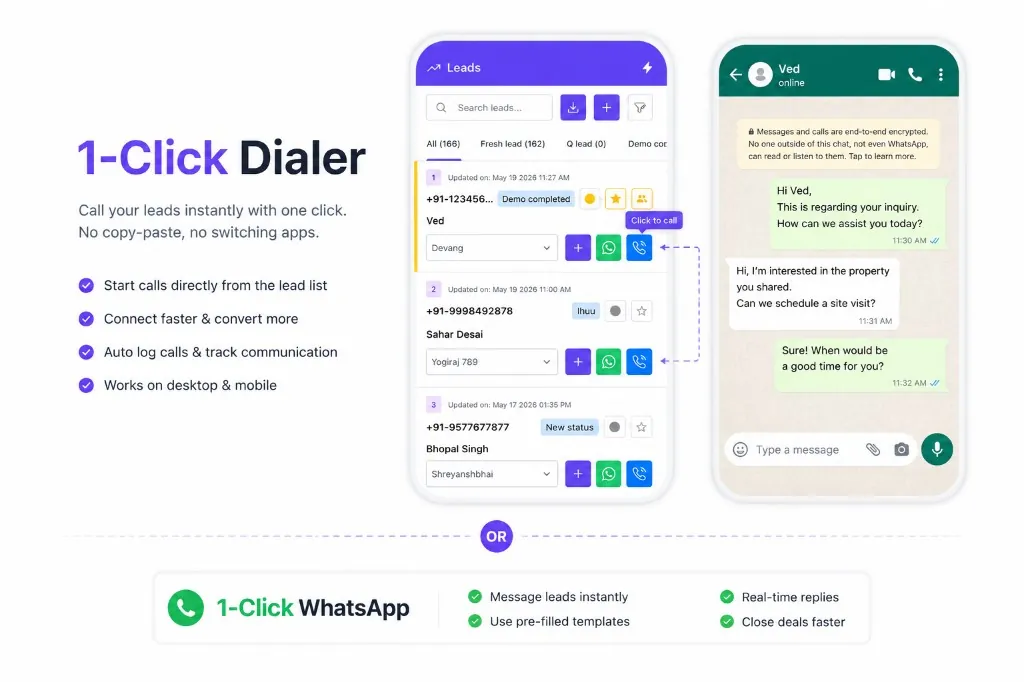
3. Make the 1-click dialer the default way to call
Agents should open the lead and tap call, rather than dialling from the phone's contacts. This keeps the right lead and the right call together.
4. Set a short list of call outcomes
Five or six outcomes are enough: connected, not reachable, busy, call back later, wrong number, not interested. Long lists get ignored.
5. Write the missed-call rule
Define who calls back, how fast, and what happens if they don't. More on this below.
6. Turn on the daily call report
Have the report land on WhatsApp and email every evening so you read it without logging in.
7. Review for two weeks, then tighten
After two weeks you have your own baseline. Use it to set targets instead of copying numbers from somewhere else.
Missed calls: the leak nobody measures
A missed call from a buyer is often a warmer signal than a form fill. They picked up the phone. If nobody calls back, they call the next number on the portal.
A missed-call rule should answer four questions:
- Owner: the agent whose number was called, or the lead owner in the CRM if different.
- Deadline: a fixed callback window during working hours, and a morning slot for night calls.
- Backup: if the owner is in a site visit, who calls instead.
- Fallback message: a WhatsApp message if the callback fails, such as "Sorry I missed your call, I'm free after 4 pm, shall I call you then?"
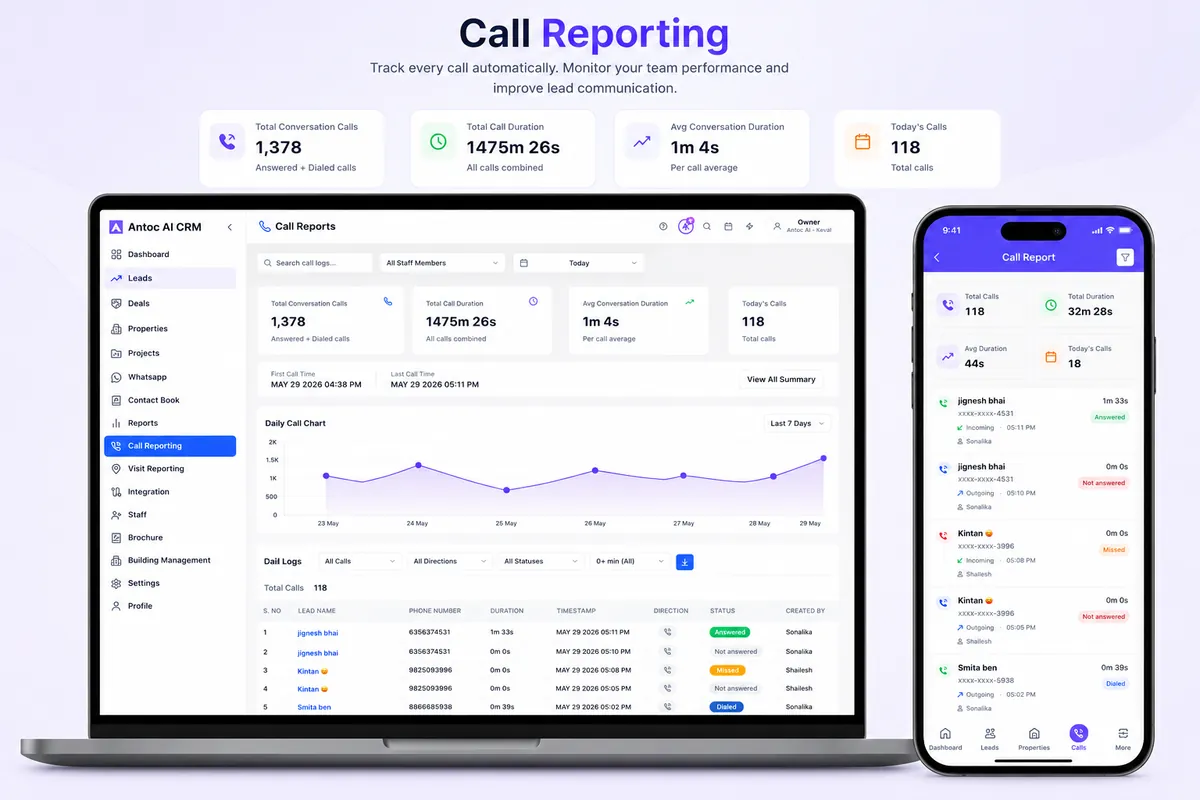
Antoc's call report shows answered and missed status in the call logs, so a manager can filter missed calls and check which were returned. Pair it with Antoc follow-up reminders so the callback becomes a task, not a memory.
An illustrative example in ₹
The figures below are made up to show the maths; use your own numbers.
Say a Pune broker team gets 80 missed buyer calls a month across 8 agents. Suppose, from your own history, roughly 1 in 40 called-back leads ends up booking. If 40 of those 80 missed calls are never returned, you lose about 1 booking a month.
If the average deal is a ₹75 lakh flat at 2% brokerage, that is ₹1,50,000 of commission a month, or ₹18 lakh a year, from a problem that costs nothing to fix except a callback rule.
IVR and virtual numbers: the basics
An IVR (interactive voice response) answers a call with a menu, such as "Press 1 for Project A, press 2 for resale". A virtual number is a single number, often printed on ads and hoardings, that a telephony provider forwards to one or more agents.
When an IVR helps:
- One number on ads must reach whoever is free, not one agent.
- You want calls split by project or language.
- You run campaigns large enough that calls outnumber agents at peak hours.
- Many agents use iPhones and you need call data from the network side.
When it adds friction:
- Small teams where buyers already have the agent's number.
- Long menus. Keep it to two or three options, or buyers hang up.
- When IVR calls don't reach the CRM. If missed IVR calls sit in the provider's dashboard only, nobody acts on them.
Before you buy an IVR, ask the provider how call records, especially missed calls, will reach your CRM. If there is no direct link, assign one person to add missed IVR callers as leads twice a day. Confirm with your CRM vendor what lead sources are enabled for your account.
Call recording and consent
Recordings help with training, disputes about what was promised, and quality checks. They also hold buyers' personal information, so treat them carefully.
Practical habits that most legal advisers would expect:
- Tell the buyer early in the call that it may be recorded for quality and training.
- Store recordings where only managers and the lead owner can access them.
- Don't share recordings on personal WhatsApp groups.
- Set a retention period and delete old recordings.
- Never record calls secretly to "catch" a buyer's words for a dispute.
India's data protection framework, including the Digital Personal Data Protection Act, 2023 and its rules, is still being put into practice. This is not legal advice; check the official text and speak to your lawyer before you set a recording policy.
Reading the daily call report
A daily report is only useful if you read it the same way every day. Antoc sends a daily CRM report on WhatsApp and email with leads added, deals closed and calls with a staff-wise breakdown.
What to look for in two minutes:
- Total calls per agent. Very low numbers mean an agent is stuck, on leave or not logging.
- Average duration. Many calls under 20 seconds usually means unanswered or very short conversations; check the lead notes.
- Missed calls not returned. This is your most urgent list for tomorrow morning.
- New leads with zero calls. Any lead older than a few hours with no call is a process failure.
- Calls vs site visits booked. High calls with no visits points to a script or lead-quality problem.
For a full list of metrics and formulas, see our guide to real estate sales KPIs. To fix the first-call gap specifically, read why real estate leads go cold in 5 minutes.
Common mistakes
- Tracking calls only in agents' phones. When the agent leaves, so does the history.
- Assuming iPhone calls are logged. They are not; plan a manual or virtual-number step.
- No owner for missed calls. "Someone will call back" means nobody does.
- Judging agents on call count alone. Fifty 10-second calls are not better than fifteen real conversations.
- Recording without telling buyers. It damages trust and creates legal risk.
- IVR menus with five or more options. Buyers hang up before reaching a person.
- Reading reports weekly instead of daily. By Friday, Monday's missed calls are already lost.
How call tracking fits the rest of your CRM
Call tracking works best when it is one part of a connected process: leads arrive automatically, get assigned, receive a welcome WhatsApp, get called, and get reminders until the next step is booked. A call log on its own shows activity; a call log on the lead timeline shows progress.
If you are setting this up from scratch, start with the real estate CRM overview and then look at how Antoc call reporting shows calls, durations and missed calls by agent. Run it for two weeks with your own team and let your numbers set the targets.
Read next
Frequently asked questions
What is call tracking in real estate?
Call tracking in real estate means recording who called whom, when, for how long and with what result, and attaching that record to the right lead in your CRM. It lets a sales head see which leads were actually called, which calls were missed, and which agents are following up, without asking for screenshots of call logs.
Can a CRM track calls automatically on iPhone?
Not from the phone's own call log. Apple's iOS does not allow third-party apps to read the phone call log, so no CRM can pull iPhone call history the way it can on Android. iPhone users can still call from the CRM app and add the outcome, or the team can route calls through a virtual number that reports calls separately.
How does Antoc log calls?
On Android, Antoc logs calls automatically against the lead, including answered and missed status and call duration. Agents can also use the 1-click dialer from the lead list or lead card. On iOS, calls can be started from the app, but the outcome has to be added by the agent because iOS blocks call-log access.
Is it legal to record sales calls with buyers in India?
Practices vary and the rules around personal data are evolving, so take advice from your lawyer. The safe working habit is to inform the buyer at the start that the call may be recorded, store recordings securely, limit who can access them, and delete them when no longer needed. Check the official text of current data protection rules.
How fast should a missed buyer call be returned?
As fast as your team can reliably manage, and the rule should be written down. A practical starting target is a callback within 15 minutes during working hours and first thing the next morning for night calls. Measure your own actual callback time from the call report and tighten the target once the team meets it.
Do I need an IVR for a small brokerage?
Usually not at the start. A small team with two to ten agents can work with agents' own numbers, automatic call logging on Android and a clear missed-call rule. An IVR or virtual number makes sense when one advertised number must reach several agents, when you run large ad campaigns, or when many agents use iPhones.
Bring one real lead source. We'll show you the floor.
Book a free demo and bring one source — Meta, 99acres or a CP WhatsApp group. We'll set it up on a lead in front of you.
We build Antoc for Indian brokers and developers, from Pasadi Technologies Pvt Ltd in Ahmedabad. These articles come from patterns we see on real sales floors.