On this page
Real estate lead response time is the gap between an enquiry arriving and your first real contact with the buyer. It matters because buyers enquire on several portals and projects at once, and the first informed caller usually gets the conversation. Aim to call and WhatsApp within minutes, and measure it every week.
This guide is for brokers and sales managers who buy leads from portals and Meta ads and feel that "the leads are bad". Often the leads are fine; they just waited too long. Below you will see why, how to measure your own speed, and a five-step setup to fix it.
Property buyers enquire on several portals and projects at once, so the first informed response usually gets the conversation. Measure your own first-call time, then automate capture, assignment, a WhatsApp welcome and reminders.
- Buyers contact several sellers at once; the first useful reply gets attention.
- Measure first-touch time from your own lead data before changing anything.
- Automate capture, assignment and the WhatsApp welcome so nothing waits.
- Managers should review untouched leads daily and reassign them the same day.
Why real estate leads go cold so fast
Think about how a buyer actually searches. On a Sunday evening, they open two portals, shortlist six or seven listings in the same locality, and tap "contact" on most of them within half an hour.
From that moment, a race starts that the buyer is not even aware of:
- Several sellers get the same enquiry. Other brokers and builders' pre-sales teams have the same phone number.
- The first useful call sets the frame. The caller who explains the project clearly and offers a visit slot becomes the buyer's reference point.
- Memory fades quickly. By the next morning, "which listing was this?" is a common reply.
- Unknown numbers get ignored. After a few calls from strangers, many buyers stop picking up.
- Life takes over. The buyer was free on Sunday evening; on Monday at 11 am they are in a meeting.
None of this needs a statistic to be true. Any broker who has called a lead the next day and heard "I have already seen it with someone else" knows the pattern.
Why "5 minutes" is a working target, not a law
The title says five minutes because it is a practical goal: the buyer is usually still on their phone, still looking at listings, and still remembers your project.
It is not a cliff. A lead called in 20 minutes is not lost, and a lead called in two minutes is not won. The point is that every hour of delay makes the conversation harder, and evening and weekend leads are where most teams lose the most time.
Your real target should come from your own data. If your current median first-call time is four hours, getting it to 30 minutes is a huge improvement worth celebrating.
How to measure your own first-call time
You cannot fix what you do not measure. Start with these numbers for the last 30 days of leads.
| Metric | Formula | What it tells you |
|---|---|---|
| First-touch time | Time of first logged call or WhatsApp − lead created time | Speed for each individual lead |
| Median first-touch time | Middle value of first-touch time across all leads | Your typical speed, not skewed by outliers |
| Touched within target | Leads touched within your target ÷ total leads | How often the team hits the goal |
| After-hours delay | Median first-touch time for leads created after 7 pm or on Sundays | Where the biggest gap usually hides |
| Untouched after 24 hours | Leads with zero calls or messages 24 hours after creation | Leads you paid for and never worked |
If you do not have a CRM yet, take the last 50 leads from your portal dashboards and Meta, note when each arrived, and ask agents to check their call logs for the first call. It takes an afternoon and it is usually eye-opening.
Break the numbers down by agent and by source. A slow source often points to a capture problem (leads arrive late), while a slow agent points to a workload or habit problem.
Want to see this on your own leads? Book a free Antoc demo.
The 5-step setup for faster lead response
Each step removes one place where leads wait. You can set this up in any good real estate CRM; below we show how it works in Antoc.
Step 1: Auto-capture every lead
Manual downloads from portal dashboards are the first delay. If someone exports leads twice a day, every lead waits hours before anyone sees it.
Connect your sources so enquiries arrive in one list on their own. In Antoc's lead management, leads from Meta lead ads, website forms, and portals such as 99acres, MagicBricks and Housing.com come in as enabled for your account, with source, campaign and listing context kept on the lead.
Step 2: Auto-assign to an agent
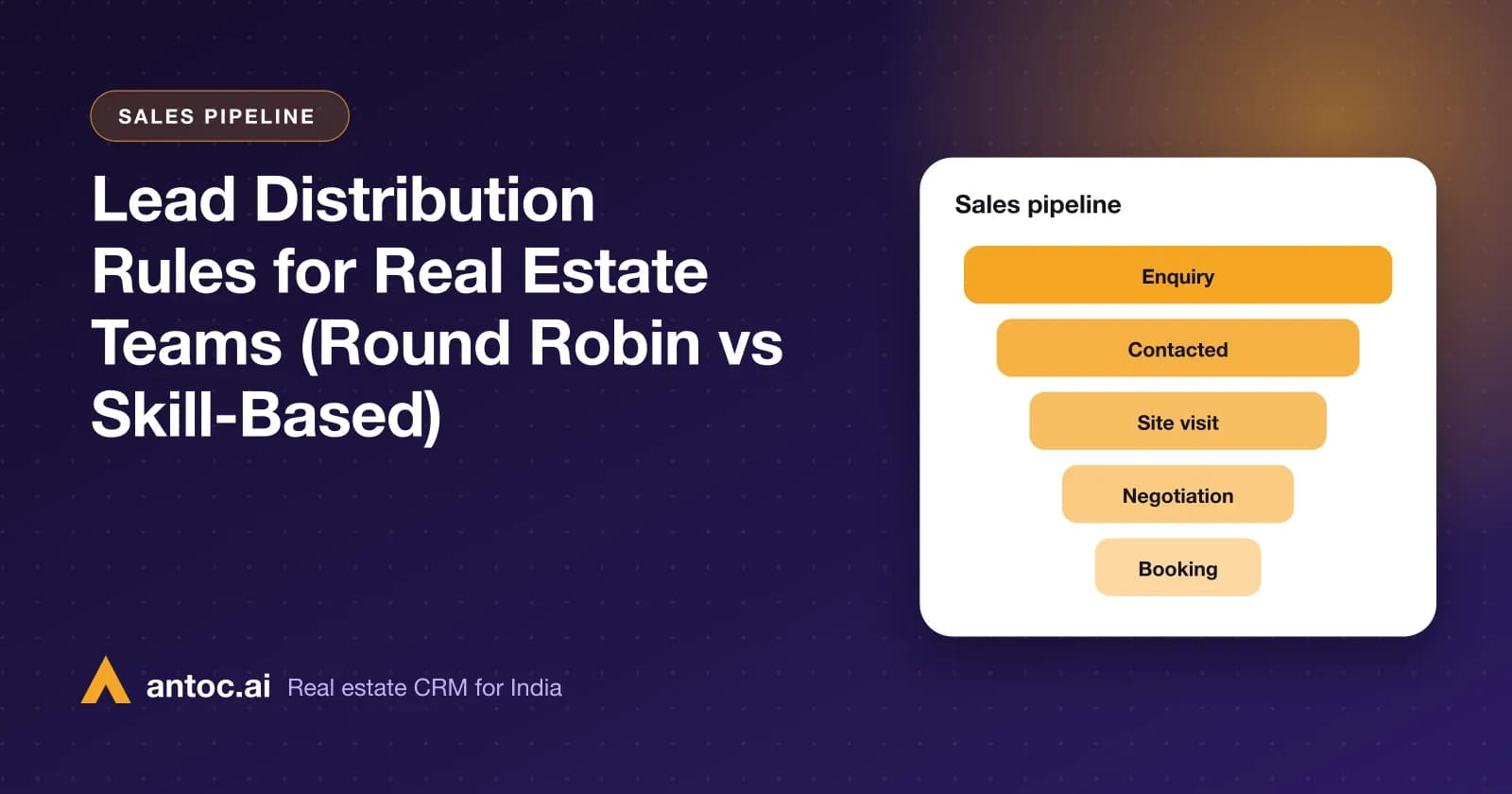
A lead without an owner is a lead nobody calls. Set rules so each new lead goes to a specific agent immediately: round robin across the team, or by project or location if agents specialise. Our guide to lead distribution rules for real estate teams compares the options.
Step 3: Send an instant WhatsApp welcome
Even with perfect assignment, the agent may be on a site visit or another call. An automatic welcome message buys you time and shows the buyer you are organised.
Antoc can send a WhatsApp welcome through the official Meta WhatsApp API the moment a new lead arrives, where WhatsApp automation is enabled. The chat then stays on the lead's timeline.
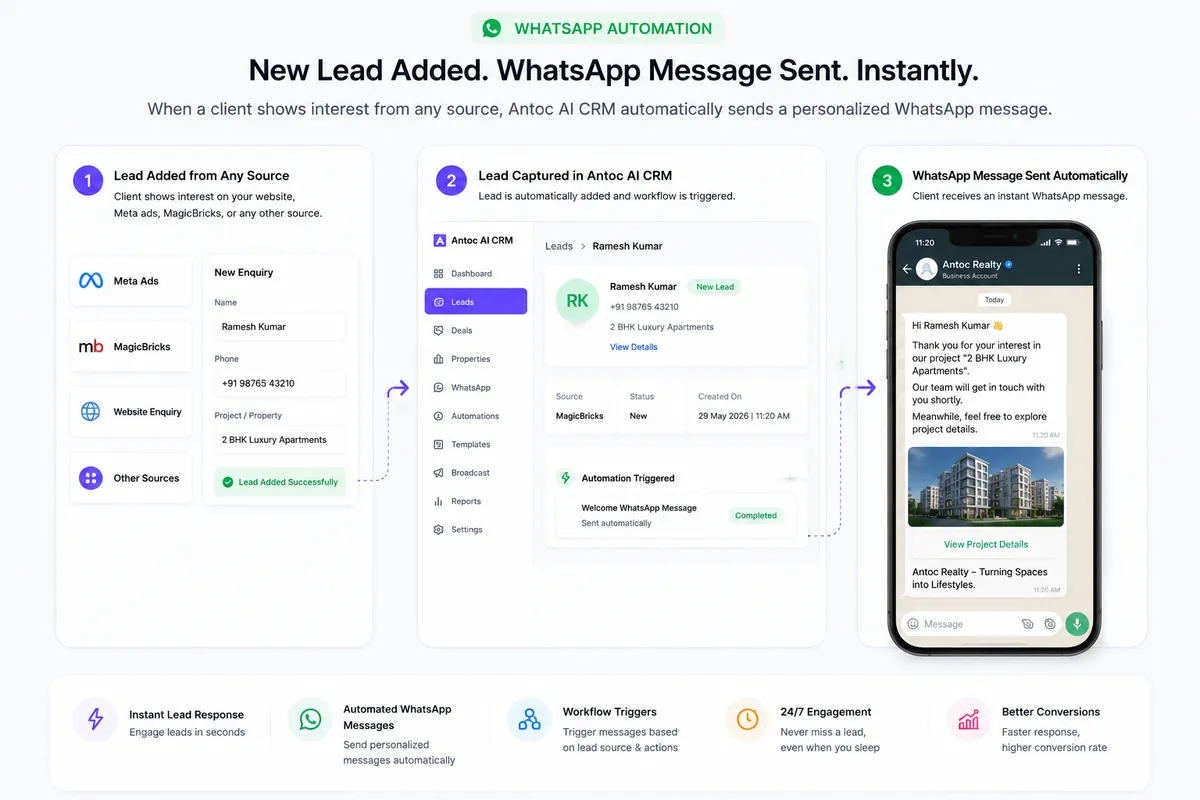
Keep the welcome short: your name, the project, and when you will call. For example: "Hi Priya, thanks for your enquiry on the 3 BHK in Sector 65. I am Rahul from the sales team and will call you within 10 minutes. You can also reply here with your questions."
Step 4: Fire a reminder that is hard to ignore
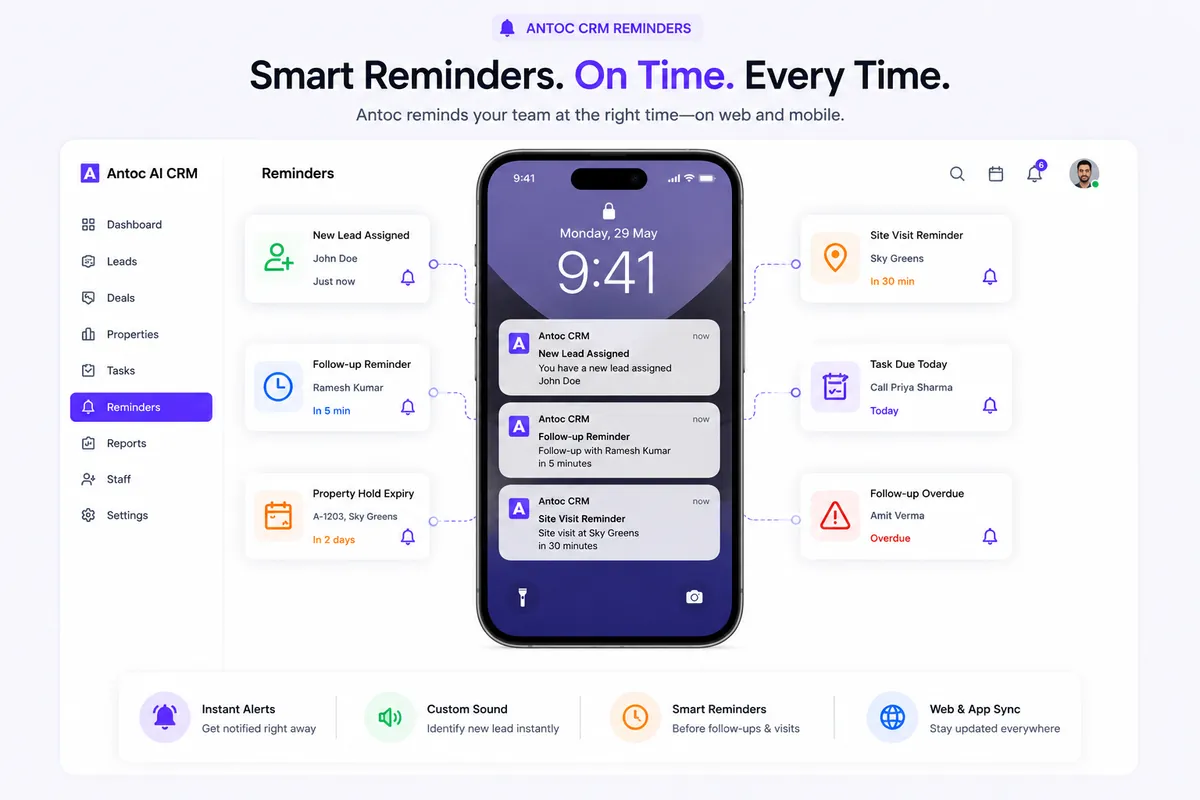
The agent needs an alert, not just a new row in a list. New-lead-assigned and follow-up reminders should reach both web and mobile, ideally with a distinct sound, so the agent notices even when busy with something else.
From the alert, agents can call with one tap. On Android, the call is logged automatically. iOS does not allow apps to read the phone call log, so iPhone users should mark the call outcome on the lead.
Step 5: Give the manager an "untouched leads" view
Automation fails quietly when an agent is on leave or simply ignores alerts. The manager needs to see, every morning and once in the afternoon, which new leads have no call logged.
Reassign those leads the same day. A reports dashboard plus a daily report on WhatsApp and email showing leads added, calls made and activity by staff makes slow spots visible without chasing anyone.
What to do with leads that arrive at 9 pm
After-hours enquiries are often where response time collapses. A practical routine:
- The WhatsApp welcome goes out automatically, saying you will call the next morning at a fixed time.
- The lead is assigned and sits at the top of the next morning's list with a reminder.
- The first call happens in the first hour of the working day, before any old follow-ups.
- If the team works late shifts during launches, one person is on lead duty until a set time.
Some teams also use AI calling to qualify leads outside working hours and sync the outcome to the CRM, so the agent starts the morning knowing budget and timeline. For a real-world version of this problem, read the lead came at 9 pm, by morning it was gone.
Response speed by lead source
Not every source behaves the same way, so set expectations per source rather than one rule for all.
| Lead source | Why speed matters here | First action |
|---|---|---|
| Property portals | Buyer often contacts several listings at once | Call immediately, WhatsApp if unanswered |
| Meta lead ads | Buyer filled a form while scrolling and may forget it | Call while the ad is fresh, then send project details |
| Website form | Buyer chose your site; intent is often higher | Call and send the brochure they asked for |
| Missed call to office | Buyer tried to reach you and failed | Call back before they dial the next number |
| Channel partner lead | CP expects quick action on the buyer they registered | Confirm receipt to the CP and call the buyer |
Review first-touch time by source every week. If one source is always slow, check whether its leads are arriving late (a capture issue) before blaming the agents.
What the first call should sound like
Speed only helps if the first call is useful. Keep it under three minutes and aim for one outcome: a visit slot or a clear next step.
"Hi Neha, I am Arjun from the sales team. You enquired about 2 BHK flats in Wakad a few minutes ago. Is this a good time for two minutes? What budget are you looking at, and when are you planning to move? Based on that, I can show you two options this weekend. Saturday morning or Sunday evening?"
Log the answers on the lead straight after the call, and set the next follow-up date before moving to the next lead.
Illustrative example: the ₹ cost of slow response
The figures below are an illustrative example, not a benchmark.
A developer in Gurugram spends ₹2,00,000 a month on Meta lead ads and gets 500 leads, so each lead costs ₹400.
Say 150 of those leads arrive after 7 pm and are not called until the next afternoon. That is ₹60,000 of leads that start the conversation late, often after competing projects have already called.
If the team also leaves 40 leads completely untouched after 24 hours, that is another ₹16,000 spent on enquiries nobody worked.
Fixing response time does not need more ad spend. It recovers value from the ₹2,00,000 you are already spending.
Common mistakes
- Blaming lead quality before checking speed. Measure first-touch time by source before calling a source "junk".
- Downloading portal leads twice a day. Every manual export adds hours of waiting.
- Shared leads with no owner. If everyone can call, often nobody does.
- A welcome message that replaces the call. Automation should buy time, not substitute for a conversation.
- No plan for evenings and Sundays. That is when many buyers browse, and when many teams go silent.
- Measuring averages only. One lead called after three days hides behind a good average; use the median and the untouched count.
- Reviewing response time once a month. Check untouched leads every day; review the trend weekly.
Start with one number
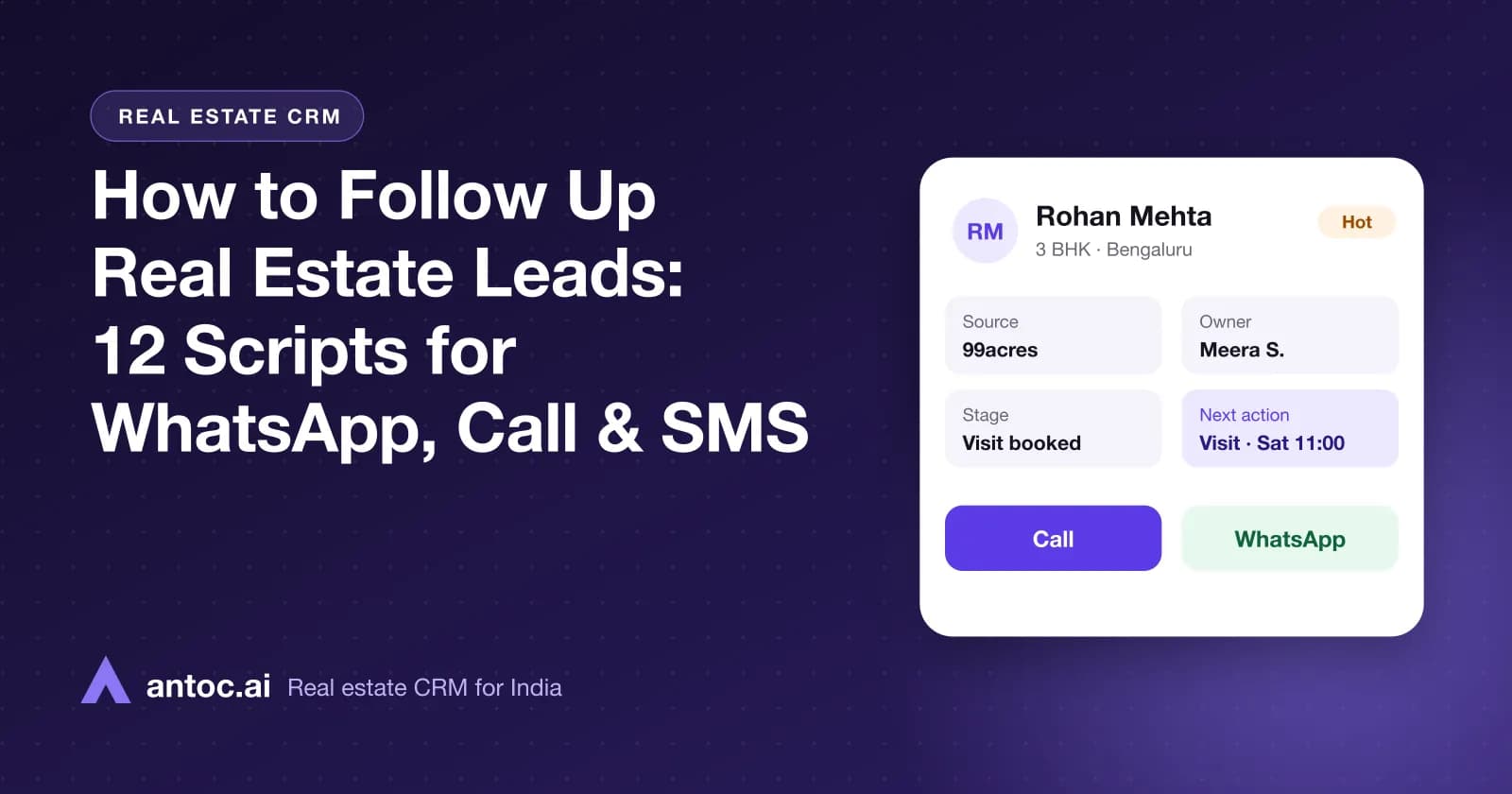
Pick one metric to improve this month: median first-touch time. Measure it today, set up auto-capture, auto-assignment, the WhatsApp welcome and reminders, and check it again in four weeks. If you want the follow-up scripts that come after the first call, see 12 real estate lead follow-up scripts. And if the team still runs on spreadsheets, a real estate CRM for Indian sales teams is the place to start.
Read next
Frequently asked questions
What is a good lead response time in real estate?
Treat a few minutes as the working target for the first call or WhatsApp, because the buyer is still looking at listings and comparing sellers. There is no single correct number for every market. Measure your current first-touch time, then work to bring it down steadily, especially for evening and weekend enquiries.
How do I measure my team's first-call time?
For each lead, subtract the time the lead was created from the time of the first logged call or WhatsApp. Look at the median across the week, the share of leads touched within your target, and how many leads have no touch after 24 hours. A CRM with call logging makes this easy.
Why do real estate leads go cold so quickly?
Most buyers enquire on several listings across portals within a short time. Whoever calls first with relevant details gets the conversation and often the site visit. If you call hours later, the buyer may not remember your listing, has already spoken to others, or has stopped answering unknown numbers.
What should I do with leads that arrive late at night?
Send an automatic WhatsApp welcome immediately so the buyer knows you received the enquiry and when you will call. Put the lead first on the next morning's call list with a reminder. Some teams also use AI calling to qualify after-hours leads and sync the outcome to the CRM.
Does an instant WhatsApp message replace the first call?
No. The WhatsApp welcome confirms you received the enquiry and keeps the buyer engaged, but a call qualifies budget, location and timeline faster. Use the welcome to bridge the gap, then call as soon as possible and log the outcome on the lead.
How does a CRM improve lead response time?
A CRM removes the waiting steps. Leads arrive from portals and ads automatically, get assigned to an agent, trigger an alert and a WhatsApp welcome, and show up in a manager view if nobody has called. Each of these replaces a manual step where leads used to sit idle.
Bring one real lead source. We'll show you the floor.
Book a free demo and bring one source — Meta, 99acres or a CP WhatsApp group. We'll set it up on a lead in front of you.
We build Antoc for Indian brokers and developers, from Pasadi Technologies Pvt Ltd in Ahmedabad. These articles come from patterns we see on real sales floors.