

On this page
Lead distribution in real estate is the set of rules that decides which agent gets each new enquiry and how fast. The common methods are round robin, project or skill-based, location-based, weighted and first-to-claim. Most Indian teams do best with routing by project or area, round robin inside each group, and strict reassignment when nobody calls.
This guide is for sales managers and agency owners with 4 to 40 agents who get leads from portals, Meta ads, websites and walk-ins, and who are tired of hearing "I never got that lead" in the Monday meeting.
Lead distribution decides which agent gets each new enquiry. Most Indian real estate teams do best with a simple rule such as project-based plus round robin, a strict reassignment rule when nobody calls, and a leaderboard built on visits and bookings.
- Assign every lead automatically the moment it arrives; never wait for a manager.
- Combine project or location routing with round robin inside each group.
- Reassign leads that get no first call within your agreed time limit.
- Rank agents on site visits and bookings, not on leads received.
Why distribution rules matter more than you think
A buyer who fills a form on a portal often enquires on several listings in the same hour. The first agent who calls with a relevant answer usually gets the conversation. If the lead waits in a manager's inbox until lunch, you have paid for an enquiry your competitor will convert.
Distribution rules also decide team morale. When agents believe the "good" leads go to the manager's favourites, they stop trusting the system and start hoarding numbers in personal phones.
Good rules do three things: assign instantly, assign fairly, and take the lead back when it is not worked.
Five lead distribution methods compared
| Method | How it works | Best for | Main risk | Rule to add |
|---|---|---|---|---|
| Round robin | Each new lead goes to the next agent in turn | Teams selling similar inventory | Weak agents get the same share as strong ones | Reassign if no first call in time |
| Skill or project-based | Lead routed by project, property type or language | Developers with several projects; teams split by resale vs new | One group overloaded during a campaign | Overflow to a backup group |
| Location-based | Lead routed by locality or city | Brokers covering many areas, e.g. Thane vs Navi Mumbai | Uneven lead volume by area | Review area mapping monthly |
| Weighted | Agents get a set share based on capacity or results | Mixed teams of seniors and new joiners | Feels unfair if weights are secret | Publish weights and review monthly |
| First-to-claim | Lead sits in a pool; first agent to accept owns it | Very small teams, overflow, after-hours leads | Aggressive agents take the best leads | Short claim time, then auto-assign |
There is no single best method. The right one depends on how your team is organised.
How to choose the right method
If everyone sells the same inventory, start with plain round robin. It is easy to explain and hard to argue with.
If you are a developer with two or more projects, route by project first. A buyer who enquired about your Kharadi project should reach the Kharadi team, not someone who only knows your Wagholi tower. Inside each project team, use round robin.
If you are a broker covering many localities, route by area. Agents who know a micro-market answer price and connectivity questions better on the first call.
If you have a mix of seniors and new joiners, use weights. New joiners get a smaller share until their first-call time and visit numbers prove they can handle more.
Use first-to-claim sparingly. It looks efficient, but in most teams the same two agents end up with every promising lead.
You can see how these rules fit into the wider lead flow on our real estate CRM page.
Want to see this on your own leads? Book a free Antoc demo.
Reassignment rules when nobody calls
Distribution is only half the job. The other half is taking the lead back when it is not worked. Agree these steps with the team and write them down:
- Assign instantly. The lead is assigned the moment it arrives, and the buyer gets a WhatsApp welcome message if you use automation.
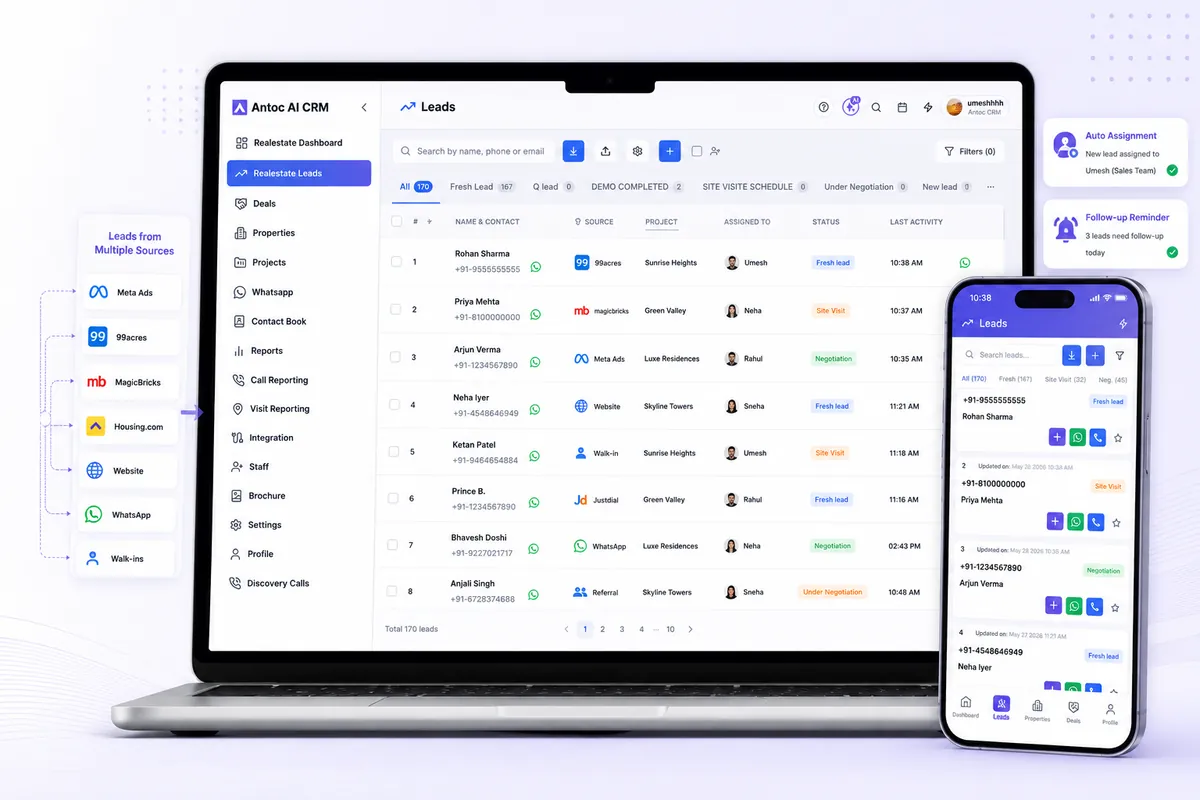
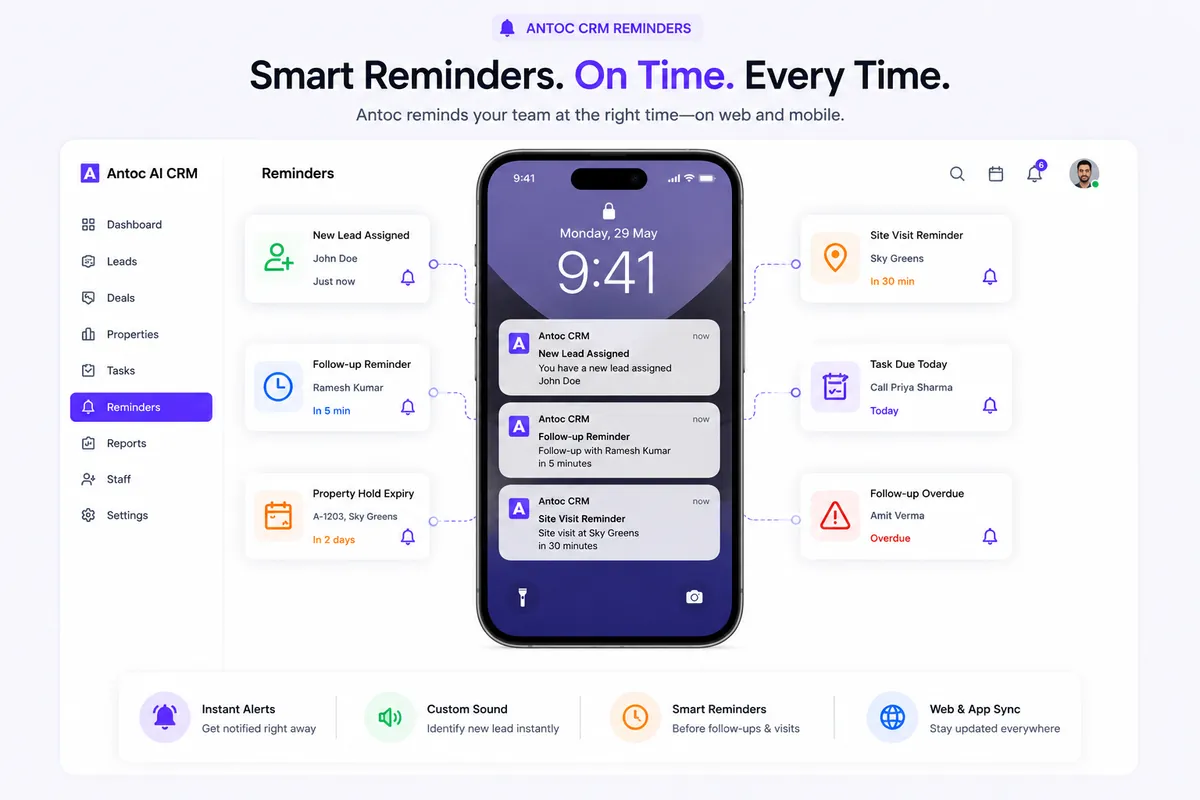
- Alert the agent. A "new lead assigned" reminder fires on the agent's phone and desktop.
- Set a first-call time limit. Pick a limit for working hours, for example 15 minutes, and agree it with the team. Measure it from the lead's arrival to the first logged call.
- Escalate before reassigning. If no call is logged within the limit, the team lead gets an alert and checks with the agent.
- Reassign if still untouched. If the lead is still not called after a second, longer limit, move it to the next agent in the rotation. Record the reason.
- Handle after-hours leads separately. Leads arriving late at night get the welcome message, then go into the first morning slot of the next agent on shift.
- Reassign on leave and exits. When an agent is on leave or leaves the company, their open leads move to named owners the same day.
One practical point: Antoc logs calls automatically on Android. iOS does not allow apps to read the phone call log, so agents on iPhones should log their calls from the CRM, or use the 1-click dialer in the app, so the reassignment rule does not wrongly take leads away.
For more on why the first call is so time-sensitive, read our guide to real estate lead response time.
Duplicate and repeat enquiries
The same buyer often enquires on 99acres on Monday, clicks your Meta ad on Wednesday and walks in on Sunday. If each enquiry goes into the rotation as a fresh lead, three agents call the same person and the buyer thinks your office is disorganised.
Add one rule above every method: a repeat enquiry from an existing mobile number goes to the current owner, not to the next agent in line. The new source and project are added to the same lead so the owner sees the full history.
Make two exceptions. If the existing lead was closed as lost months ago, treat the new enquiry as fresh and assign it normally. If the owner has left the company, assign it to whoever took over their leads.
Worked example: weighted distribution for a Thane agency
Illustrative example with made-up numbers to show the maths.
A Thane agency spends ₹1,80,000 a month across Meta ads and portal packages and receives 600 leads. That is ₹1,80,000 ÷ 600 = ₹300 per lead.
With plain round robin and six agents, each agent gets 100 leads, worth ₹30,000 of marketing spend each.
Now the owner notices that two new joiners take most of a day to make first calls and book very few visits. She moves to weights of 3 : 3 : 2 : 2 : 1 : 1.
| Agent | Weight | Share of 600 leads | Spend value at ₹300 per lead |
|---|---|---|---|
| Senior 1 | 3 | 150 | ₹45,000 |
| Senior 2 | 3 | 150 | ₹45,000 |
| Agent 3 | 2 | 100 | ₹30,000 |
| Agent 4 | 2 | 100 | ₹30,000 |
| New joiner 5 | 1 | 50 | ₹15,000 |
| New joiner 6 | 1 | 50 | ₹15,000 |
The total weight is 12, so one weight point equals 600 ÷ 12 = 50 leads. The new joiners still get real leads to learn on, but ₹30,000 of monthly spend moves to agents who work it faster.
Review weights every month. If a new joiner's first-call time and visits improve, raise their weight. Publish the weights so nobody feels cheated.
Fairness and the leaderboard
Agents accept strict rules when they see the rules applied equally. A few habits help:
- Rotate sources. Do not let one agent receive only portal leads while another gets only Meta leads. Lead quality differs by source, so mix them.
- Cap daily new leads per agent. An agent with 60 new leads in a day cannot call all of them properly. Overflow to the next agent.
- Pause on leave. Remove agents from the rotation on leave days, and add them back the day they return.
- Show the same numbers to everyone. Use one leaderboard visible to the whole team.
A useful leaderboard has five columns: leads received, median first-call time, site visits done, bookings, and leads reassigned away. Rank on visits and bookings, not on calls made. Calls are easy to inflate; site visits are not.
If you want a weekly routine for reviewing these numbers, our post on how sales managers track team performance lays one out.
Common mistakes
- Manager assigns every lead by hand. Leads wait while the manager is in a meeting or at a site, and agents suspect favouritism.
- Rules that live only in the manager's head. If agents cannot read the rule, they will argue every exception.
- No reassignment rule. A lead assigned to an agent who never calls is worse than an unassigned lead, because nobody else will touch it.
- Counting leads received as performance. Leaderboards that rank on volume reward hoarding, not selling.
- Ignoring iPhone call logging. Without manual logging on iOS, your first-call reports will show iPhone users as slow when they are not.
- Changing weights without telling the team. Publish changes and the reason, at the start of the month.
Setting it up in your CRM
You can try round robin in a spreadsheet, but it breaks as soon as leads arrive at night, agents go on leave or two people edit the sheet at once. Distribution needs to happen in the system where leads land.
Antoc captures leads from Meta lead ads, website forms, walk-ins and portals such as 99acres, MagicBricks and Housing.com, as enabled for your account, and auto-assigns each new lead with source and campaign details intact. Agents get reminders on web and mobile, and the daily CRM report on WhatsApp and email shows calls with a staff-wise breakdown. See how this works on the Antoc lead management page.
Pick one method, write down the reassignment rule, and review the leaderboard every week. For the bigger picture of how distribution fits with follow-ups, pipeline and reports, start with our real estate CRM guide.
Read next



Frequently asked questions
What is lead distribution in real estate?
Lead distribution is the rule that decides which agent gets each new enquiry from portals, Meta ads, website forms or walk-ins. It can be manual, but most teams automate it in their CRM so the lead reaches an agent within seconds, with a reminder to call, instead of waiting in a shared inbox.
Is round robin the best way to assign real estate leads?
Round robin is the fairest simple method because every agent gets leads in turn. It works best when agents handle similar projects and areas. If your team is split by project, location or language, route by that first and then use round robin inside each group.
When should a lead be reassigned to another agent?
Set a time limit for the first call during working hours, agree it with the team, and reassign if no call is logged within that time. Also reassign when an agent is on leave, has too many open leads or has not followed up by the reminder date.
How do I make lead distribution fair for my sales team?
Keep the rules written and visible, rotate lead sources so nobody gets only the weak ones, pause assignment for agents on leave, cap daily new leads per agent, and show everyone the same leaderboard of leads received, first-call time, visits and bookings.
What is first-to-claim lead distribution?
In first-to-claim, a new lead goes into a shared pool and the first agent to accept it owns it. It rewards speed but often lets the most aggressive agents take the best leads while others go idle. Use it only for small teams or overflow leads, with a short claim time.
Does Antoc assign leads automatically?
Yes. Antoc auto-assigns new leads as they arrive from enabled sources such as Meta lead ads, portals and website forms, and alerts the agent on web and mobile with a new lead reminder. Walk through your preferred distribution rules during a demo to see how they map to your team.
Bring one real lead source. We'll show you the floor.
Book a free demo and bring one source — Meta, 99acres or a CP WhatsApp group. We'll set it up on a lead in front of you.
We build Antoc for Indian brokers and developers, from Pasadi Technologies Pvt Ltd in Ahmedabad. These articles come from patterns we see on real sales floors.