On this page
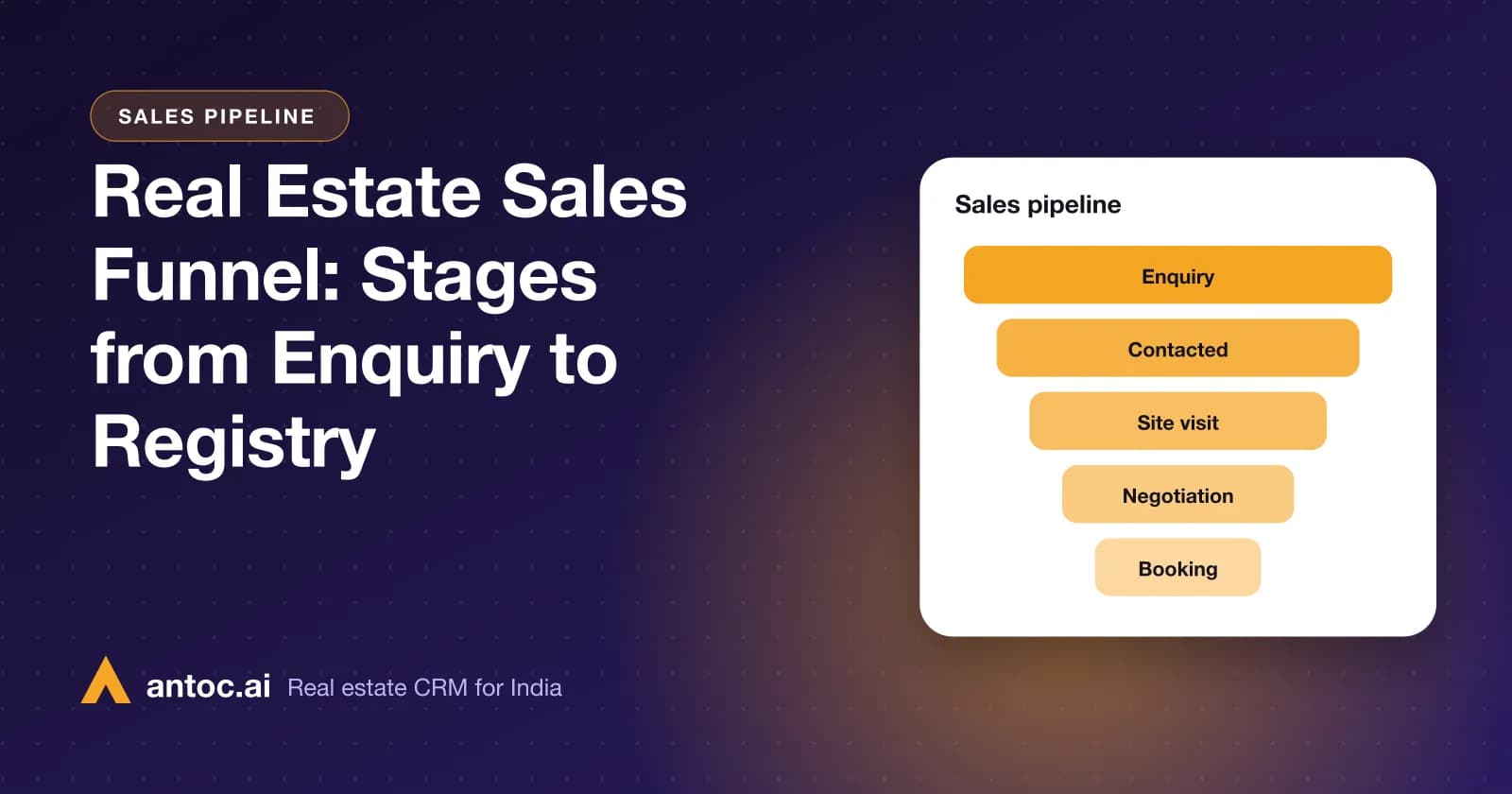
A real estate sales funnel is the sequence of stages a buyer moves through, from first enquiry to registry, with the number of buyers narrowing at each step. In India, ten stages work well: enquiry, contacted, qualified, visit scheduled, visit done, negotiation, token or EOI, booking, agreement and registry, each with a clear exit criterion.
This guide is for sales heads and agency owners who want their team to use the same stages, move leads forward for the same reasons and see exactly where buyers drop out. It applies to brokers and developers, with notes where the two differ.
A real estate sales funnel tracks every buyer from enquiry to registry through ten clear stages. Clear exit criteria and recorded lost reasons show exactly where buyers drop out and what to fix first.
- Use ten fixed stages, from enquiry to registry, with written exit criteria.
- A lead moves forward only when the exit criterion is actually met.
- Record a lost reason at the stage where each buyer drops out.
- Work backwards from your booking target using your own stage ratios.
Funnel vs pipeline: what is the difference?
The two words are often used interchangeably, but they answer different questions.
The funnel answers, "Out of 100 enquiries last month, how many reached each stage?" It is about conversion and leaks.
The pipeline answers, "Which deals are sitting at each stage right now, and what should we do today?" It is about action.
Both come from the same data: every lead having exactly one current stage, with a timestamp each time it moves. Get the stages right, and both views follow.
The 10 stages from enquiry to registry
The most important column here is the exit criterion. Without it, one agent marks a lead "qualified" after a two-minute call and another waits for a confirmed budget, and your funnel report means nothing.
| Stage | What it means | Exit criterion: move forward when | Usual owner |
|---|---|---|---|
| 1. Enquiry | Lead received from any source | Lead is assigned and first contact attempted | System, pre-sales |
| 2. Contacted | Two-way conversation happened | Buyer has spoken or replied on WhatsApp | Pre-sales |
| 3. Qualified | Budget, need and timeline confirmed | Budget, configuration, location and timeline recorded | Pre-sales |
| 4. Visit scheduled | Date and time agreed | Visit confirmed in writing to the buyer | Pre-sales |
| 5. Visit done | Buyer saw the project or property | Visit marked done with outcome logged | Closing manager |
| 6. Negotiation | Discussing price, unit or plan | Specific unit and price range under discussion | Closing manager |
| 7. Token or EOI | Buyer paid to show intent or hold a unit | Amount received and receipt issued | Closing manager, accounts |
| 8. Booking | Formal booking made | Booking form signed and booking amount received | Closing manager, CRM team |
| 9. Agreement | Agreement for sale executed | Agreement signed and registered as required | CRM or post-sales team |
| 10. Registry | Sale deed registered | Registration complete | Post-sales, legal |
Brokers handling resale may skip token or EOI and go from negotiation straight to a token-cum-agreement. Developers selling at launch often use EOI before allotment. Adjust the names, but keep one exit criterion per stage.
Want to see this on your own leads? Book a free Antoc demo.
What to do at each stage
1. Enquiry
Every lead from portals, Meta ads, website forms and walk-ins should land in one list, already assigned. The goal is first contact while the buyer is still looking. Read our guide on real estate lead response time for the setup.
2. Contacted
"Called, not answered" is not contacted. A lead moves here only after a real conversation, on call or WhatsApp. Until then it stays at enquiry with attempts logged.
3. Qualified
Ask four things: budget, configuration, preferred location and buying timeline. Add loan or self-funded if it matters for your project. Record the answers in fields, not notes.
4. Visit scheduled
Agree a date and time, then confirm it in writing. A visit agreed only on a call is half a visit.
5. Visit done
Mark it at the site, with the outcome logged within the hour. For the full process, including reminders and KPIs, see our site visit management guide.
6. Negotiation
The buyer is now discussing a specific unit, price or payment plan. Track the unit, the quoted price and the objections. This is where sales heads should step in on high-value deals.
7. Token or EOI
Money changes hands, so paperwork matters. Issue a receipt, write down the refund terms and the hold period, and set a reminder before the hold expires.
8. Booking
The booking form is signed and the booking amount received. Under the RERA Act, a promoter generally cannot take more than 10% of the cost as an advance without a registered agreement for sale. Check your state RERA rules and your legal adviser for the exact position.
9. Agreement
The agreement for sale is executed and registered as required. Hand the buyer over to the post-sales team with the payment schedule attached.
10. Registry
The sale deed is registered. Stamp duty and registration charges vary by state, so check your state's official registration portal. This is also the best moment to ask for a referral.
How to measure your funnel: a 6-step process
- Freeze stage definitions. Share the exit criteria table with the team and use the same names in your CRM.
- One stage per lead. Every lead must sit in exactly one stage at any time. No "misc" or "follow up later" buckets.
- Timestamp every move. The CRM should record when a lead entered each stage, so you can measure time-in-stage.
- Calculate stage-to-stage conversion monthly. Divide the leads that reached the next stage by the leads that reached the current stage.
- Find the biggest drop against your own history. Compare with your last three months, not with someone else's numbers.
- Fix one thing, then re-measure. Change one process at that stage, such as evening-before visit confirmations, and check the next month.
Illustrative example: working backwards from a booking target
This is an illustrative example. The ratios are made up to show the method. Use your own last-quarter ratios from your CRM.
A Hyderabad developer wants ₹20 crore of bookings next quarter, with an average unit value of ₹1 crore. That means 20 bookings.
Suppose the team's own ratios from last quarter were:
- 1 booking for every 10 visits done, so 20 bookings need 200 visits done.
- 2 out of 3 scheduled visits actually happen, so 200 visits done need 300 visits scheduled.
- 1 in 2 qualified leads schedules a visit, so 300 visits scheduled need 600 qualified leads.
- 1 in 4 enquiries becomes qualified, so 600 qualified leads need 2,400 enquiries.
If the team's own marketing cost per enquiry was ₹400, the quarter needs about ₹9.6 lakh of lead generation. Now the marketing budget is a calculation, not a guess.
The same maths shows what improvement is worth. If show-up improves from 2 in 3 to 3 in 4, the same 300 scheduled visits produce 225 visits done instead of 200. At 1 booking per 10 visits, that is about 2 more bookings, or roughly ₹2 crore of extra bookings, without spending more on ads.
Time in stage: the second number to watch
Conversion tells you how many buyers move forward. Time in stage tells you how fast. Both matter, because a buyer who sits at "qualified" for three weeks without a visit is quietly being sold to by someone else.
Track the average days a lead spends in each stage, using the stage timestamps in your CRM. Then set a simple rule per stage, for example:
- Enquiry: no lead should stay here past the same working day.
- Qualified: a visit should be proposed within a few days.
- Visit done: a next step should be dated before the buyer leaves.
- Token or EOI: follow up before the hold period expires.
The exact limits are yours to set. What matters is that the CRM flags leads that cross them, so the sales head reviews a short list each morning instead of the whole pipeline.
Lost reasons: record them where they happen
A lead closed as "lost" without a reason teaches you nothing. Make the lost reason mandatory, and keep the list short so agents actually use it.
| Lost reason | Usually seen at | What it tells you |
|---|---|---|
| Not reachable | Enquiry | Response speed or source quality |
| Wrong number or fake | Enquiry | Form or portal quality |
| Broker, not a buyer | Contacted | Source targeting |
| Out of budget | Qualified | Ad targeting or pricing on the listing |
| Location or configuration mismatch | Qualified | Targeting or inventory gaps |
| Did not show up | Visit scheduled | Confirmation and reminders |
| Price objection | Negotiation | Pricing, payment plan or closing skill |
| Bought elsewhere | Any stage | Speed and follow-up |
| Loan not approved | Token, booking | Loan pre-checks before booking |
| Plan postponed | Any stage | Nurture candidate, not truly lost |
"Plan postponed" leads are not dead. Move them to a nurture list with a reminder for the month they mentioned.
Seeing the funnel in your CRM
Once stages and lost reasons are consistent, the funnel becomes a live report instead of a month-end exercise. A real estate CRM should show the pipeline by stage, recent leads, follow-ups due and scheduled visits on one screen.
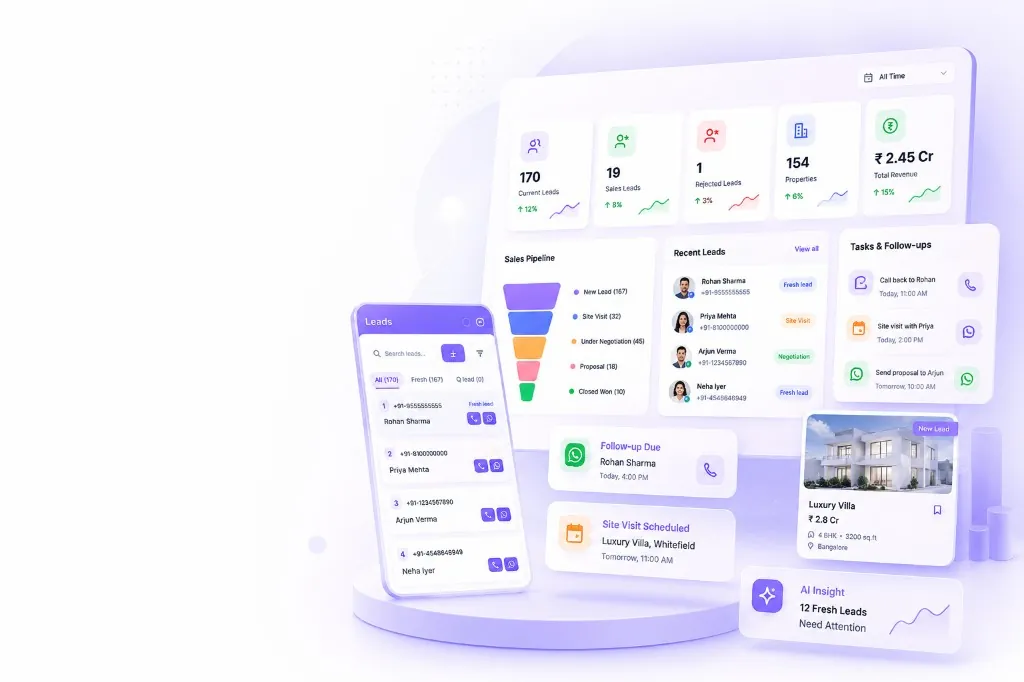
Antoc's lead management keeps source, stage, calls, WhatsApp chats and site visits on each lead, with auto-assignment and follow-up reminders. Deals and pipeline are included from the Basic plan, and a daily report on WhatsApp and email shows leads added, deals closed and calls by staff.
Common mistakes
- Using stage names without exit criteria, so every agent applies them differently.
- Marking leads "contacted" after an unanswered call.
- Letting leads sit in a stage for weeks with no next step or reminder.
- Closing leads as lost without a reason, or using "other" for everything.
- Treating token, booking and agreement as one stage, which hides cancellations.
- Comparing your conversion with numbers from other firms instead of your own history.
- Changing five things at once, so you never learn which one worked.
Start with the stages
Print the exit criteria table, agree on it in a team meeting, and set the same stages in your CRM this week. After one month you will have your first honest funnel, and after three months a baseline worth improving.
For the full picture of how a real estate CRM for Indian teams supports each stage, from capture to registry, start with our CRM overview.
Read next
Frequently asked questions
What are the stages of a real estate sales funnel?
A practical Indian funnel has ten stages: enquiry, contacted, qualified, visit scheduled, visit done, negotiation, token or EOI, booking, agreement and registry. Some teams merge or split stages, but each one should have a clear exit criterion so everyone on the team moves leads forward for the same reason.
What is the difference between a sales funnel and a sales pipeline?
The funnel shows how many buyers reach each stage and where they drop off, so it is about conversion between stages. The pipeline shows the live deals at each stage right now, often with their value, so it is about what to work on today. Most CRMs show both from the same stage data.
What is the difference between token, EOI and booking?
An EOI (expression of interest) is usually a refundable amount paid before launch or allotment to show intent. A token is a smaller amount to hold a specific unit for a short time. A booking is a formal commitment with a booking form and amount. Terms vary by developer and state, so put them in writing.
How do I find where my funnel is leaking?
Calculate the conversion from each stage to the next for the last three months, using your CRM data. The stage with the biggest drop compared with your own past months is the place to start. Then read the lost reasons recorded at that stage to see whether the cause is speed, price, product or follow-up.
Which lost reasons should real estate teams track?
Keep a short fixed list: not reachable, wrong number, broker or not a buyer, out of budget, location mismatch, configuration not available, bought elsewhere, plan postponed, loan not approved and price objection. Make the reason mandatory when a lead is closed as lost, so reports stay complete.
When is a real estate deal considered closed?
For a broker, the deal is usually closed when brokerage becomes due, often at agreement or registry depending on your terms. For a developer, booking is a sales milestone, but the agreement for sale and registry complete the legal transaction. Track all three, because cancellations between booking and agreement do happen.
Bring one real lead source. We'll show you the floor.
Book a free demo and bring one source — Meta, 99acres or a CP WhatsApp group. We'll set it up on a lead in front of you.
We build Antoc for Indian brokers and developers, from Pasadi Technologies Pvt Ltd in Ahmedabad. These articles come from patterns we see on real sales floors.