

On this page
This real estate lead management case study is an illustrative operating playbook: how a 12-agent Mumbai broker team can handle 1,000+ leads a month by doing the capacity maths, auto-assigning every enquiry, running a fixed daily calling rhythm and reviewing the same few reports every morning. The team is fictional; the method is real.
It is written for agency owners and sales managers running 8 to 25 agents, with leads coming from Meta ads, property portals and walk-ins, who feel the team is busy all day yet leads still slip.
A 12-agent broker team can handle 1,000+ leads a month by splitting pre-sales and field roles, auto-assigning every lead, running a fixed daily rhythm and reading the same reports each morning. The capacity maths shows where the limits are.
- Do the capacity maths before hiring: leads per day, attempts, minutes per call.
- Split first-call pre-sales from field closers so new leads never wait.
- Fix the daily rhythm: morning huddle, calling blocks, evening calls, day close.
- Read untouched leads and overdue follow-ups every morning, conversion by source weekly.
The illustrative team: 12 agents in Mumbai's western suburbs
Illustrative example. This is not an Antoc client and the numbers are not benchmarks. They exist to make the maths concrete.
Picture a brokerage covering Andheri, Goregaon, Malad and Borivali. It sells resale flats, handles some rentals and is empanelled with three developers for new launches. The owner runs marketing and developer relationships. One sales manager runs the floor.
The team gets about 1,020 leads a month:
| Source | Leads per month (illustrative) | What's different about it |
|---|---|---|
| Meta lead ads | 400 | High volume, mixed intent, many first-time enquirers |
| 99acres | 200 | Listing-specific; buyers compare several brokers |
| MagicBricks | 180 | Listing-specific; similar handling to 99acres |
| Housing.com | 120 | Mix of rental and purchase enquiries |
| Website forms | 60 | Usually warmer; often project-specific |
| Walk-ins and referrals | 60 | Highest trust; need fast, senior attention |
| Total | 1,020 |
Before this playbook, leads sat in four places: portal dashboards, a Meta sheet, agents' WhatsApp and a walk-in register. Nobody could say how many leads were never called.
Capacity maths: how many leads per agent per day?
Most teams hire by feel. Do the arithmetic first. It tells you whether you have a people problem or a process problem.
Step 1: new leads per day. 1,020 leads ÷ 26 working days ≈ 39 new leads a day.
Step 2: if every agent did everything. 39 ÷ 12 agents ≈ 3.3 new leads per agent per day. Sounds easy. The catch: an agent on a site visit in Borivali cannot call a Meta lead within minutes. Leads wait for whoever is free, and speed dies.
Step 3: split the roles. The team moves to 4 pre-sales callers and 8 field closers. Now each caller handles 39 ÷ 4 ≈ 10 new leads a day.
Step 4: minutes per caller. Assume 2.5 dial attempts per new lead and about 3 minutes per attempt, including notes:
- New leads: 10 × 2.5 × 3 = 75 minutes
- Follow-ups: each caller holds about 120 active leads, each touched every 4 days, so 30 follow-ups × 3 minutes = 90 minutes
- Total ≈ 165 minutes of calling work per caller per day
Step 5: compare with available time. If a caller has about 300 productive calling minutes in a day (the rest goes on WhatsApp, breaks, huddles), load is roughly 55%. That headroom matters: a launch weekend can double the day's leads.
Step 6: field load. Assume 12% of leads reach a site visit (your number will differ). That is about 122 visits a month, or roughly 15 per field agent. With travel across the suburbs, weekend clustering, negotiation and paperwork, that is a full month.
Swap in your own numbers. The formula is: (new leads per day × attempts × minutes per attempt + follow-ups × minutes) ÷ productive minutes per agent. When it stays high for weeks and untouched leads keep rising, hire.
Roles: who owns what
| Role | People | Owns | Measured on |
|---|---|---|---|
| Owner | 1 | Marketing budget, developer tie-ups | Cost per closing by source |
| Sales manager | 1 | Distribution rules, huddle, reassignments | Untouched leads, overdue follow-ups |
| Pre-sales callers | 4 | First call, qualification, visit booking | First-call time, contact rate, visits booked |
| Field closers | 8 | Site visits, negotiation, closing, documentation | Visits done, visit-to-closing rate |
The handover from caller to field closer happens inside the CRM: the lead is reassigned with notes, budget, preferences and the confirmed visit slot. No "I told him on the phone."
Want to see this on your own leads? Book a free Antoc demo.
The lead flow, from enquiry to closing
This is the process every lead follows, whatever the source:
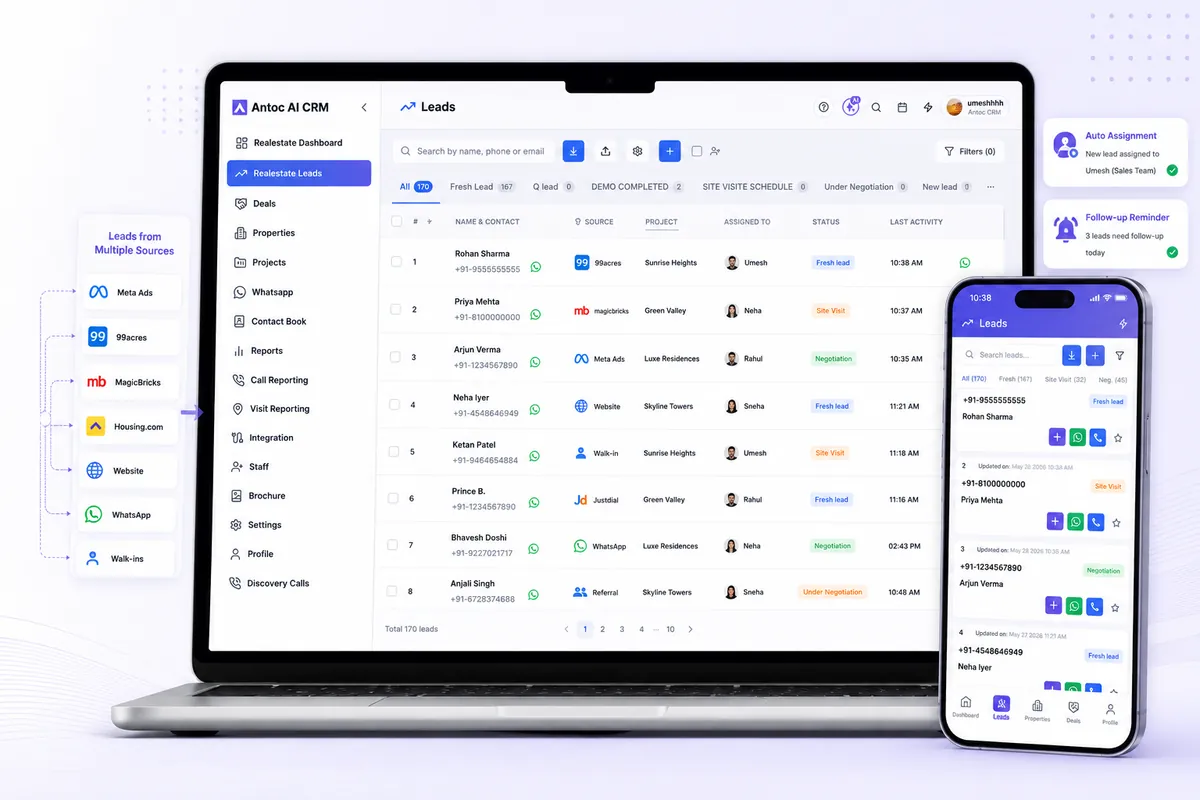
- Capture. All sources flow into one list. In a real estate CRM like Antoc, Meta lead ads, website forms, walk-ins and portals such as 99acres, MagicBricks and Housing.com are captured as enabled for your account, with source and campaign kept on the lead.
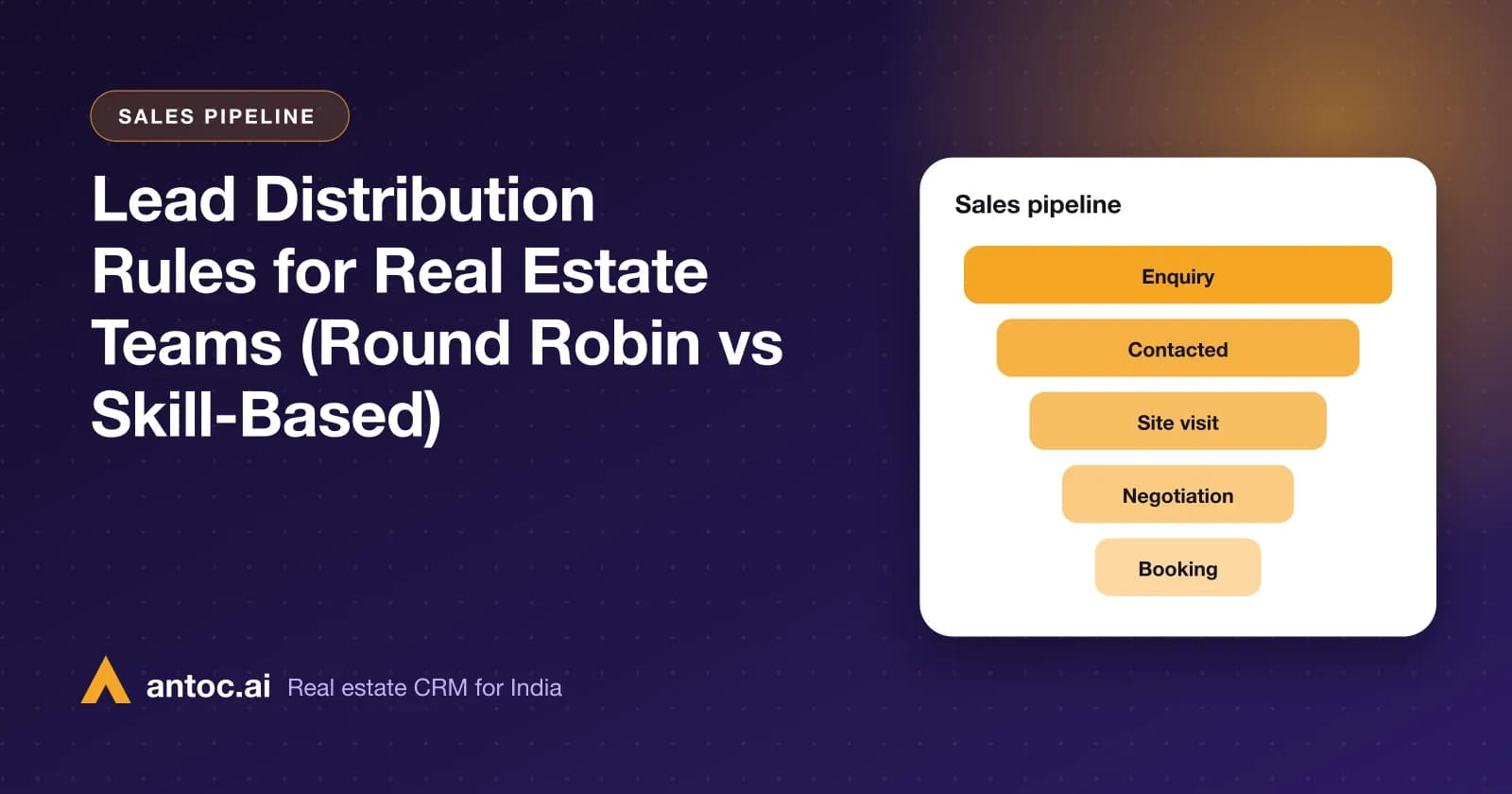
- Auto-assign. Round robin across the four callers, with Marathi- and Gujarati-speaking callers getting leads from certain projects. Rules are explained in our guide to lead distribution for real estate teams.
- WhatsApp welcome. An automatic message goes out the moment the lead arrives, mentioning the project or listing.
- First call. The caller gets a reminder with sound. If a lead has no call attempt within the team's agreed window, the manager reassigns it.
- Qualify. Budget, loan status, location, configuration, timeline, decision makers. Stage and next follow-up date updated before the next dial.
- Book the visit. The lead moves to a field closer with the visit slot. Site visit reminders go to the closer, and a confirmation goes to the buyer.
- Visit and close. The closer logs the visit outcome the same day, runs negotiation and tracks token, agreement and registration.
- Recycle. Leads that are "not now" go into a slower nurture list with a monthly touch. Leads that are dead get a lost reason.
The daily rhythm
Volume is handled by routine, not heroics. The team runs the same day, every day:
- 9:30 am — 15-minute huddle. The manager reads the daily report: yesterday's leads, calls by agent, overnight leads still unassigned, today's visits.
- 10:00 am to 1:00 pm — calling block one. Overnight and morning leads first, then due follow-ups. No internal meetings.
- 2:00 pm to 5:00 pm — follow-ups and visits. Callers work the follow-up list; closers are on site.
- 5:30 pm to 7:30 pm — evening calling block. Many Mumbai buyers only pick up after office. Retries for unreached leads go here.
- 7:30 pm — day close. Every lead touched today has a stage and a next date. The manager checks the untouched list before leaving.
Weekends flip the balance: closers run back-to-back visits, callers confirm slots in the morning and book next week's visits in the evening.
Reports the manager actually reads
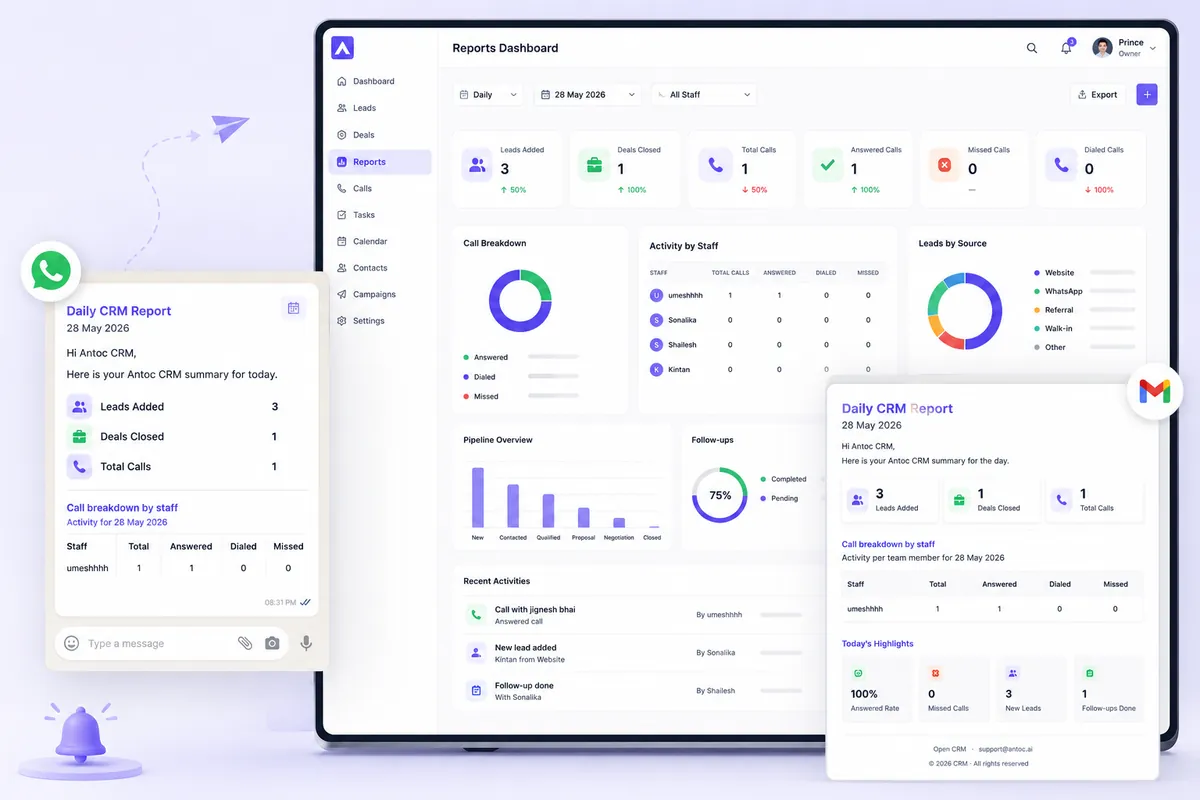
At 1,000 leads a month you cannot manage from WhatsApp groups. The manager reads a short set of numbers.
Every morning:
- New leads by source, and any still unassigned
- Leads with no first-call attempt
- Overdue follow-ups by agent
- Calls by agent (on Android, Antoc logs calls automatically; iOS does not allow apps to read the phone call log, so iPhone users log outcomes manually)
- Site visits scheduled for today and tomorrow
Every week:
- Visit rate and closing rate by source
- Visit-to-closing rate by field closer
- Lost reasons by source, to spot junk-heavy campaigns
- Leads per caller versus capacity
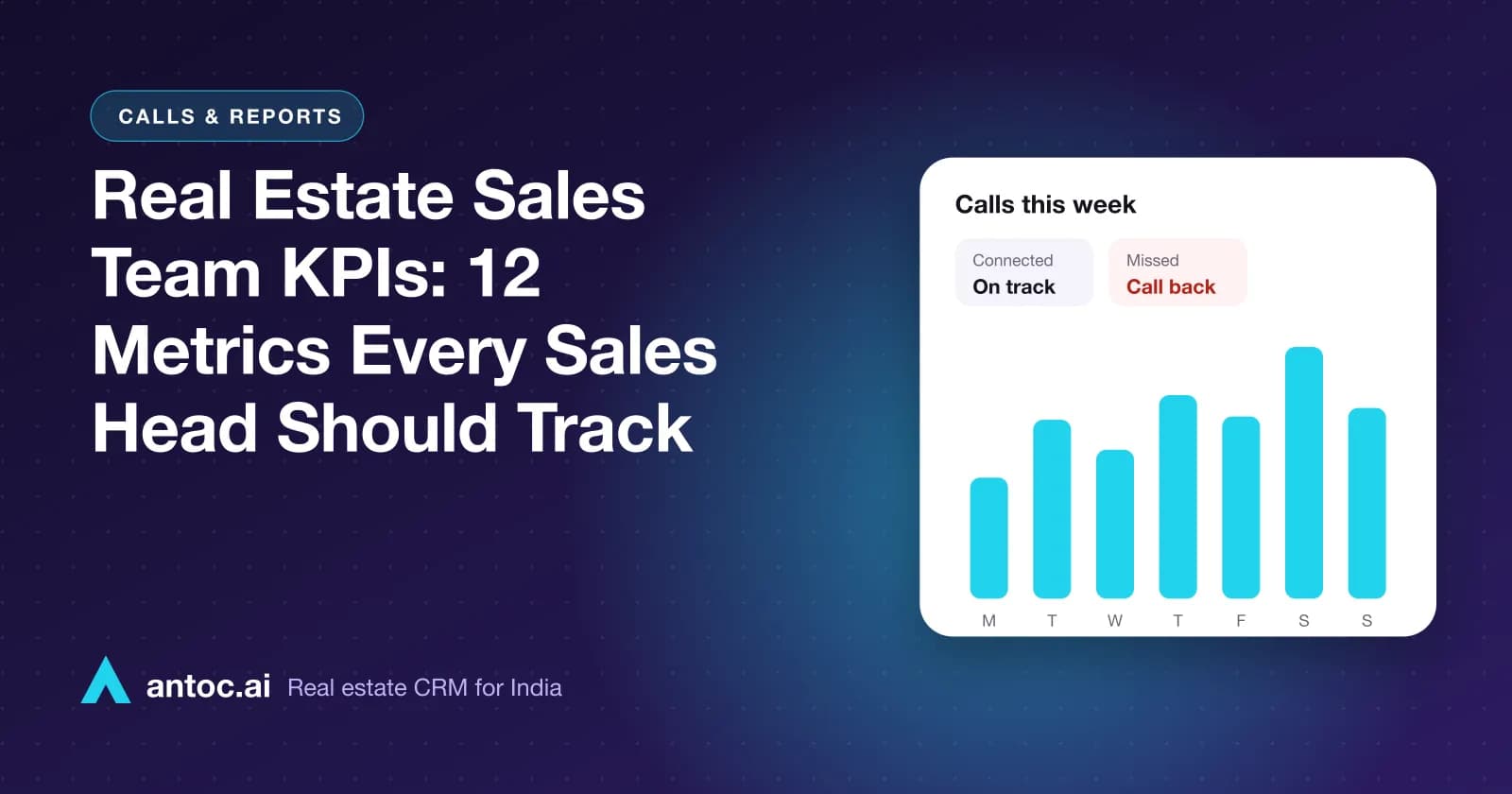
Antoc sends a daily CRM report on WhatsApp and email with leads added, deals closed and calls with a staff breakdown. Our list of real estate sales KPIs explains the formulas behind the weekly view.
The ₹ maths: what this costs and what it protects
Illustrative example with round numbers. Your commissions, deal sizes and spend will differ.
- Marketing spend: ₹3,00,000 a month across Meta and portals
- Cost per lead: ₹3,00,000 ÷ 1,020 ≈ ₹294
- CRM: 14 users (12 agents, manager, owner) on Antoc Prime at ₹699 per user per month (annual plan) = ₹9,786 a month
- Average deal: ₹1.4 crore, with average brokerage of 1.5% = ₹2,10,000 per closing
One closing covers the CRM bill more than 20 times over. Put differently: if better follow-up rescues even one deal a month that would otherwise have gone cold, the software is paid for many times.
The bigger number is the ₹294 per lead. If 100 leads a month are never called properly, that is about ₹29,400 of marketing spend thrown away every month, before counting the lost commission.
Five floor rules that keep the system honest
Software only works if the team follows a few non-negotiable rules. The manager announces these once, then enforces them at every huddle:
- No lead lives only on WhatsApp. If a buyer messages an agent directly, the agent adds them to the CRM the same hour. Otherwise the lead leaves when the agent does.
- Every call ends with a next date. "Will call later" is not a stage. The follow-up date goes in before the next dial.
- Lost needs a reason. Wrong number, budget mismatch, bought elsewhere, broker posing as buyer, not reachable after the full cadence. No blank "lost".
- Reassignment is not a punishment. If a lead has no first-call attempt in the agreed window, it moves. Agents know the rule, so nobody takes it personally.
- Visit outcomes are logged the same day. A closer who logs Saturday's visits on Tuesday has already lost the follow-up window.
These rules also make the weekly numbers trustworthy. If half the lost leads have no reason, you can't tell whether a Meta campaign is bad or a caller is weak.
What breaks first when volume doubles
When this team grows from 1,000 to 2,000 leads, these are the cracks to watch:
- Duplicates. The same buyer enquires on three portals and gets three calls from three agents. Merge duplicates and keep one owner.
- Night and Sunday leads. Without instant capture and WhatsApp welcomes, they wait 12+ hours.
- Hoarding. Agents sit on leads they never call. Reassignment rules fix this.
- Launch spikes. A new project can bring a week's leads in a day. Plan temporary extra callers.
- Reporting by WhatsApp. "Send me your numbers" every evening wastes the manager's time and gives inconsistent data.
Common mistakes
- Hiring before doing the capacity maths. More agents won't fix leads that are never assigned.
- One agent doing everything at scale. Field agents on site visits cannot make first calls on time.
- No reassignment rule. Uncalled leads sit with the same agent for days.
- Skipping the day close. A lead without a next date is a lead nobody will call.
- Measuring calls, not outcomes. Call counts matter less than visits booked and closings by source.
- Ignoring iPhone users. If half the team uses iOS, set a rule for manual call outcome logging.
- Treating walk-ins and referrals like Meta leads. They deserve your most senior people.
How to start this week
Pick one change a week. Week one: get every source into one list with an owner. Week two: split pre-sales and field roles. Week three: fix the daily rhythm. Week four: run the morning and weekly reports.
If your team is a brokerage outgrowing spreadsheets, see how Antoc works as a CRM for real estate brokers, or read our overview of what a real estate CRM should do for growing teams.
Read next
Frequently asked questions
How many leads can one real estate agent handle per day?
It depends on attempts per lead, minutes per call and the size of each agent's follow-up pool, so work it out for your team. Multiply new leads per day by attempts and minutes per attempt, add follow-up minutes, and compare with productive calling minutes per agent. Keep headroom for launch spikes rather than running at full load.
Should one agent handle a lead from first call to closing?
At low volumes, yes. Once leads arrive faster than field agents can call them, split roles: pre-sales callers handle first call, qualification and visit booking, and field agents handle visits, negotiation and closing. The handover must happen inside the CRM so history, notes and next steps move with the lead.
What reports should a sales manager check daily with 1,000 leads a month?
Check untouched new leads, overdue follow-ups, calls by agent, visits scheduled for the next day and leads by source. Weekly, review visit rate and closing rate by source and agent, plus lost reasons. A daily CRM report on WhatsApp or email makes the morning check take minutes instead of an hour.
How do you handle real estate leads that come in at night?
Capture them automatically, assign them instantly and send a WhatsApp welcome so the buyer hears from you at once. Then put night leads at the top of the first calling block next morning. The manager should check at the morning huddle that every overnight lead has an owner and a first-call attempt logged.
Is this a real Antoc client case study?
No. The Mumbai team in this article is an illustrative example built to show the maths and routine clearly. Antoc is trusted by 100+ real estate firms across India, but we do not publish client metrics. Use the formulas here with your own lead volumes, call times and conversion numbers.
When should a broker team hire another pre-sales caller?
Hire when the per-caller load from your capacity maths stays high for a few weeks and first-call time or contact rate starts slipping. Look at untouched leads and overdue follow-ups in the CRM. If they grow every week while callers are fully busy, the team is short of capacity, not effort.
Bring one real lead source. We'll show you the floor.
Book a free demo and bring one source — Meta, 99acres or a CP WhatsApp group. We'll set it up on a lead in front of you.
We build Antoc for Indian brokers and developers, from Pasadi Technologies Pvt Ltd in Ahmedabad. These articles come from patterns we see on real sales floors.