On this page
A payment schedule for a real estate builder is the list of instalments a buyer pays from booking to possession, each linked to a construction milestone or a fixed date. Builders keep collections on track by raising demand letters the day a milestone is reached, sending reminders, issuing receipts and updating one unit-wise ledger per buyer.
This guide is for developers, CRM (customer relationship) heads and accounts teams managing anywhere from one tower to several projects, especially those still running demands from Excel and Word templates.
This is general operational guidance, not legal or tax advice. Payment terms, interest on delays, GST and RERA requirements depend on your agreement and your state. Check with your lawyer, CA and your state RERA authority.
A builder's payment schedule links each instalment to a construction milestone or a date. Collections stay on track when every demand, reminder, receipt and overdue amount is recorded against the buyer's unit-wise ledger, not in separate Excel sheets.
- Choose construction-linked or time-linked plans and attach one to every booking.
- Raise demands for all units the day a milestone is certified.
- Every payment needs a receipt and an immediate ledger entry.
- Sort overdue dues into age buckets and give each bucket an owner.
Construction-linked vs time-linked payment plans
Most Indian projects use one of two plan types, sometimes with a mix offered to different buyers.
| Point | Construction-linked plan (CLP) | Time-linked plan (TLP) |
|---|---|---|
| Instalment trigger | A construction stage, e.g. plinth, 5th slab, brickwork | A calendar date, e.g. every 90 days |
| Buyer's view | Pays only as the building rises | Pays on schedule even if work slows |
| Builder's cash flow | Depends on construction speed | More predictable |
| Demand trigger | Site certifies the milestone | Calendar date arrives |
| Home loan fit | Banks disburse against stage-wise demands | Banks may still want stage proof |
| Main risk for builder | Delays on site delay collections | Buyer complaints if work falls behind |
| Typical use | Under-construction projects | Shorter projects or nearly ready towers |
Some builders also offer possession-linked or down-payment plans with a different split. Whatever the plan, it must be written into the agreement for sale and attached to the booking in your system.
The RERA Act generally restricts how much a promoter can collect as an advance before a registered agreement for sale, commonly 10% of the cost. Check the Act and your state RERA rules before you design the first two rows of your schedule.
Example schedule for an ₹80 lakh flat
Illustrative example only. The stages and percentages below show how a construction-linked schedule works; your agreement will differ.
A 2 BHK with an agreement value of ₹80,00,000. Taxes, stamp duty, registration and maintenance deposits are excluded and billed separately.
| # | Milestone | % of value | Amount | Cumulative |
|---|---|---|---|---|
| 1 | Booking / application | 10% | ₹8,00,000 | ₹8,00,000 |
| 2 | Registered agreement for sale | 10% | ₹8,00,000 | ₹16,00,000 |
| 3 | Plinth completion | 10% | ₹8,00,000 | ₹24,00,000 |
| 4 | 2nd slab | 10% | ₹8,00,000 | ₹32,00,000 |
| 5 | 5th slab | 10% | ₹8,00,000 | ₹40,00,000 |
| 6 | 8th slab | 10% | ₹8,00,000 | ₹48,00,000 |
| 7 | Top (terrace) slab | 10% | ₹8,00,000 | ₹56,00,000 |
| 8 | Brickwork and internal plaster | 10% | ₹8,00,000 | ₹64,00,000 |
| 9 | Flooring, plumbing and electrical | 10% | ₹8,00,000 | ₹72,00,000 |
| 10 | Offer of possession | 10% | ₹8,00,000 | ₹80,00,000 |
The same flat on a time-linked plan might collect 10% at booking, 10% at agreement, then 10% every three months. The ₹80 lakh total is the same; only the trigger changes.
Now imagine a 12-floor tower with 48 flats on this schedule. When the 5th slab is certified, accounts must raise 48 demands on the same day, each for the right buyer, the right amount and the right bank. That is where most builders' processes break.
How a demand moves from milestone to receipt
Follow the same steps for every milestone so nothing depends on one person's memory:
- Milestone confirmed. The site or project team confirms the stage is complete, with whatever certificate your process or lender requires, and records the date.
- Demands raised for all linked units. Accounts raises a demand for every unit on that tower whose plan includes the milestone. Units with different plans are handled by their own schedule.
- Demand letter sent. The letter shows buyer and unit, milestone, percentage, amount, taxes separately, any earlier dues, due date and bank details. Send by email and share on WhatsApp.
- Bank copy for loan buyers. Buyers with home loans forward the demand to their bank, or the builder's team does it with the buyer's consent, so disbursement starts quickly.
- Reminders before and after the due date. A reminder a few days before, on the due date, and after it if unpaid.
- Payment received and matched. Each payment is matched to the right demand, a receipt is issued, and the ledger updates the same day.
- Unpaid demands move to overdue. Anything past due goes into an age bucket with a named owner.
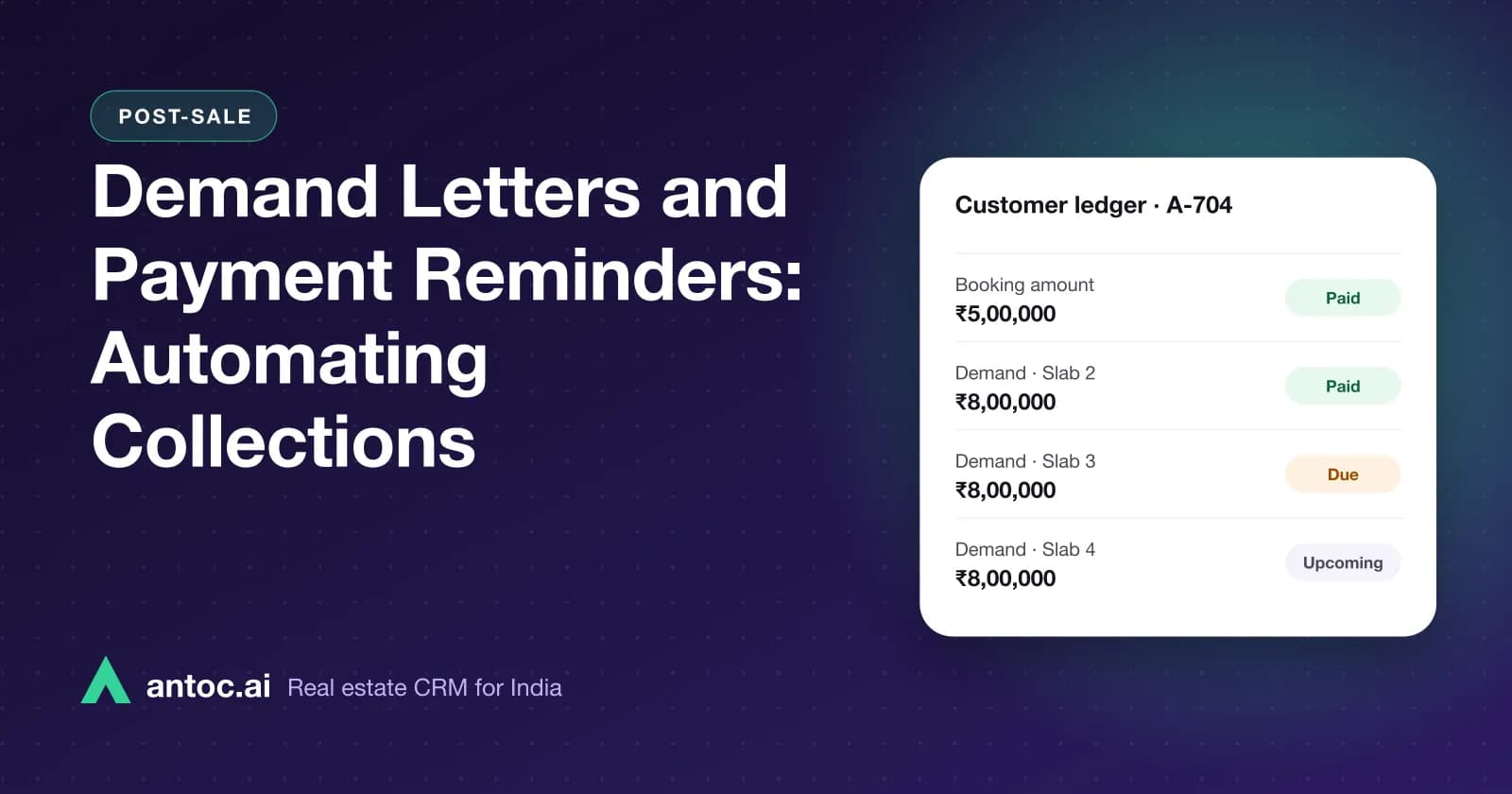
For ready-to-use wording and automation ideas, see our guide on demand letters and payment reminders.
Want to see this on your own leads? Book a free Antoc demo.
What the buyer ledger must show
The ledger is the single source of truth for each buyer. If sales, accounts and the CRM team each keep their own sheet, you will send a reminder to a buyer who paid last week, and they will remember it.
A good unit-wise ledger shows:
- Agreement value and the payment plan attached to the booking
- Every demand raised, with date, milestone and amount
- Every payment received, with date, mode, reference and receipt number
- Adjustments such as discounts or credit notes approved by management
- Interest on delayed payment, if your agreement provides for it
- Running balance: total demanded, total received, current due, overdue
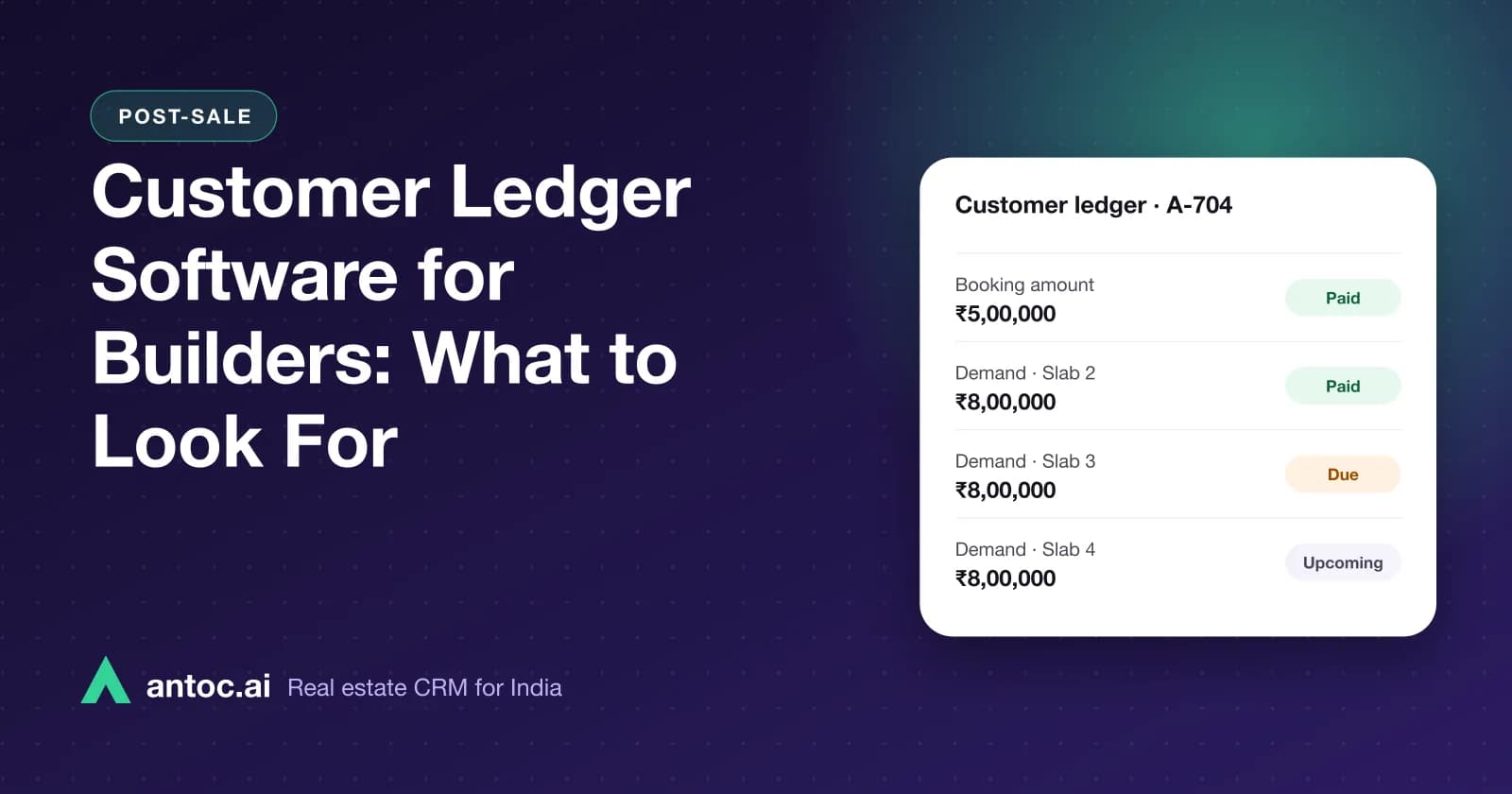
Our post on customer ledger software for builders covers what to look for in more detail.
Receipts buyers and banks will accept
A receipt is the buyer's proof, and often their bank's proof, that money reached you. Issue one for every payment, including part payments and cheques that have cleared.
Each receipt should carry the buyer and co-applicant names, project and unit number, receipt number and date, amount in figures and words, payment mode and reference (cheque number, UTR or UPI reference), and the demand it was applied against. Show taxes separately if your accountant advises it.
Send the receipt the same day on email and WhatsApp. Buyers who receive receipts quickly call your office less, and they are usually more willing to pay the next demand on time.
Overdue buckets and who acts
Treat overdue dues like a pipeline. The older the due, the more senior the person who handles it.
| Days overdue | Action | Owner |
|---|---|---|
| 1–15 | Automatic WhatsApp and email reminders; friendly call | CRM executive |
| 16–30 | Personal call, check if it is a loan disbursement delay | Payment collector |
| 31–60 | Written reminder as per agreement; meeting with buyer | CRM head |
| 60+ | Management review; next steps strictly as per agreement terms | Management with legal advice |
Many overdue amounts are not buyer reluctance. The bank needs a document, the buyer's own contribution is delayed, or the demand went to an old email. A short call in the 16–30 day bucket often finds the real reason.
Worked example: one overdue buyer
Illustrative example continuing the ₹80 lakh flat above.
The 5th slab demand of ₹8,00,000 was due on 10 June. The buyer paid ₹5,00,000 on 8 June from savings and is waiting for the bank to release the rest.
On 2 July, the ledger shows total demanded ₹40,00,000, total received ₹37,00,000 and ₹3,00,000 overdue by 22 days. The case sits in the 16–30 bucket. The collector calls, learns the bank wants a fresh stage certificate, and the CRM team sends it the same day.
Without a ledger, this buyer gets a generic "your payment is overdue" letter for the full ₹8 lakh, and an avoidable complaint follows.
The payment collector role
In larger projects, give overdue follow-up to a dedicated person or small team: the payment collector. Their list is simple: every buyer with an overdue amount, sorted by bucket and amount.
The collector needs to see the ledger, the last reminder sent, the last call and any notes about loans or disputes. They should not have to ask accounts for a fresh Excel every morning.
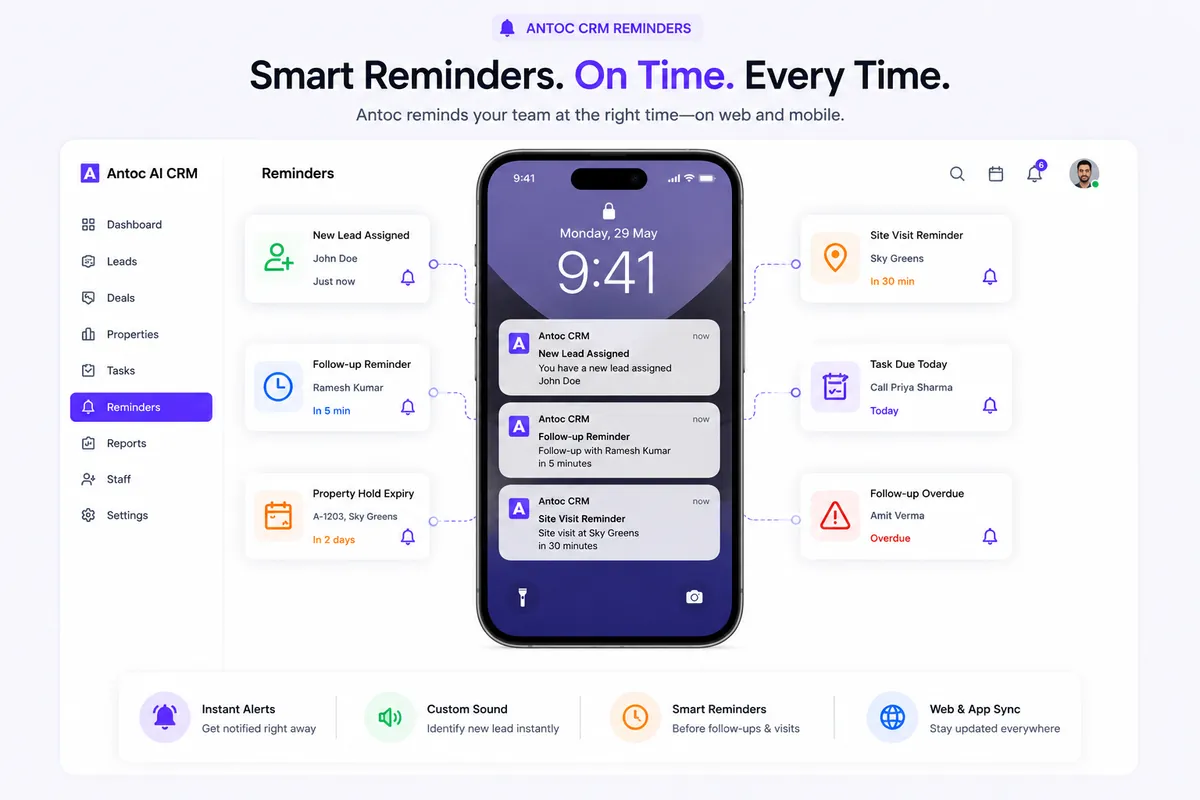
A monthly collections review
Once a month, the promoter, CRM head and accounts head should look at four numbers per project: total demanded to date, total received, total overdue by bucket, and demands due in the next 30 days.
The last number is the one most builders skip. It tells you which milestones are coming, which towers need site progress to trigger demands, and how much cash to expect. Compare it with your construction plan, not just last month's collections.
Common mistakes
- Raising demands one by one from Word templates. Copy-paste errors in amounts, names and unit numbers are common, and every error delays payment.
- Sales, accounts and CRM teams keeping separate sheets. Buyers get conflicting numbers and lose trust.
- Sending demands only by courier or only by email. Share on WhatsApp as well, and keep proof of sending on the buyer's record.
- Not recording partial payments properly. A part-paid demand must show the exact balance, not the full amount as overdue.
- Treating all overdue buyers the same. A 5-day delay from a loan buyer needs a call, not a legal notice.
- Changing plans without updating the system. If management approves a revised schedule for one buyer, attach it to that booking immediately.
- Ignoring stage proof for home-loan buyers. Banks often need documents; slow paperwork from your side looks like buyer default in your reports.
Where Antoc fits
Antoc's post-sale module follows the same chain this article describes: booking, buyer, payment plan, demands, payments, ledger and reminders, with a payment collector view for overdue dues. Because it sits in the same CRM as pre-sale leads and inventory, the unit booked by sales is the unit accounts bills. See how it works on the Antoc post-sale page.
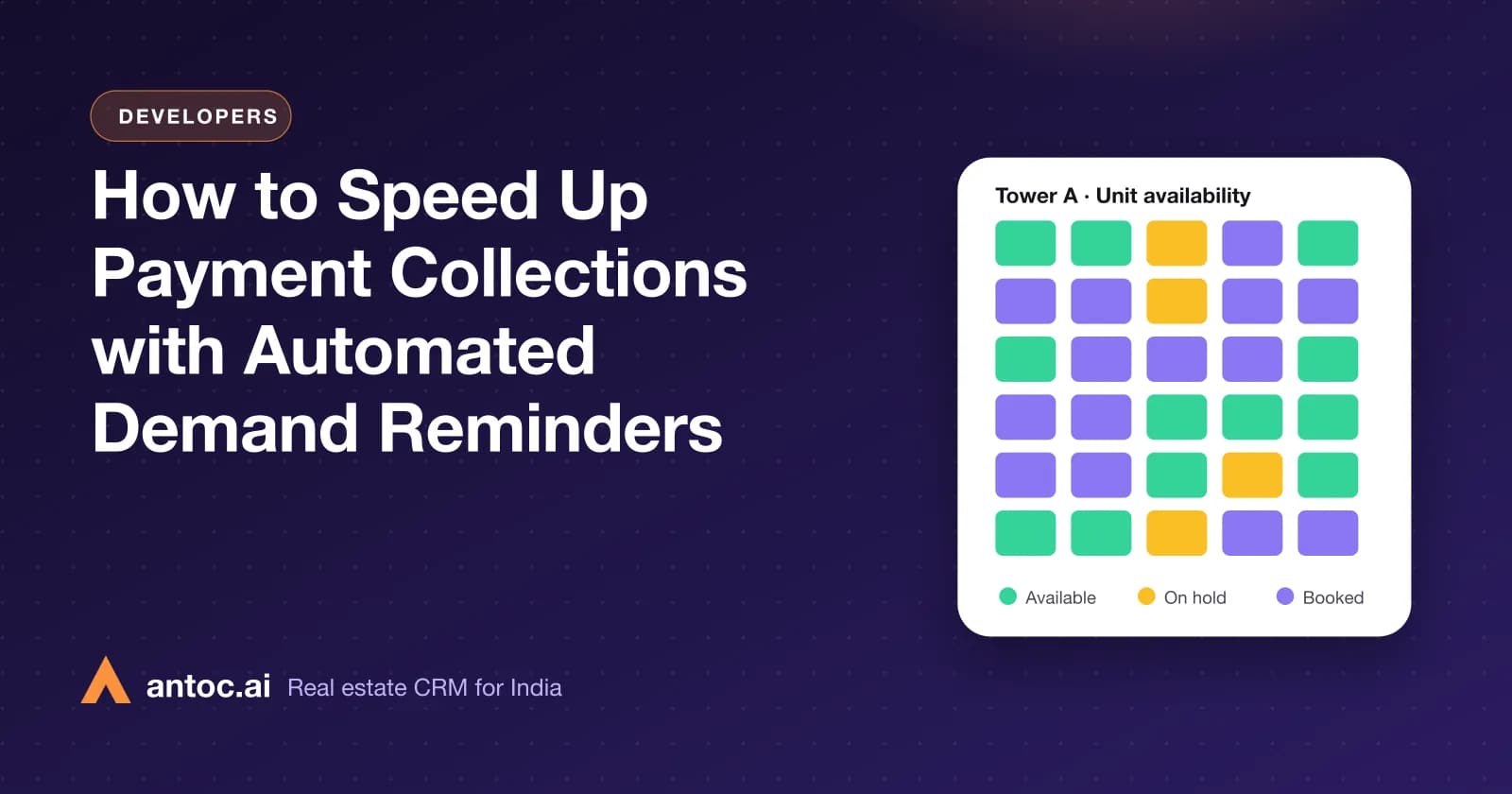
If you also need building inventory, unit-wise availability and channel partner management, the Developer plan covers both sides; our CRM for developers page explains the full workflow. For more on speeding up collections, read how automated demand reminders speed up payments.
Start with one tower. Put every booking's plan in the system, raise the next milestone's demands from it, and compare the effort with your last Excel round. For the bigger picture of running sales, inventory and collections together, explore Antoc for real estate developers.
Read next
Frequently asked questions
What is a payment schedule in real estate?
A payment schedule is the agreed list of instalments a buyer pays a builder, from booking to possession. Each instalment is a percentage of the agreement value, linked either to a construction milestone such as a slab, or to a calendar date. It is part of the agreement for sale and drives every demand letter.
What is the difference between construction-linked and time-linked payment plans?
In a construction-linked plan, the buyer pays when the builder reaches a stage such as plinth or a slab. In a time-linked plan, the buyer pays on fixed dates regardless of progress. Construction-linked plans protect buyers from paying ahead of work; time-linked plans give builders more predictable cash flow.
What should a builder's demand letter include?
Include the buyer and unit details, the milestone reached, the instalment percentage and amount, taxes shown separately, any earlier dues, the due date, bank details for payment and a contact for questions. Keep the format the same for every buyer so home-loan banks can process disbursement requests quickly.
How much can a builder collect before the agreement for sale?
The RERA Act generally restricts how much a promoter can accept as an advance or application fee before entering into a registered agreement for sale, commonly 10% of the cost. State rules and interpretations vary, so check the official RERA Act text and your state RERA website before finalising your schedule.
How should builders follow up on overdue payments?
Sort dues by age, for example 1 to 15 days, 16 to 30, 31 to 60 and over 60. Send automatic reminders for the first bucket, assign a person to call the second, escalate the third to the CRM head, and handle the last as per your agreement terms with management involved.
Can a CRM generate demands and track the buyer ledger?
A post-sale CRM for builders links each booking to a buyer, a payment plan, demands, payments and a ledger, with reminders for due and overdue amounts. Antoc's post-sale module follows this flow and includes a payment collector view for overdue dues, so the sales and accounts teams see the same numbers.
Bring one real lead source. We'll show you the floor.
Book a free demo and bring one source — Meta, 99acres or a CP WhatsApp group. We'll set it up on a lead in front of you.
We build Antoc for Indian brokers and developers, from Pasadi Technologies Pvt Ltd in Ahmedabad. These articles come from patterns we see on real sales floors.