On this page
A post sales CRM for real estate is the system a builder uses after the booking form is signed. It holds the buyer record, payment plan, demand letters, receipts, ledger and reminders, then carries the same file through possession, handover, snag fixing and referral requests, so each unit has one complete history from token to keys.
This guide is for developers, CRM heads and accounts teams running anything from a single tower to several projects. If your post-booking work lives across Excel, Tally, WhatsApp chats and a register at the site office, this is written for you.
A post-sales CRM keeps every booked unit's buyer details, payment plan, demands, receipts and ledger in one record. It then carries that record through possession, handover, snag fixing and referral requests, so nothing depends on memory or Excel.
- Set up post-sales in order: booking, buyer, plan, demands, payments, ledger, reminders.
- Never fix a possession date until the ledger shows dues cleared or agreed.
- Log every snag with a photo, owner and target date, then get buyer sign-off.
- Ask for referrals at booking, handover and festivals, and tag each referred lead.
Why post-sales needs more than the sales team's spreadsheet
The sales team's job ends at booking. The builder's relationship with the buyer is only starting. Between booking and possession there can be years of demands, bank disbursements, document requests and construction updates.
When this runs on spreadsheets, three things break. Demands go out late because nobody connected the slab completion to the demand list. Receipts don't match what the buyer's bank asks for. And at possession, the handover team has no single file showing what is paid, what is pending and what was promised.
A post-sales CRM fixes this by keeping every unit, buyer and rupee in one place. Reminders fire on dates and milestones, not on someone remembering to check a sheet on Monday. That is why a real estate CRM built for developers treats post-sales as its own module, not an afterthought.
It also protects you when people leave. CRM executives change jobs. If the history of a buyer's account sits in one person's WhatsApp, the next executive starts from zero, and the buyer notices.
The post-sales chain: from booking to ledger
The order matters because each step feeds the next. In Antoc's post-sale module the flow is booking, buyer, payment plan, demands, payments, ledger and reminders, with a payment collector view for overdue dues. Whatever tool you use, set it up in this sequence:
- Booking. Mark the unit booked in inventory so it cannot be sold twice. Record booking date, booking amount, agreed price and the sales person or channel partner who closed it.
- Buyer. Create the buyer profile: all applicants, KYC documents as per your process, phone numbers, email, address for correspondence and the home loan bank, if any.
- Payment plan. Attach the plan the buyer signed (construction-linked, time-linked or custom) with each instalment as a percentage or fixed amount.
- Demands. Raise a demand when a milestone is reached, such as plinth or a slab. Each demand carries the amount, due date and milestone reference.
- Payments. Record each receipt against the demand it settles: amount, date, mode (cheque, NEFT/RTGS, UPI or bank disbursement) and reference number.
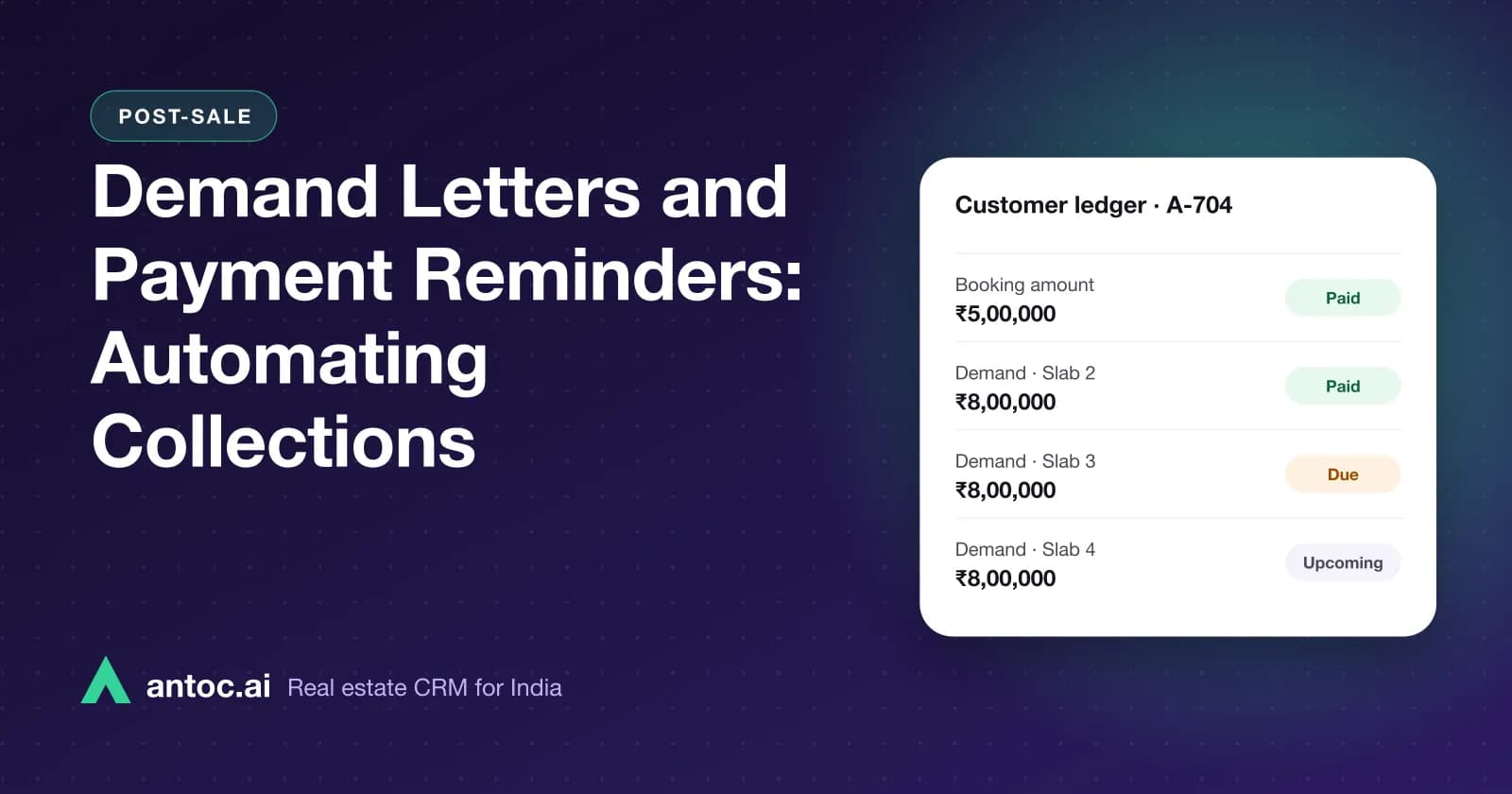
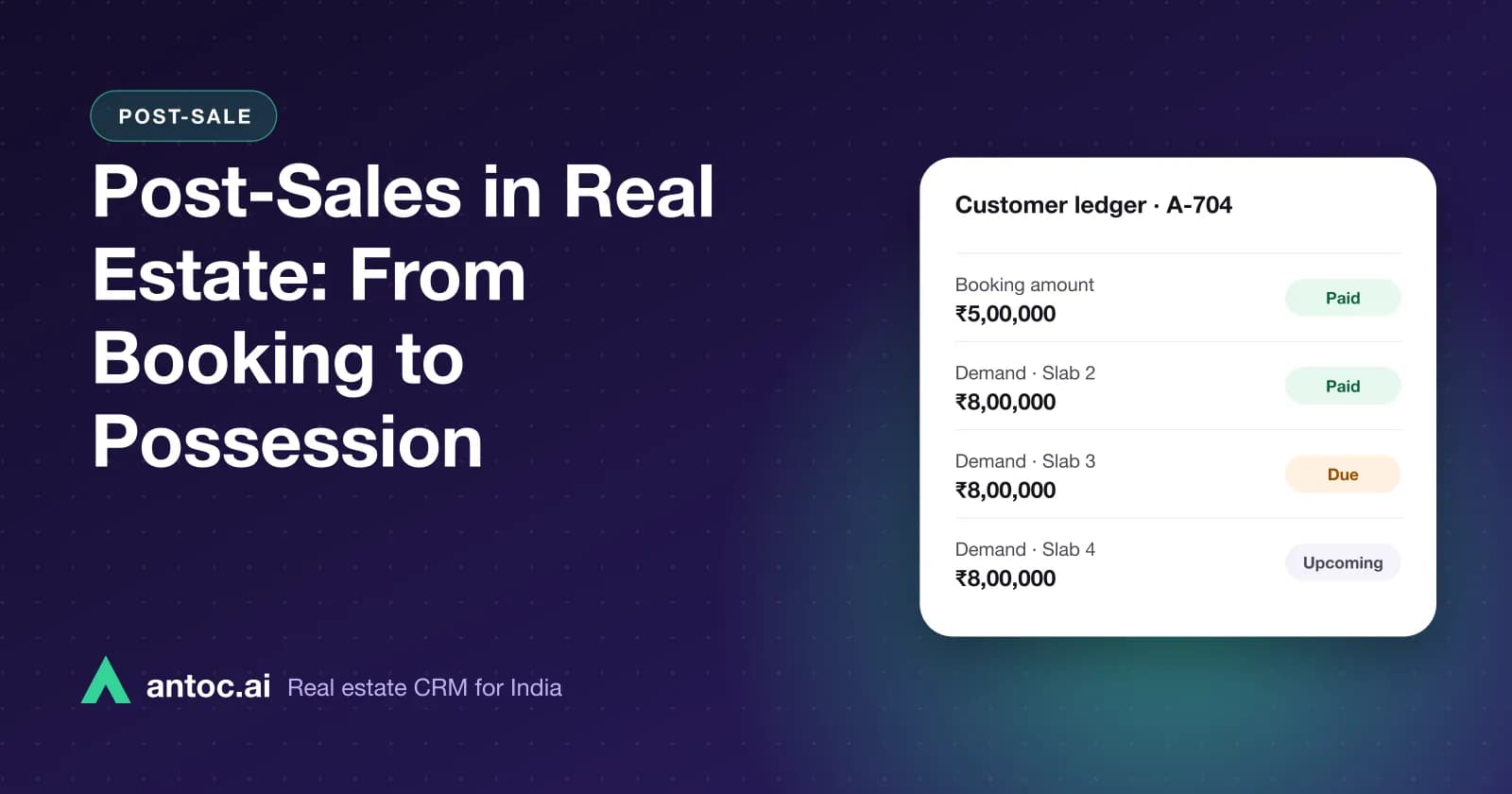
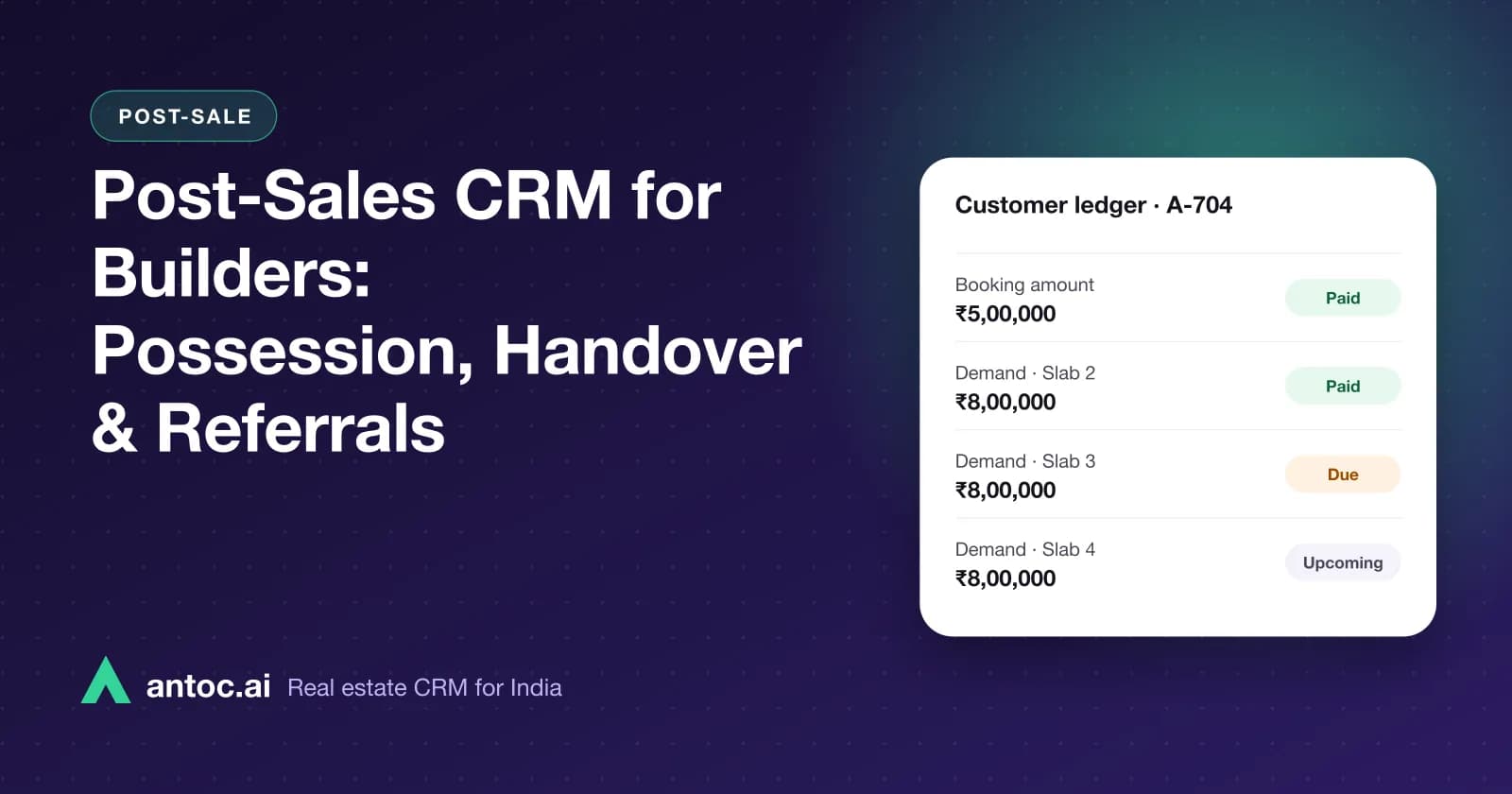
- Ledger. The running statement of total demanded, total received, outstanding and any adjustments. Buyer, bank and accounts team should all see the same numbers.
- Reminders. Before-due, on-due and overdue reminders to the buyer, plus internal reminders to the CRM executive who owns the account.
For a longer walkthrough of this journey, read our guide to post-sales management from booking to possession.
What each post-sales stage should record
Use this table as a field checklist when you set up the system. If a stage has no owner, it will be skipped.
| Stage | Must-have fields | Owner | Trigger for the next action |
|---|---|---|---|
| Booking | Unit, agreed price, booking amount, closed by (agent or CP), date | Sales | Booking form signed |
| Buyer | All applicants, KYC, contacts, loan bank | CRM executive | Same week as booking |
| Payment plan | Plan type, instalments, % or ₹ per milestone | CRM + accounts | Agreement draft prepared |
| Demand | Milestone, amount, due date, letter sent date | CRM executive | Milestone confirmed by site engineer |
| Payment | Amount, date, mode, reference, demand settled | Accounts | Receipt or bank credit |
| Ledger | Demanded, received, outstanding, adjustments | Accounts | Every new demand or payment |
| Possession | Final demand, dues status, approvals status, letter date | CRM head | Final demand settled or agreed |
| Handover | Checklist, keys, meter readings, snag list | Site + CRM | Possession date fixed |
| Referral | Asked on, referred leads, reward status | CRM executive | Booking, handover, festivals |
Want to see this on your own leads? Book a free Antoc demo.
Illustrative example: one ₹68 lakh flat in Pune
Illustrative example only. Figures are made up for clarity and exclude GST, stamp duty, registration, maintenance and other charges.
A buyer books a 2 BHK at an agreed price of ₹68,00,000 on a construction-linked plan. Booking and agreement instalments (10% each, ₹6,80,000 each) come from the buyer's own funds. The plinth and 4th slab demands (15% each, ₹10,20,000 each) are paid by the home loan bank.
On 5 March, the 8th slab demand of ₹10,20,000 goes out with a due date of 20 March. By 5 April it is still unpaid. Here is what the ledger shows:
- Total demanded: ₹44,20,000
- Total received: ₹34,00,000
- Outstanding: ₹10,20,000, overdue by 16 days
A post-sales CRM moves this account into the overdue bucket and alerts the CRM executive. The executive calls and learns the bank is waiting for a stage certificate. That is a document problem, not a payment problem, and it gets fixed in two days instead of turning into an angry buyer escalation.
Now jump to possession. The final demand is ₹6,80,000. The bank's last disbursement covers ₹5,10,000, leaving ₹1,70,000 from the buyer's own funds. Without a ledger the site team might hand over keys while that amount is pending. With one, the handover slot is confirmed only after the shortfall is paid or a written arrangement is recorded on the buyer's file.
Construction-linked and time-linked schedules each change how demands are raised, so match the reminder logic to the plan type. This is not legal or tax advice; follow your agreement for sale and your accountant.
Reminders: the part that actually collects money
Most collection delays are not refusals. They are forgotten due dates, a cheque in someone's drawer, or a bank waiting for a document nobody asked the buyer for.
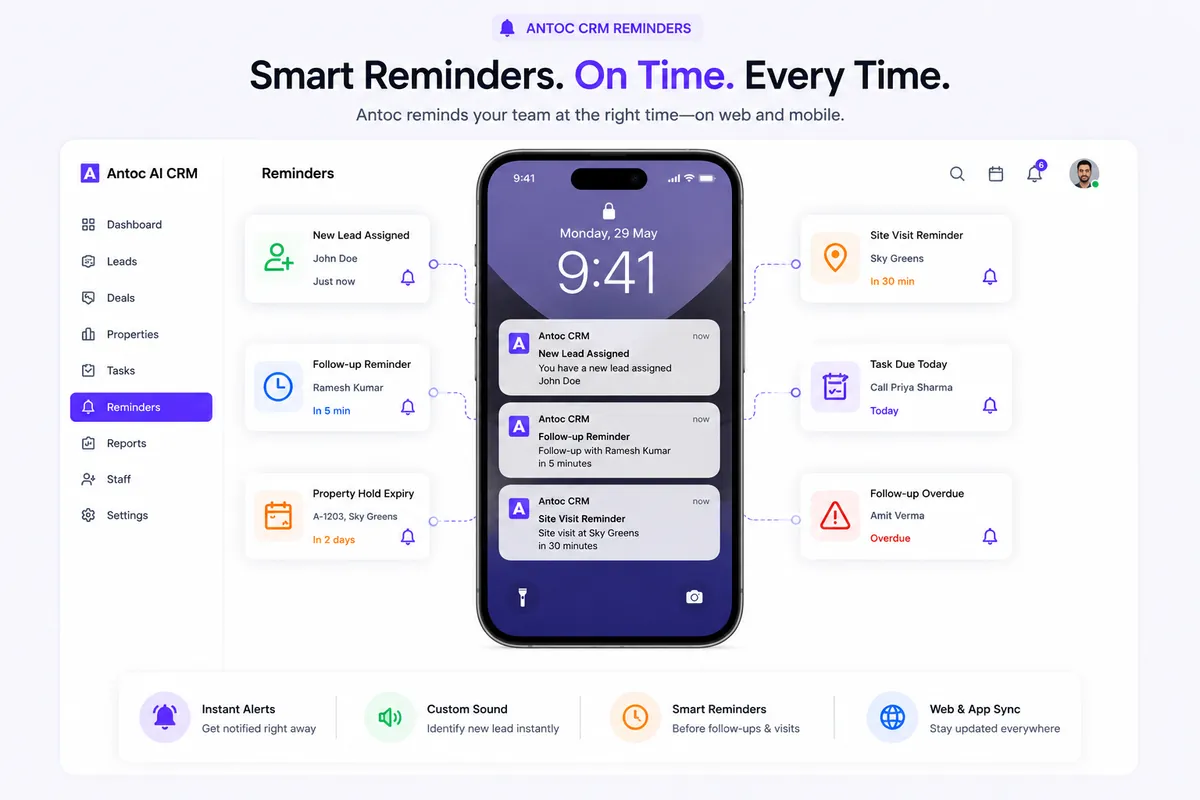
Set three buyer reminders per demand: a few days before the due date, on the due date, and after it turns overdue. Pair each with an internal reminder so the CRM executive follows up by phone when a buyer reminder gets no response.
Review overdue accounts weekly in age buckets: up to 15 days, 16 to 30, 31 to 60, and above 60. The older the bucket, the more senior the person who calls.
Possession: the stage most builders still run on paper
Possession is where your brand is either made or damaged. Buyers have waited years, and the experience of the final month is what they repeat to friends.
Get these things ready before you announce possession dates:
- Approvals. Confirm the occupancy certificate or equivalent approvals required by your local authority are in hand.
- Final demands. Raise final demands for all units in the tower, including any charges allowed under the agreement.
- Dues status. Run a ledger report for every unit: cleared, partly paid, or disputed.
- Handover slots. Plan slots per day per tower so your site team is not overwhelmed. Share the slot by WhatsApp and confirm it a day before.
- Possession letter. Issue it and record the acknowledgement on the buyer's file.
Timelines and what can be charged at possession depend on your agreement and your state's RERA rules. Check the official source for your state and your legal team before you finalise the process.
Buyer communication in this phase should be calm and frequent. One clear WhatsApp update per tower per week beats twenty individual calls asking "when will we get keys?"
Handover checklist for builders
Copy this list into your handover process. Every line should map to a field or a document on the buyer's record:
- Dues cleared, or a written arrangement noted in the ledger
- Possession letter issued and acknowledgement uploaded
- Joint walkthrough of the unit with the buyer
- Snag list recorded with photos and agreed fix dates
- Electricity and water meter numbers and opening readings noted
- Keys counted and handed over: main door, rooms, letter box, access cards
- Parking allotment confirmed in writing
- Warranty cards for fittings and appliances handed over
- Maintenance deposit receipt and facility manager contact shared
- Handover acknowledgement signed and uploaded
Snag list: log it, assign it, close it
A snag list is the list of defects the buyer finds at walkthrough: a leaking tap, a door that doesn't close, uneven tiles, a dead switch. The problem is rarely the snag. It is that nobody remembers who promised to fix it.
Log every snag with a category (civil, plumbing, electrical, carpentry, painting, waterproofing), a photo, the contractor responsible and a target date. Re-inspect, then close it only after the buyer signs off.
Look at snags by tower and by contractor every week. If one contractor's work keeps showing up, fix that at source before the next tower is handed over.
Documents buyers will ask for at handover
Keep these on the buyer's record so anyone in the CRM team can share them in minutes:
- Allotment letter and agreement for sale
- All demand letters and payment receipts
- Ledger statement and no-dues confirmation
- Possession letter
- Occupancy certificate copy, where issued
- Bank documents linked to the final disbursement
- Society or maintenance documents
- Warranty documents for fittings
Exact documents vary by state and project, so confirm the list with your legal team.
Referral asks: built into the post-sales timeline
Your happiest buyers are a lead source you already paid for. Most builders never ask them in a structured way.
Ask at three moments: right after booking, when the buyer is excited and telling family; at handover, when keys are in hand; and during festivals such as Diwali, Gudi Padwa or Akshaya Tritiya, when families discuss property. Make the ask simple: a short message they can forward, with your project details and a contact number.
Every referred enquiry should enter your CRM as a lead with source "Referral" and the referrer's name and unit attached. That way the reward is tracked and the referrer is thanked at each step. Our guide to real estate referral programs that work in India covers rewards, terms and RERA advertising norms.
Common mistakes
- Starting post-sales at agreement, not booking. The buyer's details and promises made at booking get lost in the gap.
- Keeping the ledger only in accounting software. The CRM team can't see dues, so they fix possession dates blind.
- Sending demands without a milestone reference. Banks and buyers ask "which slab?" and payment gets delayed.
- Treating every overdue account the same. A document delay and a genuine refusal need different callers and different tones.
- Handing over keys without a signed snag list. Every later complaint becomes your word against the buyer's.
- Leaving buyer history in one executive's phone. When that person leaves, the next one starts from zero.
- Asking for referrals once, at random. Ask at booking, handover and festivals, and track every referred lead.
Where to start
You do not need to move every project at once. Start with the tower closest to possession: load its units, buyers, payment plans and ledger balances, then run the next round of demands and the handover from the CRM.
If you are also comparing tools for inventory, channel partners and pre-sales, our page on CRM for real estate developers explains how pre-sale and post-sale fit together in one system. Once the first tower runs cleanly, the next one takes far less effort.
Read next
Frequently asked questions
What is a post-sales CRM in real estate?
A post-sales CRM is software a builder uses after booking. It stores the buyer profile, payment plan, demand letters, receipts and running ledger for each unit, sends payment reminders, and tracks possession, handover and snag closure. The aim is one record per unit so sales, CRM and accounts teams all see the same status.
How is post-sales different from pre-sales in real estate?
Pre-sales covers everything until booking: lead capture, follow-ups, site visits, inventory holds and channel partners. Post-sales starts at booking and runs till possession and beyond: agreement, payment plan, demands, collections, ledger, documents, handover and referrals. Many builders use separate teams for each, so the handover of data between them must be clean.
When should a builder issue the possession letter?
Follow your agreement for sale and the rules of your state RERA and local authority. In practice, CRM teams check that the final demand is raised, dues are paid or a written arrangement is recorded, and required approvals such as the occupancy certificate are in place. Check the official source and your legal team before setting a policy.
What should a handover checklist include?
A good handover checklist covers dues status, possession letter acknowledgement, a joint walkthrough, snag list with photos, meter readings, keys and access cards counted, parking allotment, warranty cards for fittings, maintenance deposit receipt and a signed handover acknowledgement uploaded to the buyer's record.
Can a CRM send payment reminders to buyers automatically?
Yes. A post-sales CRM can trigger reminders before a due date, on the due date and after it becomes overdue, and alert the CRM executive who owns the account. In Antoc's post-sale module, overdue dues also appear in a payment collector view so the team can prioritise follow-up calls.
When is the best time to ask a buyer for a referral?
The strongest moments are right after booking, at handover when keys are in hand, and during festivals when families talk about property. Ask simply, share a short message they can forward, and tag every referred lead in your CRM with the referrer's name and unit so rewards are tracked correctly.
Bring one real lead source. We'll show you the floor.
Book a free demo and bring one source — Meta, 99acres or a CP WhatsApp group. We'll set it up on a lead in front of you.
We build Antoc for Indian brokers and developers, from Pasadi Technologies Pvt Ltd in Ahmedabad. These articles come from patterns we see on real sales floors.