On this page
Facebook ads for real estate in India work best as lead ads with an instant form, synced to your CRM and judged by cost per site visit and cost per booking rather than cost per lead. Tight targeting, three or four smart form questions and a first call within minutes matter more than the size of your budget.
This guide is for marketing heads at developers and for brokers running their own Meta campaigns on Facebook and Instagram. It covers how to read your costs honestly, how to target, how to write forms and how to get leads to agents quickly.
Facebook lead ads can fill a property pipeline in India, but judge them by cost per site visit and cost per booking, not cost per lead. Tight forms and instant CRM sync decide the result.
- Judge Meta campaigns by cost per site visit and booking, not cost per lead.
- Use three or four multiple-choice form questions to filter casual enquiries.
- Sync leads to your CRM instantly and call while the buyer is still online.
- Review spend, visits and lost reasons by campaign every week.
How Facebook lead ads work for property
A lead ad shows a creative on Facebook or Instagram. When someone taps it, an instant form opens inside the app, often prefilled with their name and phone number from their profile. They submit without visiting a website.
That convenience is the strength and the weakness. You get more enquiries than a landing page usually would, but some people submit out of curiosity, by accident or with an old number.
Meta lets you choose a form type. A "more volume" style form is quicker to submit. A "higher intent" style form adds a review step before submission, which tends to filter out accidental taps. Test both on your own project before deciding.
What decides your cost
Meta ads run on an auction. Your cost changes with:
- Audience size and location: a tight radius in a busy city can cost differently from a wider area.
- Creative quality: ads people stop and engage with usually deliver more cheaply.
- Competition: launch season and festive periods bring more advertisers targeting the same buyers.
- Form friction: more questions usually mean fewer, but better, leads.
- Learning: campaigns that change every day rarely settle.
We will not quote a typical cost per lead, because any number would be misleading for your city and project. The useful approach is to measure your own funnel.
How to calculate cost per lead, site visit and booking
Every campaign should be judged on three numbers. All of them come from combining Ads Manager spend with stages tracked in your CRM.
| Metric | Formula | Where the data lives |
|---|---|---|
| Cost per lead (CPL) | Spend ÷ leads received | Ads Manager spend, CRM lead count |
| Contact rate | Leads contacted ÷ leads received × 100 | CRM call and WhatsApp logs |
| Cost per qualified lead | Spend ÷ leads that match budget and timeline | CRM status or qualification field |
| Cost per site visit | Spend ÷ site visits done | CRM visit status |
| Cost per booking | Spend ÷ bookings | CRM deal stage |
Illustrative example: two campaigns for a Bengaluru project
The numbers below are an illustrative example to show the maths. They are not benchmarks.
A developer runs two campaigns for a 2 and 3 BHK project in Bengaluru for 30 days, spending ₹1,00,000 on each.
| Campaign A: broad, short form | Campaign B: tighter radius, 4 questions | |
|---|---|---|
| Spend | ₹1,00,000 | ₹1,00,000 |
| Leads | 250 | 120 |
| Cost per lead | ₹400 | ₹833 |
| Site visits done | 10 | 16 |
| Cost per site visit | ₹10,000 | ₹6,250 |
| Bookings | 1 | 2 |
| Cost per booking | ₹1,00,000 | ₹50,000 |
On cost per lead alone, Campaign A looks twice as good. On cost per booking, Campaign B is twice as good. This is why your CRM, not Ads Manager, should decide where the next rupee goes.
Want to see this on your own leads? Book a free Antoc demo.
Targeting basics for property buyers
Start simple and let results guide you.
- Location: target the area around the project and the places your buyers live or work, such as nearby IT parks or the neighbourhoods they are upgrading from.
- Age and household: keep the range broad at first; narrow only if your CRM data shows a clear pattern.
- Interests vs broad: test an interest-based audience against a broad audience. With a good form, broad targeting sometimes works well.
- Custom audiences: website visitors and people who engaged with your page are often warmer.
- Exclusions: exclude existing buyers and recent leads where your data and Meta's policies allow it.
Meta has special ad category rules for housing in some regions, which can restrict targeting. Check what Ads Manager asks when you create the campaign, and read Meta's current advertising policies.
Creative that attracts buyers, not browsers
The creative decides who taps. A glossy render with "Luxury living awaits" invites everyone. A specific ad invites people who might actually buy.
- Show the real project: actual site photos, sample flat walkthroughs or construction progress build more trust than stock images.
- Lead with the facts buyers filter on: locality, configuration, carpet area and possession timeline.
- Use price carefully: a "starting from" price filters out buyers outside your range, but only use a figure the developer has confirmed.
- One project per ad: mixing three projects in one carousel makes the form answers hard to route.
- Short video works well on Instagram: a 20-second walkthrough of the sample flat often explains more than a static image.
Include the RERA registration number where your state's rules require it, and check the official RERA website for your state before publishing.
Form questions that cut junk leads
The form is your first qualification step. Keep it short, but make every question count.
- Name and phone, prefilled by Meta. Consider asking the buyer to confirm the number.
- Budget range, as multiple choice. For example: under ₹60 lakh, ₹60–90 lakh, ₹90 lakh–1.2 crore, above ₹1.2 crore.
- Configuration: 1, 2, 3 or 4 BHK.
- Purchase timeline: within 3 months, 3–6 months, later, just exploring.
- Optional: "Are you a channel partner or broker?" so you can route them to your CP desk.
Avoid free-text questions. They slow buyers down and are hard to sort. Add a privacy policy link, which Meta requires on lead forms, and a thank-you screen that says when someone will call.
For more ways to raise the share of genuine buyers, read our guide on improving Meta lead quality.
Instant CRM sync and the first call
A Meta lead that waits in Ads Manager until someone downloads a CSV is a lead that has already enquired with your competitor. The buyer filled four forms in that scroll session.
What should happen instead:
- The lead lands in your CRM with campaign, ad set and form answers attached.
- It is assigned automatically to the right agent or project team.
- A WhatsApp welcome goes out through the official API, where enabled.
- The agent gets a reminder and calls with one tap.
Antoc's lead management captures Meta lead ads, along with portals, website forms and walk-ins, as enabled for your account. Source and campaign context stay on the lead, so the agent knows which ad the buyer responded to.
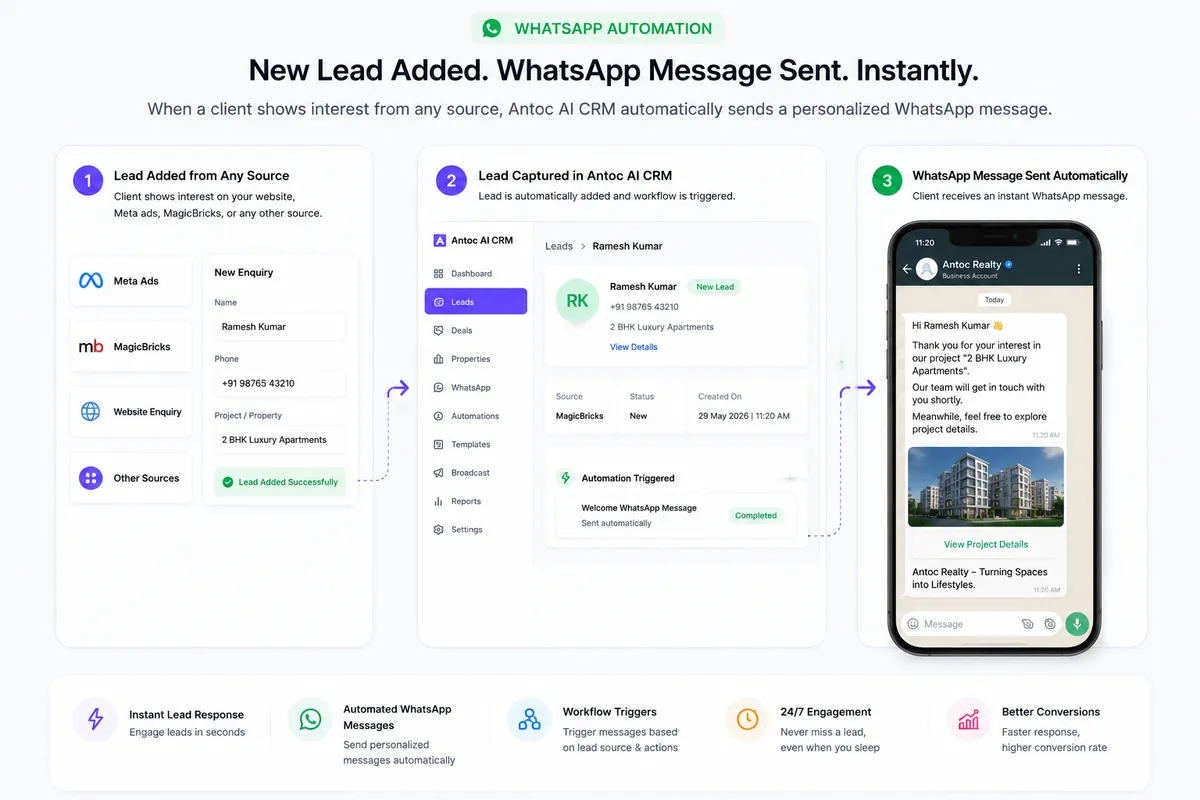
The first call should use the form answers. "You mentioned a 3 BHK in the ₹90 lakh to 1.2 crore range within three months" shows you read it. For a full setup, see our guide on cutting real estate lead response time.
When a Meta lead does not pick up
Many Meta leads will not answer the first call. They tapped the ad on a commute, or they do not answer unknown numbers. That is not a reason to mark them junk.
A practical attempt pattern for unanswered leads:
- Attempt 1: call immediately, then send a "missed you" WhatsApp with the project name.
- Attempt 2: call again later the same day, at a different hour.
- Attempt 3: call the next evening, when working buyers are more likely to answer.
- Final touch: a WhatsApp asking for a convenient time, with simple reply options.
Only after these attempts should a lead be marked "not reachable", with that lost reason recorded. If one campaign produces far more unreachable leads than others, the problem is the audience or form, not your agents.
A weekly review routine
Every Monday, the marketing head and sales head should look at the same report, split by campaign:
- Spend and leads from Ads Manager.
- Leads contacted within the first hour.
- Qualified leads, site visits and bookings from the CRM.
- Top lost reasons, such as wrong number, out of budget or broker.
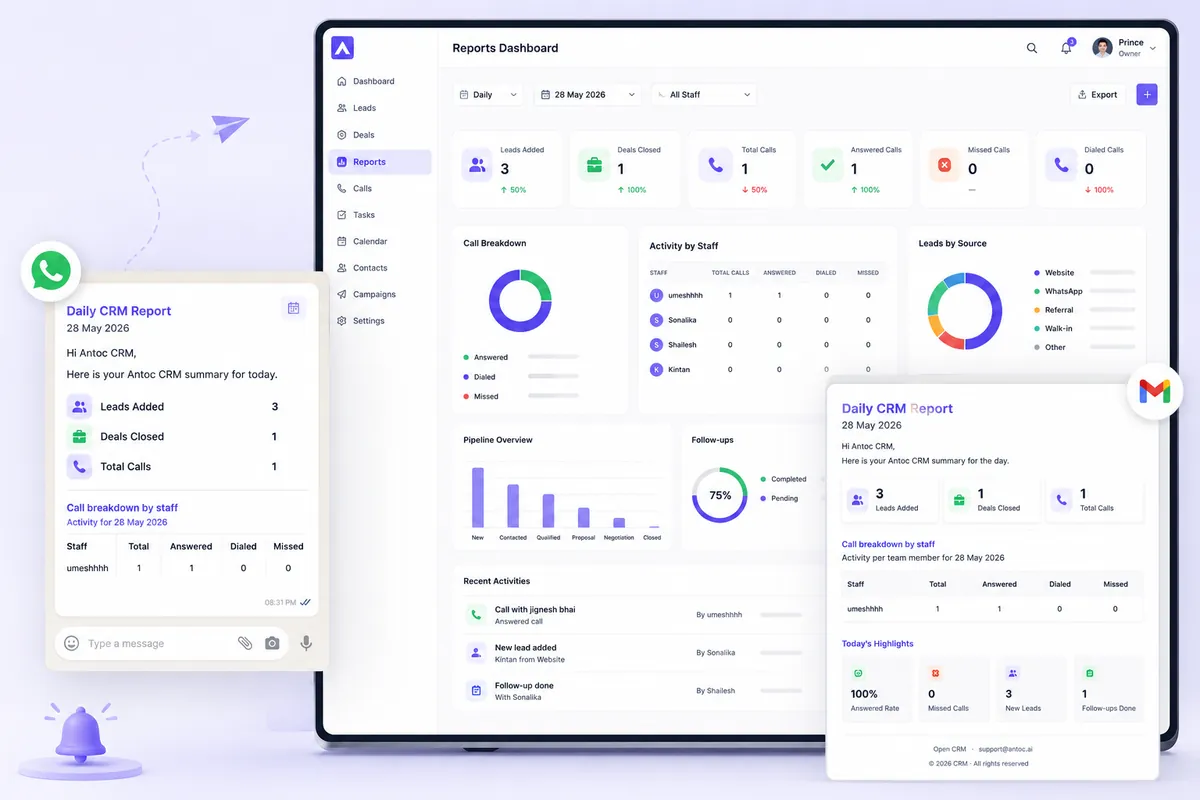
Pause or rework any campaign whose cost per site visit stays well above the others for two weeks. Move that budget to what is producing visits. If your setup sends CRM stages back to Meta through its Conversions API, the algorithm can also learn which leads became real buyers.
Common mistakes
- Judging campaigns by cost per lead and scaling the one that produces the fewest visits.
- Downloading leads from Ads Manager once a day instead of syncing them instantly.
- Asking free-text questions that buyers skip or fill with junk.
- Changing budgets and audiences daily, so campaigns never stabilise.
- Running ads without a confirmed price or RERA number where required.
- Not recording lost reasons, so bad campaigns are never identified.
- Letting the agent call without reading the form answers first.
Bringing it together
Meta lead ads are one source among many. Most Indian teams also run portals, Google and walk-ins, and the honest comparison happens only when every source lands in one CRM with the same stages. That is why connecting all your lead sources comes before scaling any single channel.
Set up your first test campaign with the formulas above, run it for two to three weeks, and compare it with your other sources on cost per site visit. To see which sources can feed the same pipeline, browse the Antoc integrations page.
Read next
Frequently asked questions
How much do Facebook ads cost for real estate in India?
There is no fixed price. Meta ads run on an auction, so your cost depends on audience, location, creative, season and how many advertisers target the same buyers. The only reliable figure is your own: run a small test for two to three weeks and calculate cost per lead, per site visit and per booking.
Are Facebook lead ads good for real estate?
They can be, especially for new launches and mid-segment projects where buyers browse on mobile. The trade-off is that instant forms are easy to submit, so some leads are casual. Better form questions, a fast first call and judging campaigns by site visits rather than lead count usually make them work.
What questions should a real estate lead form ask?
Keep it to three or four multiple-choice questions after name and phone: budget range, configuration such as 2 or 3 BHK, purchase timeline and preferred visit day. Some teams add a question asking whether the person is a broker. Multiple choice keeps the form quick and the answers easy to sort in your CRM.
How do I get Facebook leads into my CRM automatically?
Connect your Meta lead forms to a CRM that supports Meta lead ads. New leads then arrive with the campaign and form details, get assigned to an agent and can receive a WhatsApp welcome. In Antoc, Meta lead capture is available as enabled for your account, so confirm the setup with support.
What is a good cost per lead for property ads?
Cost per lead on its own can mislead you. A campaign with cheap leads that never visit costs more per booking than a campaign with pricier leads who do. Compare campaigns on cost per site visit and cost per booking from your CRM data, and use cost per lead only as an early signal.
Do I need to declare a special ad category for housing ads?
Meta has special ad category rules for housing in some regions, which can limit targeting options. Whether and how they apply depends on where you advertise and Meta's current policy. Check the prompt in Ads Manager when you create the campaign and read Meta's official advertising policies before launch.
Bring one real lead source. We'll show you the floor.
Book a free demo and bring one source — Meta, 99acres or a CP WhatsApp group. We'll set it up on a lead in front of you.
We build Antoc for Indian brokers and developers, from Pasadi Technologies Pvt Ltd in Ahmedabad. These articles come from patterns we see on real sales floors.