On this page
Google Ads for real estate in India works best when you bid on high-intent searches such as project names, locality plus BHK and builder brand terms, block junk queries with negative keywords, and judge campaigns by site visits recorded in your CRM. Set budget backwards from your booking target, not from a guessed cost per click.
This guide is for marketing heads at developers, broker-owners who run their own campaigns, and anyone who has spent a month on Google Ads and is now staring at a pile of leads that do not pick up the phone.
Google Ads works for Indian real estate when you bid on project, locality-plus-BHK and builder brand searches and block junk with negative keywords. Plan budget backwards from bookings and judge campaigns by cost per site visit in your CRM.
- Project name, locality plus BHK and builder brand searches carry the strongest buying intent.
- Negative keywords like rent, PG and jobs are the cheapest lead-quality fix.
- Plan budget backwards from bookings using your own CRM conversion ratios.
- Judge every campaign by cost per site visit, not cost per click.
Why Google Search leads behave differently from Meta leads
On Facebook and Instagram, your ad interrupts someone scrolling reels. On Google Search, the person typed "3 BHK flats in Gota" or your project name themselves. That is a different starting point.
Search leads usually know what they want. They have often already shortlisted a few projects and are comparing. That is good for intent, but it also means they are enquiring with three or four other sellers at the same time.
Search also attracts people you do not want: brokers researching a competitor launch, people looking for rentals, job seekers searching your brand name, and students looking for "floor plan pdf". Your keyword list and negative list decide how much of that you pay for.
Keyword themes that bring real buyers
Group keywords into themes and give each theme its own ad group, ad copy and landing destination. Mixing themes in one ad group makes it impossible to tell what is working.
| Keyword theme | Example searches | Typical intent | Where to send the click | Watch out for |
|---|---|---|---|---|
| Project name | "Skyline Heights Shela", "Skyline Heights price" | Very high | Project page or lead form | Other brokers bidding on your name; check Google's trademark policy |
| Builder brand | "[Builder name] new projects Ahmedabad" | High | Developer page listing live projects | Job and complaint searches on your brand |
| Locality + BHK | "3 BHK flats in Wakad", "2 BHK in Gota" | High to medium | Project page filtered to that configuration | Rental searches for the same locality |
| Locality + budget | "flats under 60 lakh in Thane" | Medium | Page showing configurations in that range | Budget below your cheapest unit |
| Near a landmark | "flats near Hinjewadi Phase 1" | Medium | Project page with location map and travel times | IT workers looking for PG or rent |
| Generic | "flats for sale", "new projects in Pune" | Low to medium | Only after the above themes are profitable | Expensive clicks with mixed intent |
Start with phrase and exact match on the first four themes. Broad match can work later, but only once your negative list is long and your conversion tracking is reliable. Google changes how match types behave from time to time, so check the current Google Ads Help documentation before you rely on any one setting.
Writing ads for each theme
For project-name ads, use the exact project name in the headline and add one fact the buyer cares about: configuration, possession timeline or starting price. For locality ads, lead with the locality and BHK. Show the RERA registration number wherever your state RERA requires it in advertising, and check the official state RERA site for current rules.
Negative keywords: the cheapest lead-quality fix
Every rupee spent on a "2 BHK on rent in Baner" click is wasted if you sell new launches. Build your negative list before you launch, then add to it every week from the search terms report.
A starting negative list for a new-launch residential project:
- rent, rental, lease, PG, hostel, paying guest
- jobs, careers, salary, vacancy, hiring
- interior, furniture, modular kitchen
- resale, second hand (if you only sell fresh inventory)
- plot, land, commercial, shop, office (if you only sell apartments)
- pdf, drawing, autocad, project report (students and researchers)
- complaint, fraud, court (handle reputation separately, do not pay for these clicks)
Do not add your competitors' names as negatives without thinking. A buyer searching a nearby project might be a genuine prospect for yours. Test it on a small budget before deciding.
Lead form vs landing page
Google offers lead form assets that let a buyer submit details without leaving the search results page. A landing page sends them to your site first. Both are valid; they bring different kinds of leads.
| Factor | Google lead form asset | Landing page with form |
|---|---|---|
| Effort for the buyer | Very low, details often pre-filled | Higher, has to browse and fill |
| Information before enquiring | Only what is in the ad and form | Floor plans, price range, amenities, location |
| Likely lead volume | Higher | Lower |
| Likely lead seriousness | More casual enquiries mixed in | Buyers have seen more before calling |
| Qualifying questions | A few short questions | Can ask more, but each field reduces submissions |
| Tracking into CRM | Needs a lead form sync | Website form with UTM parameters |
Whichever you choose, add one or two qualifying questions: configuration (2 BHK / 3 BHK) and buying timeline (within 3 months / 3 to 6 months / just exploring). Answers travel with the lead, so the agent knows how to open the first call.
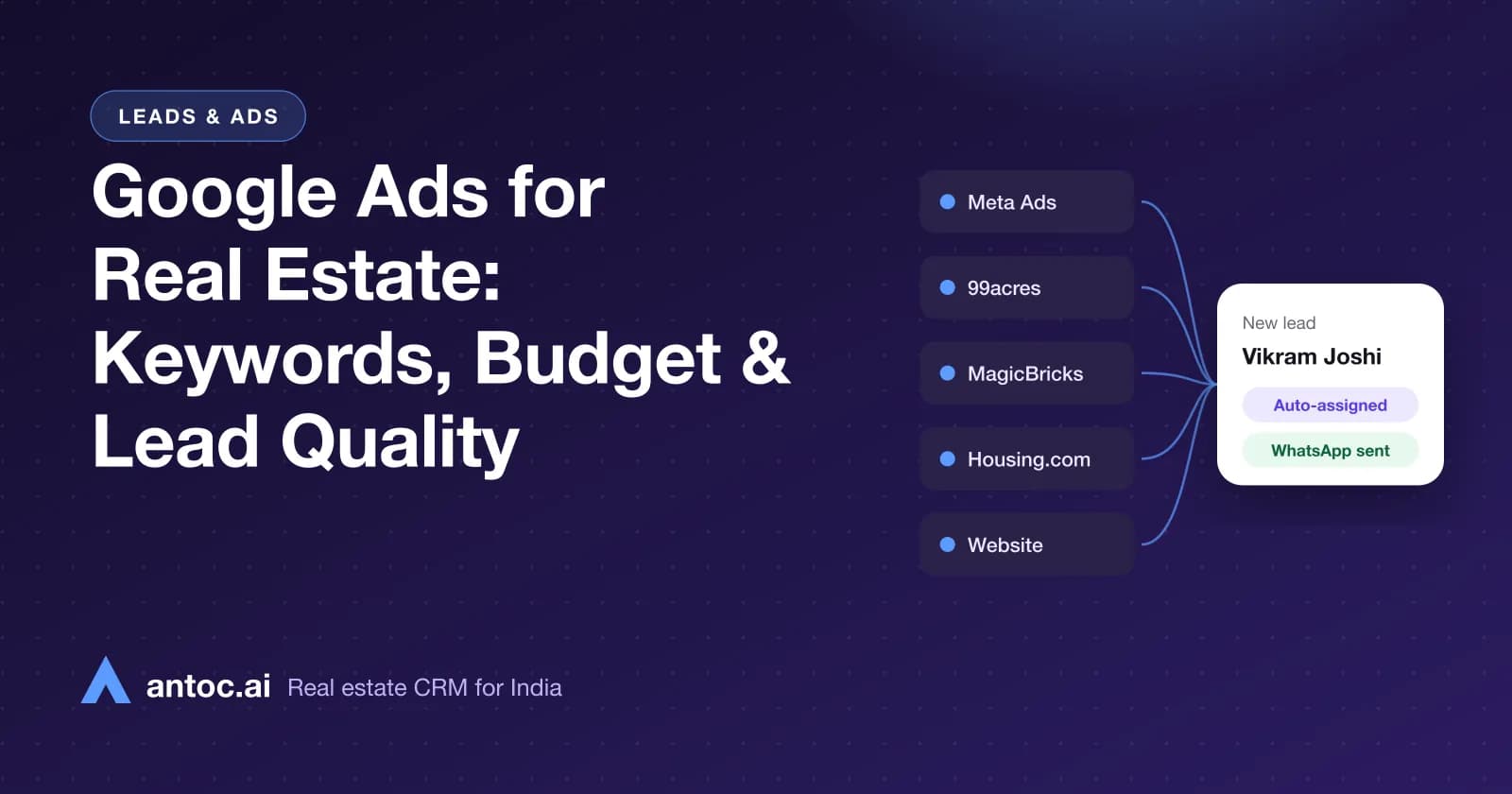
Antoc can capture leads from Google Ads lead forms where supported, website forms, Meta lead ads and property portals, as enabled for your account, with source and campaign kept on the lead. You can see the full list on our lead source integrations page.
Want to see this on your own leads? Book a free Antoc demo.
How to plan a Google Ads budget without CPC benchmarks
Cost per click varies by city, locality, competition and season, and any number someone quotes you from another market will mislead you. Plan from your own data instead.
- Set a booking target from search. For example, "6 bookings a month from Google Ads for Tower B".
- Pull your own conversion ratios from the CRM. Look at the last 3 to 6 months: how many site visits did it take to get one booking, and how many leads to get one visit? Use search-source leads if you have them, otherwise overall numbers as a starting point.
- Work out the leads you need. Bookings × visits per booking × leads per visit.
- Check Google Keyword Planner for estimated bid ranges on your themes. Treat these as Google's estimates for your area, not a promise.
- Run a fixed-budget test for 2 to 3 weeks on the high-intent themes only.
- Recalculate with real numbers: actual cost per lead, cost per visit and cost per booking.
- Shift budget towards the campaigns with the lowest cost per site visit and cut or fix the rest.
Illustrative example in ₹: a Pune project
This is an illustrative example with simple maths, not a benchmark. A developer in Pune sells 2 and 3 BHK flats priced between ₹75 lakh and ₹1.1 crore. Their target is 6 bookings a month from Google Search.
From their own CRM history, they need about 8 site visits per booking and about 6 leads per visit. So they need 48 visits and roughly 288 leads a month.
In the test month, they spend ₹3,00,000 across three campaigns:
| Campaign | Spend | Leads | Site visits done | Cost per lead | Cost per visit |
|---|---|---|---|---|---|
| Project name | ₹1,00,000 | 60 | 14 | ₹1,667 | ₹7,143 |
| Locality + BHK | ₹1,50,000 | 130 | 12 | ₹1,154 | ₹12,500 |
| Generic "new projects Pune" | ₹50,000 | 50 | 3 | ₹1,000 | ₹16,667 |
| Total | ₹3,00,000 | 240 | 29 | ₹1,250 | ₹10,345 |
Look at what happens if you judge on cost per lead. The generic campaign looks cheapest at ₹1,000 a lead. On cost per visit, it is the most expensive at ₹16,667. The project-name campaign has the highest cost per lead but the cheapest visits.
Say the month produced 4 bookings. Cost per booking is ₹3,00,000 ÷ 4 = ₹75,000. Compare that with what the same booking would cost through other channels, such as a channel partner brokerage on a ₹90 lakh flat. Now you have a business decision, not a marketing guess. For a deeper walkthrough of this maths, see our guide on calculating cost per booking in real estate.
Track every Google lead to a site visit in your CRM
None of the maths above works if leads sit in a Google sheet or an agent's inbox. The tracking chain has to be unbroken from click to booking.
Keep source and campaign on the lead
Use UTM parameters on landing page URLs (utm_source=google, utm_campaign=project-name and so on) so website form leads carry the campaign. For lead form assets, make sure the sync brings the campaign or form name along. A lead tagged only "Google" is not enough to compare campaigns.
Respond while the buyer is still searching
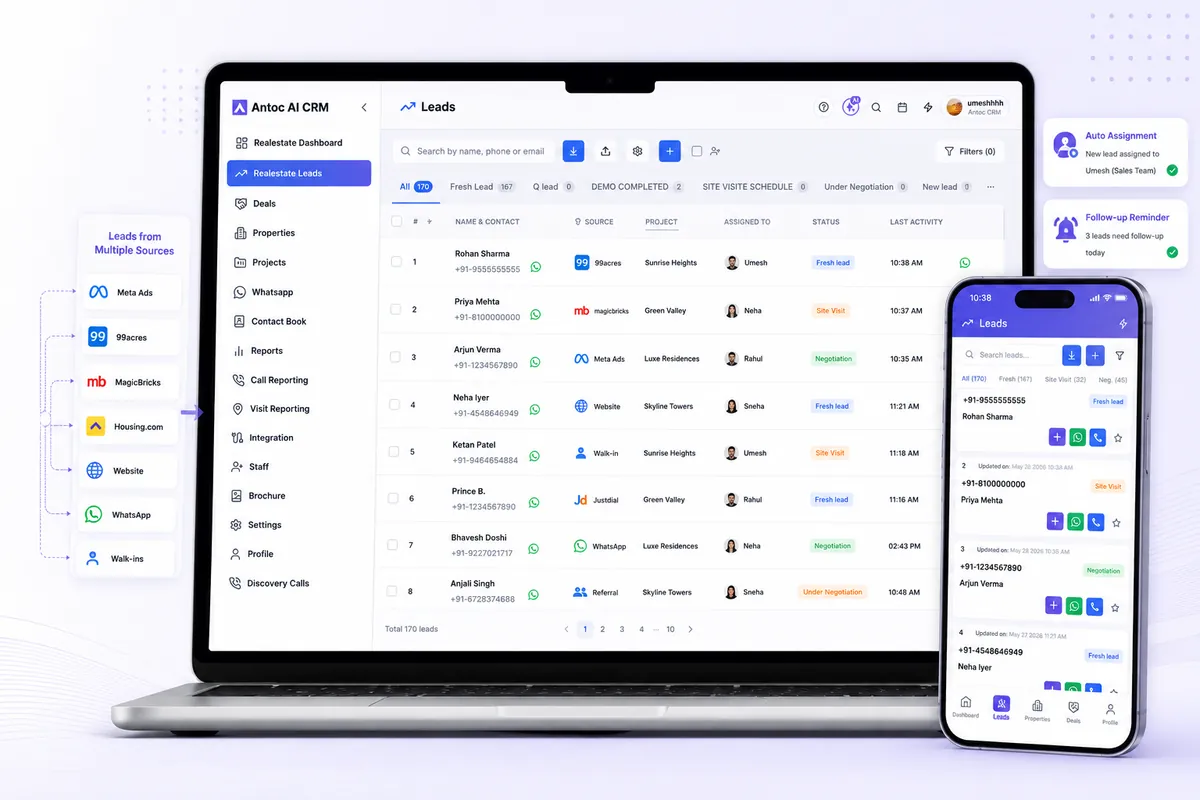
A search lead is usually comparing projects that same hour. Auto-assign the lead to an agent, send a WhatsApp welcome with the project brochure, and set a first-call reminder. Our post on real estate lead response time covers how to measure and shorten your first-call time.
Log visits and outcomes against the same lead
When the agent schedules a visit, mark it. When the buyer turns up, mark visit done. When the buyer drops out, record why: budget, location, already bought, not reachable. Antoc's lead management keeps source, status and follow-ups on one lead record, so these outcomes stay tied to the campaign that produced the lead.
Review by campaign every week
Once a week, pull leads by source and compare visits by campaign. If a campaign has plenty of leads but few visits, look at its search terms and form questions first. If it has visits but no bookings, the problem may be pricing, inventory or the site experience, not the ad.
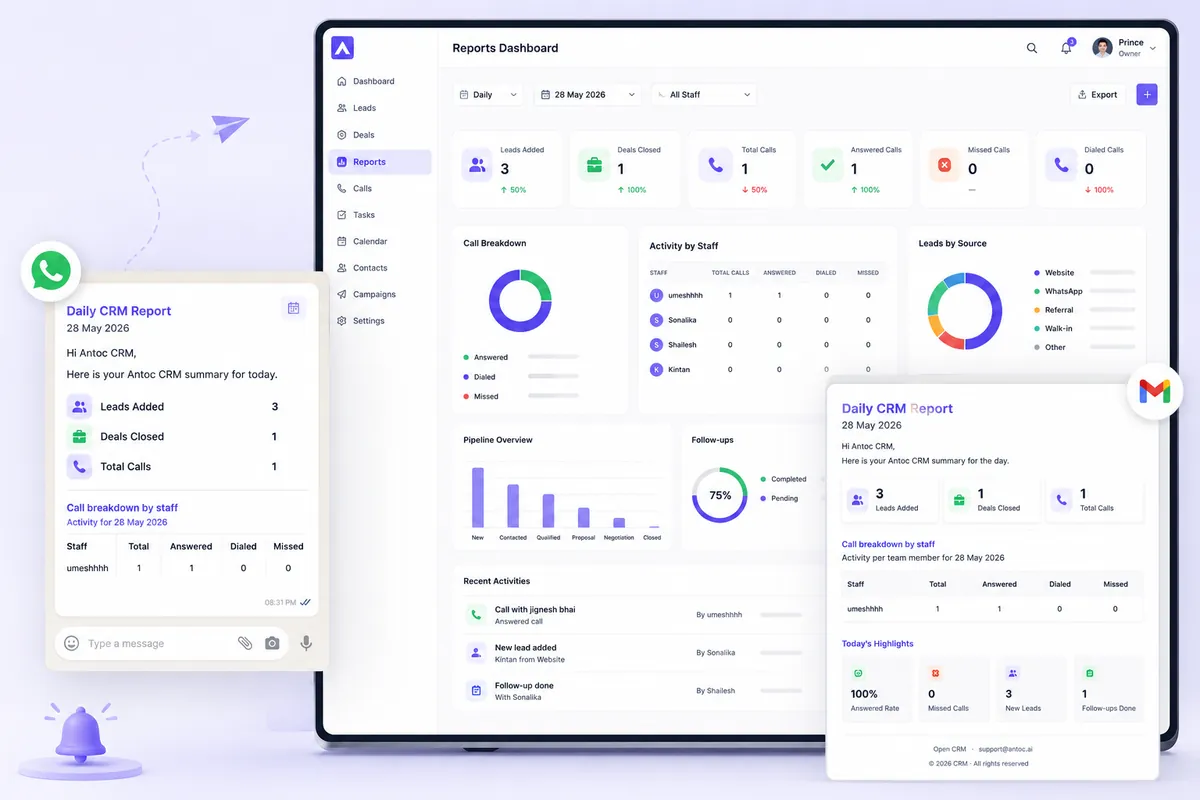
Google Ads also lets you import offline conversions, such as site visits or bookings, back into your account so bidding can learn from them. Setup depends on your account and tracking, so follow Google's official documentation and confirm what your tools support before you rely on it.
A simple weekly routine for the marketing team
- Monday: Review last week's search terms report and add negatives.
- Tuesday: Check cost per visit by campaign from the CRM report; move budget.
- Wednesday: Listen to a few first calls with the sales head to check lead quality complaints are real.
- Thursday: Refresh ad copy for any campaign with falling click-through.
- Friday: Agree next week's budget split with sales, based on visits, not leads.
The Wednesday step matters. Sales teams often call a campaign "junk" when the real issue is a slow first call. Before you cut a campaign, check how fast those leads were called. Our guide on reducing junk leads has a qualification framework you can apply to search leads too.
Common mistakes
- Judging campaigns on cost per lead. Cheap leads that never visit are the most expensive leads you can buy.
- Launching without a negative keyword list. Rental, PG and job searches eat budget from day one.
- One ad group for every keyword. You cannot see which theme works, and ad copy cannot match the search.
- Sending all clicks to the home page. A "3 BHK in Wakad" search should land on 3 BHK details, not a brand video.
- Leads living outside the CRM. If Google leads are downloaded once a day, you lose both speed and the campaign tag.
- No lost reasons. Without them, you cannot tell bad keywords from bad follow-up.
- Copying another city's budget. CPC and conversion ratios differ by market; plan from your own test month.
Getting the setup right
Google Ads for real estate is less about clever ads and more about plumbing. Bid on searches that mean "I want to buy here", block the rest, and make sure every lead lands in one place with its campaign attached.
Once leads flow into your CRM with source intact, the weekly question becomes simple: which campaigns produce site visits at a cost you can live with? To see how Antoc pulls Google, Meta, website and portal leads into one pipeline, explore the Antoc integrations or compare with our guide to Facebook lead ads for real estate.
Read next
Frequently asked questions
Is Google Ads or Facebook Ads better for real estate in India?
They do different jobs. Google Search catches people already searching for a project, locality or BHK, so intent is usually higher but volume is limited. Meta ads create demand among people who were not searching. Most developers run both and compare them on cost per site visit and cost per booking inside their CRM, not on cost per lead alone.
What keywords should a builder bid on in Google Ads?
Start with your project name, your brand name with words like new projects, and locality plus configuration searches such as 3 BHK flats in your micro-market. Add budget searches like flats under a price in your city. Avoid broad generic terms such as flats for sale until your negatives and conversion tracking are working.
How much should I spend on Google Ads for a real estate project?
Work backwards. Decide how many bookings you want from search, apply your own visit-to-booking and lead-to-visit ratios from past CRM data, and estimate cost per lead from a two to three week test. That gives a budget tied to your numbers instead of someone else's benchmark.
Should I use Google lead form assets or a landing page?
Lead forms are quick for the buyer and usually bring more submissions, but they can bring more casual enquiries. Landing pages let buyers see floor plans, pricing ranges and amenities first, so leads tend to be better informed. Test both on the same keywords and compare site visits, not form fills.
Which negative keywords should real estate advertisers add?
Common ones are rent, rental, PG, hostel, jobs, careers, salary, interior, loan, resale if you sell new launches, and plot or commercial if you only sell apartments. Review the search terms report every week and add any query that clearly cannot become a buyer for your project.
How do I track Google Ads leads to site visits?
Make sure every lead lands in your CRM with source and campaign attached, either through lead form sync or website forms with UTM tags. Then mark visit scheduled, visit done and booking against the same lead. A weekly report of visits and bookings by campaign shows which keywords actually sell.
Bring one real lead source. We'll show you the floor.
Book a free demo and bring one source — Meta, 99acres or a CP WhatsApp group. We'll set it up on a lead in front of you.
We build Antoc for Indian brokers and developers, from Pasadi Technologies Pvt Ltd in Ahmedabad. These articles come from patterns we see on real sales floors.